
Last night, Atlassian announced a $610 million all-cash acquisition of The Browser Company—the team behind Arc and the in-testing AI browser Dia. An entry point ignored for two decades suddenly moved to the industry’s center: no longer just a container for web pages, the browser is becoming a “workfront” that can observe, reason, and execute. This deal turns “AI browsers” from a talking point into an industrial fact: Who will carry the agent? How do workflows land in an operable interface? How is value priced? Those questions are now front and center.
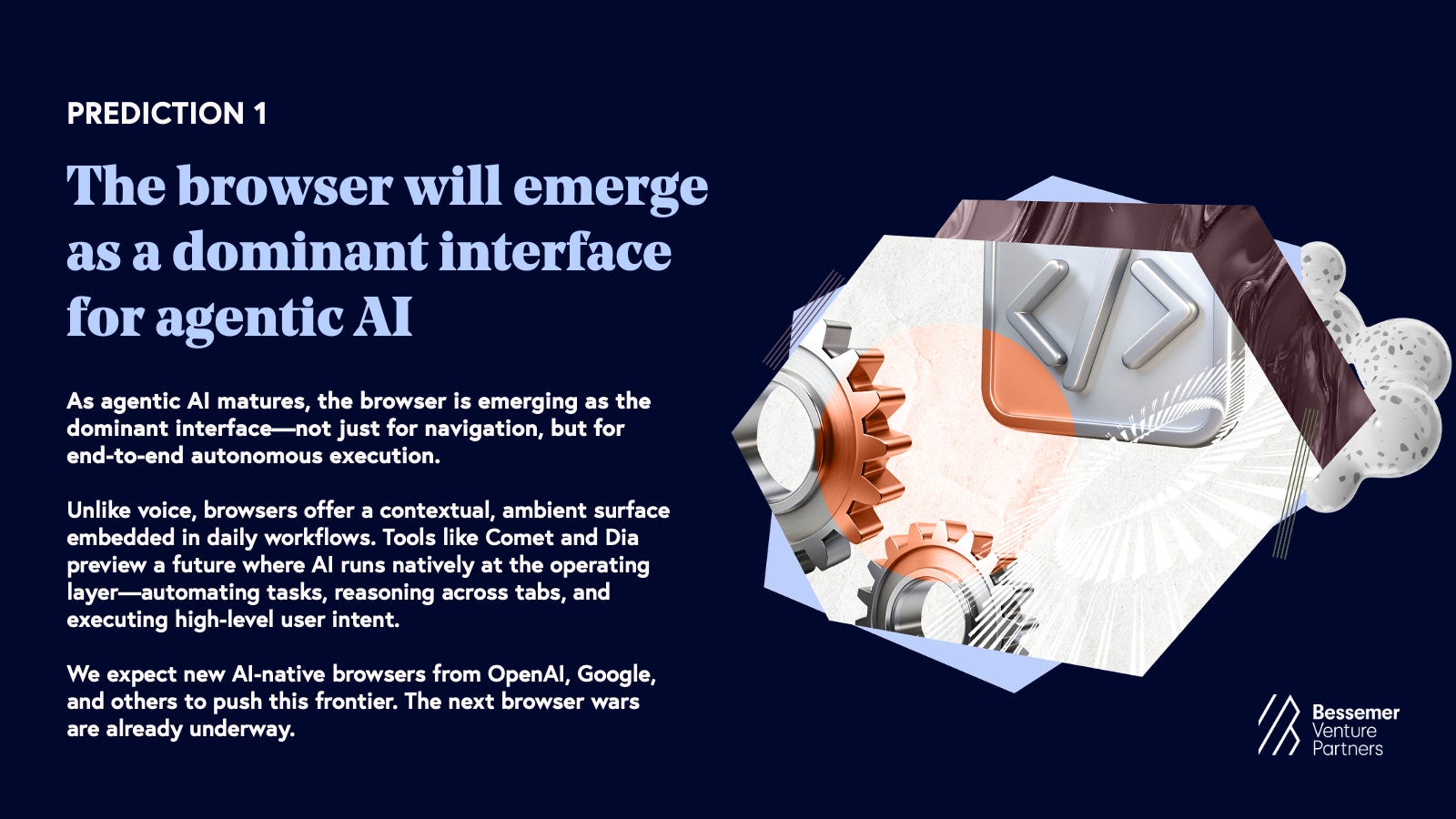
Bessemer’s The State of AI 2025 makes a blunt call: the browser will become the dominant interface for agentic AI. It sits flush with users’ daily workflows and naturally holds context and permissions. The next generation of browsers (Comet, Dia, etc.) are not plug-ins—they’re part of the operating layer, able to collaborate across tabs and execute multi-step tasks by intent. In short, the browser is shifting from “seeing” the web to “doing” things.
I. Why the “browser layer”—three forces converging
Over the past two years, search, productivity, and system-level entry points have all moved toward an action-centric interface.
Search replacement. Perplexity launched Comet, upgrading “find an answer” to “get the task done”: from web research to scheduling across email/calendar, the browser itself becomes an invokable assistant. Perplexity also floated a headline-grabbing narrative—an “offer” to buy Chrome for $34.5 billion. Whether or not it’s real, the move thrust “the browser = strategic asset” into the spotlight.
Browser reconstruction. Dia makes the “programmable interface” the default, and Atlassian is wiring it into the enterprise collaboration estate—Jira and Confluence on the process/data side; Dia on the front-end/action side; and the join is precisely AI’s “intent-to-execution.” That’s why a collaboration software company would pay $610 million for a browser with “no traditional revenue model”: they’re buying not traffic, but the front end of organizational workflows.
System-level embedding. Anthropic’s Claude for Chrome has entered a controlled pilot, letting agents read, click, and navigate pages and—under user authorization—perform actions. This isn’t another chat box; it embeds “action permissions” into the browser’s event loop. Security and controlability will define whether these products scale—or don’t.
II. Three technical routes: from “answer” to “execution”
Route A: Answer-first search replacement
Comet’s product philosophy is clear: turn the internet into an immediate interface for extended thinking—research, compare, decide, then translate into tasks across email/calendar/Slack in one flow. The advantage is the connection from answers to action; the hard parts are permission governance and cross-domain stability.
Route B: Agent-native browser redesign (Dia / Fellou)
These products make “multi-step tasks,” “cross-tab state,” and “identity/session management” native browser capabilities. Fellou goes further: not only automating the web, but bridging into desktop-level operations. The challenge is security sandboxing and enterprise-grade auditability: once a browser can pay/post/order, audit logs and replay aren’t nice-to-haves—they’re table stakes.
Route C: AI internalization in system browsers
Edge+Copilot, Chrome’s ecosystem evolution, and Claude for Chrome’s permission pilot point to a path of “going deeper on action inside existing distribution.” The upside: lower user-education costs and strong compatibility. The trade-off: innovation speed and risk appetite ride the cadence of mainstream platforms.
III. The engineering of a “programmable interface”: translating intent into action
Putting agents inside the browser is far more complex than “summarize a page”:
Unified context: shared memory across tabs, addressable DOM fragments, and stitched-in external context from calendar/email/docs.
Action orchestration: lift low-level click/type/scroll into “intent APIs” (e.g., “submit expense,” “amend indemnification clause”) and save/reuse them via a declarative DSL or visual steps.
Identity & session: unify login state, cookies/tokens, and least-privilege grants; in enterprises, map to SSO and fine-grained RBAC.
Security & audit: every action is replayable and reversible; handle edge cases (CAPTCHAs, pop-ups, form validation) automatically; gate sensitive operations (payments/compliance filings) with strong interactive confirmations.
Reliability metrics: not just a one-off success, but cross-site success rate (CSR), mean time to repair (MTTR), and robustness to unpredictable UI changes.
Bessemer sums this up as “AI native to the operating layer”: the browser evolves from a data pane to an execution plane.
IV. Valuation and deals: narrative, substitution rate, and workflow stickiness
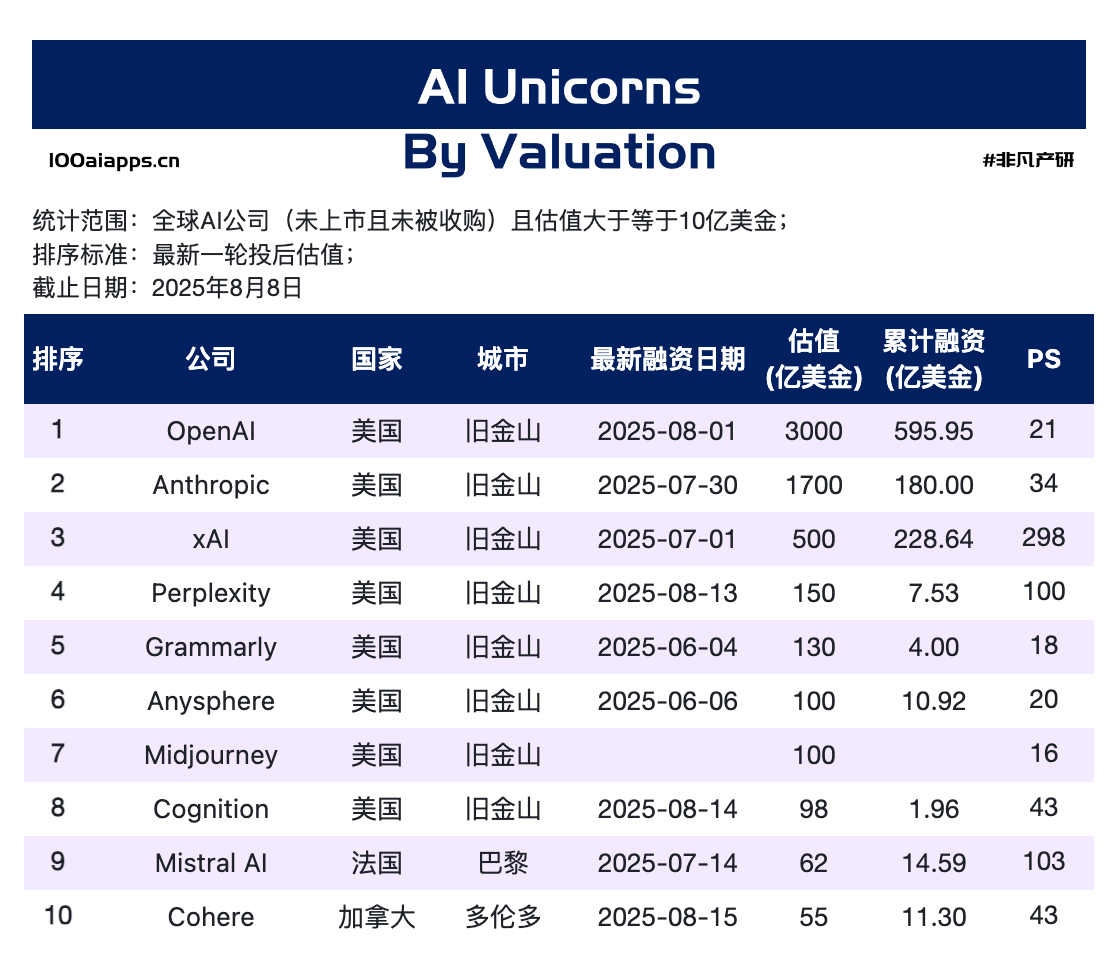
Perplexity’s capital trajectory offers a reference point: as of August, multiple media and Reuters reports place its latest valuation around $15B, with roughly $1B in total funding repeatedly cited. The valuation isn’t only a bet on search share—it’s a bet on the substitution rate from “search→action” and the dwell time inside workflows. Meanwhile, the public “offer” to Google to acquire Chrome reads as a narrative war over “entry-point sovereignty.”
Now back to last night’s deal: Atlassian paid $610 million for The Browser Company. They weren’t buying DAU or ad inventory; they were buying an engineering asset that fronts agents—and a puzzle piece that clicks into enterprise collaboration. When “work outcomes” become the reason to buy, a browser’s business value is no longer priced by “page views,” but by “task completion.”
V. Global vs. China: two paths to entry-point mindshare
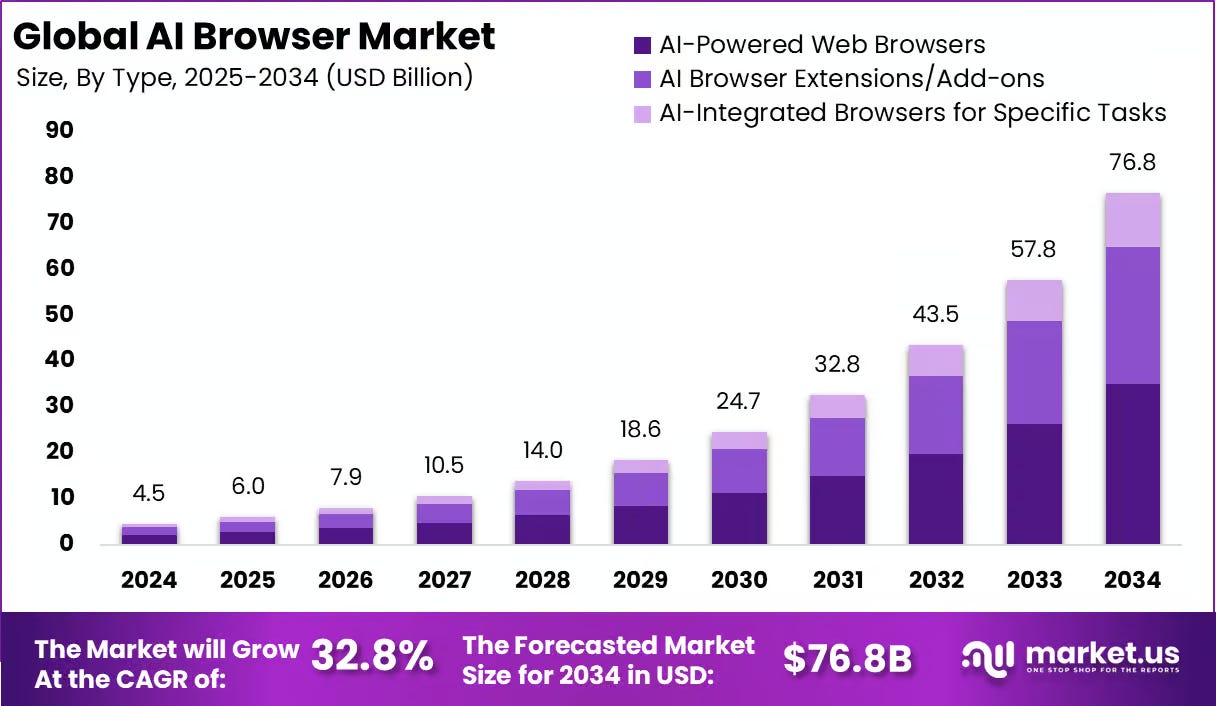
Globally, AI browsers are poised for lift-off. Market estimates suggest growth from $4.5B in 2024 to $76.8B by 2034—an eye-popping 32.8% CAGR.
In China, QYR research indicates the AI search/browser market was on the order of several hundred million RMB in 2023 and is set to expand sharply, with a 2024–2030 CAGR of 34.3%. That outpaces the global average, reflecting strong domestic demand for AI-enhanced browsers.
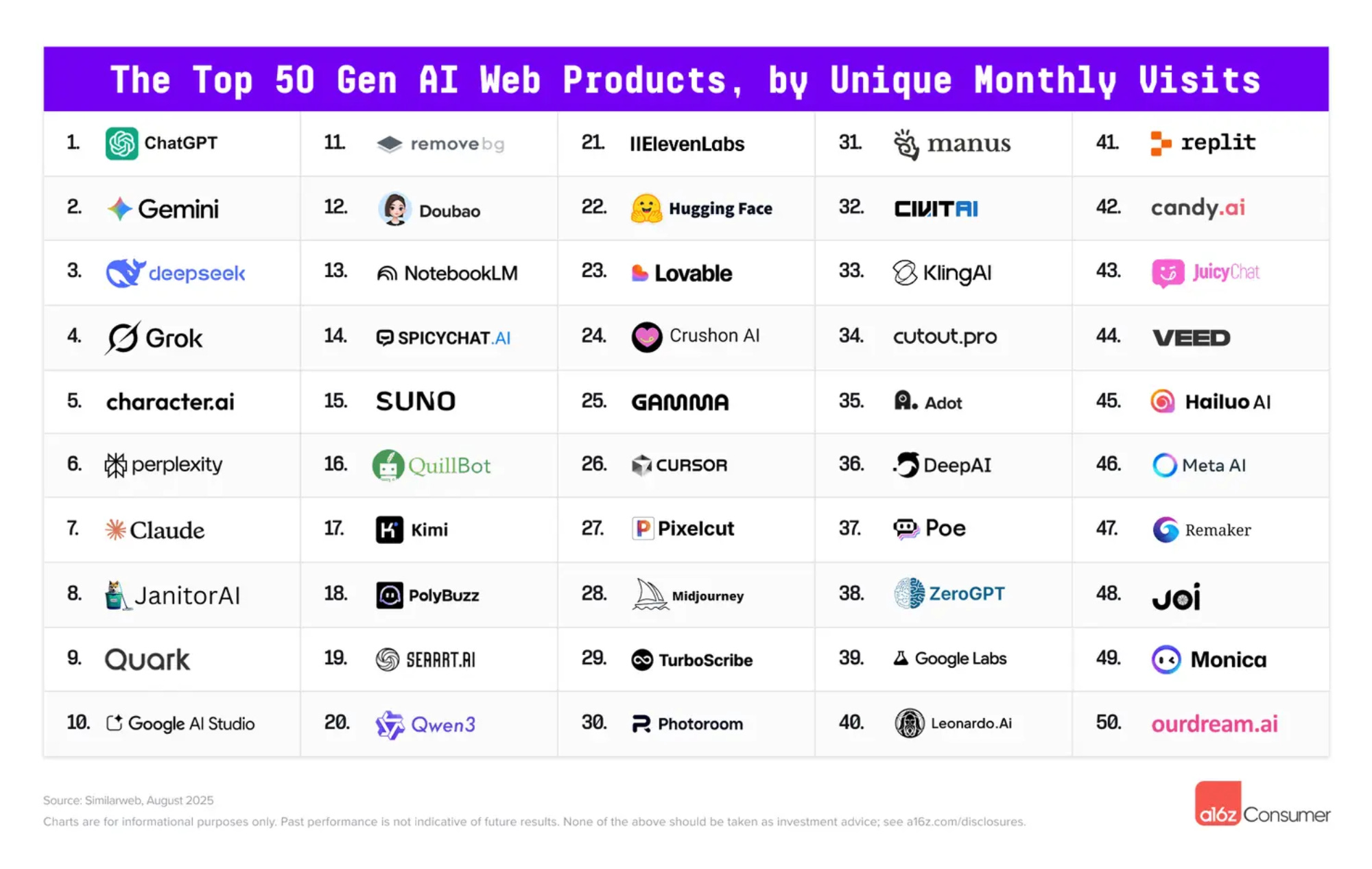
a16z’s 5th Top 100 Gen AI Consumer Apps shows that on the web side, Quark ranked in the top 10, with Doubao and Kimi in the top 20. China’s advantages come from strong entry points/distribution and the aggregation of high-frequency, must-have scenarios; the challenge is translating those scenarios into standardized action APIs—and building verifiable security and compliance attestations for going global.
For Chinese teams, a pragmatic path might be: first, make “action depth” stable in a single market (high CSR, low MTTR); then unlock overseas markets through “local ecosystem partners + compliance capabilities + observability.” Automation without auditability will struggle to pass enterprise procurement.
VI. The product–business “execution triangle”
Speed: extreme responsiveness and instruction-path compression.
Safety: least-privilege, action replay, explainability, and accountability.
Usability: cover more end-to-end scenarios—not just single-point demos.
Engineering teams must balance the triangle: blazing fast, but can’t audit payments? Broadly usable, but crumbles on CAPTCHAs in third-party backends? Ultra secure, but five confirmations to send an email? None of these will scale.
VII. An actionable checklist for enterprises, founders, and investors
Entry metrics: shift from “opens” to “task triggers/completion rate.”
Action graph: how many cross-site/system “Shareable Action Packs” exist?
Compliance & audit: enterprise-grade audit logs, SLAs, and DLP hooks?
Ecosystem binding: depth of integrations with major SaaS/data platforms (read-only vs. write vs. transactional).
Human-in-the-loop: when the agent stalls, can it package ambiguity into hand-off micro-tasks for people—and resume automation seamlessly?
If you’re an enterprise buyer: start with a low-risk, high-frequency use case (e.g., internal knowledge retrieval → daily report automation). While you use it, accumulate “action packs” and establish permission/audit baselines.
If you’re a founder: self-audit with the EDAA frame—Entry (entry point) / Depth (action depth) / Autonomy (degree of autonomy) / Assurance (provable safety & reliability).
If you’re an investor: look for the completion→retention loop, not isolated traffic spikes; look for the reuse rate of the action graph, not the drama of the demo.
VIII. The next 12 months: alliances and convergences
System vendors will accelerate AI action layers: Chrome/Edge will standardize permission, policy, and audit surfaces to widen what’s “executable.” Claude for Chrome’s pilot has already baked “controlled permissions + action” into the mainstream browser narrative.
Collaboration suites and browser front-ends will merge: Atlassian plugging Dia into its work stack is a template—the loop from docs/tickets to browser actions will be closed.
Search and browser boundaries will blur further: Comet fuses “search” and “do” in one scene; next up is wiring in “team knowledge” and “enterprise permissions.”
Browsers once competed on who rendered pages better; now they’ll compete on who completes tasks more reliably. Dia’s destination, Comet’s ambition, Claude’s pilot, and Fellou’s aggression all underline one fact: the battle for the entry point is shifting from “information display” to “intent execution.” The real winners won’t be those with the “smartest” model, but those who turn security, permissions, reliability, and action graphs into an engineering system that scales and reuses. This time, the browser isn’t a supporting actor.