
AI’s real competitor isn’t the studio next door. It’s the next model update.
Good stories have always existed in the back catalog. Their number doesn’t go up or down because of AI.
A series was scheduled to launch in mid-January. Half a month before launch, Seedance came out.
The team held a meeting and made a decision: redo 80% of the content. The reason was simple — the new model was clearly better in quality, and launching the old content at that point would have looked like showing weakness.
That’s a true story told by Sun Linli, head of custom series at Wukong Culture, on a recent panel. It’s basically a snapshot of the AI content industry today: in AI content, the studio next door is no longer your real competitor. The next model update is.
The panel was hosted by Wu Wei of Unique Research. On stage were four parties across the content chain: Chen Weiyu, CTO and head of AI at Yuewen Group (IP source); Gao Jianbo, head of AIGC content at Kuaishou (platform distribution); Sun Linli and Xi Tang of Aizao Tech (production).
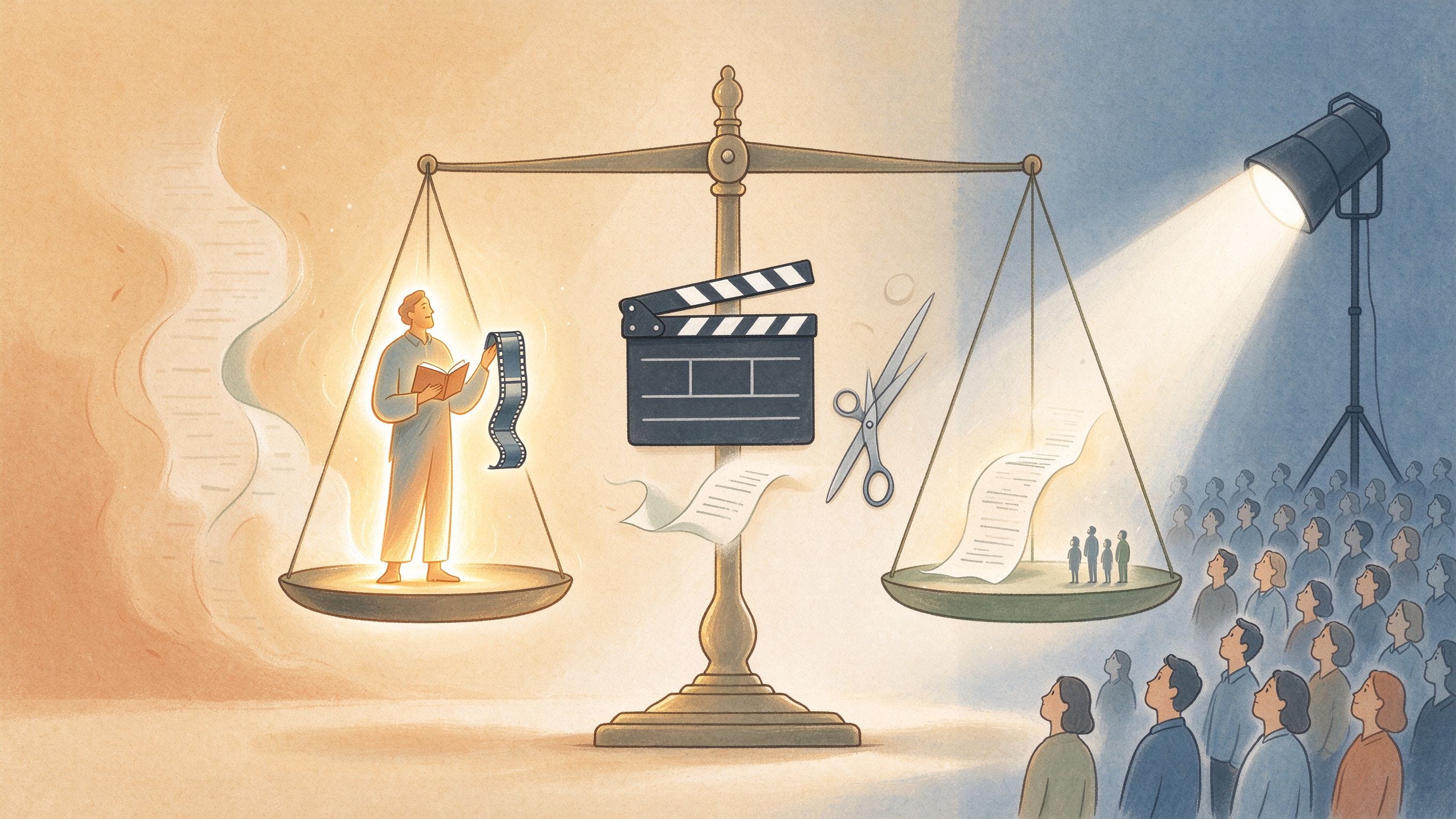
Read individually, each person sounds like they’re talking about something different. Read again, they’re all describing the same shift: value in AI content is moving away from the production step, to both ends — upstream, to stories and IP; downstream, to being seen. The middle, which used to be the busiest part, is becoming the least valuable.
Xi Tang both does AI production and trains creators. He made a practical observation on stage: training someone to make AI video is far easier than training someone to be a screenwriter.
Anyone can learn the tools. You can’t learn screenwriting.
“There’s a saying like this: the harder and more turbulent your life, the more likely you are to become a good screenwriter. AI can assist you, but it won’t produce a good story out of nothing. The substrate is still you.”
That’s the first test: can this step be trained? Whatever can be copied through training is getting cheaper.
The second test: will this step be directly erased by the next model iteration? Chen Weiyu said he used to believe cinematographic language was a real moat in video. New models have partially overturned that assumption. Sun Linli’s 80% redo is the same story, another version.
The third test is price. Xi Tang entered the business right when Sora launched and has lived through the full AI video cycle: “At the beginning, our project fees could be very high. Now, everyone knows it’s extremely hard.”
The production chain keeps shrinking. The time to market-validate a work has compressed from two weeks to three days.
Put the three tests together and the conclusion is harsh: anything that can be trained, or can be covered by the next model iteration, is depreciating. Production hits both.
If production isn’t worth money, where does the money go? Start upstream.
Chen Weiyu made two claims on stage.
First:
“Good stories have always existed in the back catalog. Their number doesn’t increase or decrease because of AI. But because of AIGC, good stories get more chances to be seen.”
The counterintuitive part: most people think AI is creating stories. What AI is actually doing is repricing “being seen.” Scarcity of story hasn’t changed. Accessibility has.
Second: as AI capability improves, downstream capacity and outlets keep expanding, which creates a bottleneck at the front end — the story source, i.e., IP. The wider the downstream opens, the scarcer IP becomes.
Push that to two outcomes: top-tier IP becomes even more top-tier because it’s seen more; and a long tail of mid-tier IP finally gets a chance to be adapted — stories that used to lie in text because filming was too expensive can now be made.
Sun Linli gave an example from sci-fi. Historically, sci-fi content had a supply gap. Only IP on the scale of Liu Cixin attracted investment, because translating sci-fi into screen language was too expensive. But sci-fi has to be a pyramid; below the tip you need a lot of softer, easier-entry works. AI is filling the broken middle.
Don’t rush to celebrate “everyone can build an IP.” Sun Linli has a high bar for what counts as IP: it has to be systematic and extensible — able to grow games, interactive dramas, derivative worlds. A story that only supports one film, she calls “idea literature.” Between a story and an IP, what sits there is never technology. It’s time.
Upstream stories are worth more. What about downstream? Gao Jianbo shared a set of platform numbers worth reading together.
Kuaishou has 412 million DAU. 280 million users actively consume AIGC content, at 11.5 billion VV per day. On the supply side, the platform adds 1.09 million AIGC videos per day, 70% of which are narrative story content. The quality rate of that supply is roughly 20%.
Last month, the platform took down nearly 25,000 accounts for low-quality reposting and content laundering.
Translate that: when supply approaches infinity, the power to allocate “being seen” becomes the scarcest resource. The platform screens content on six dimensions, from story completeness to distribution data, and has to spend extra effort policing reposts and laundering to protect original creators.
Sun Linli, from the production side, said the same thing. She thinks the real challenge today is no longer production. The hard part is “how to filter out good stories, how to make them seen, and how to turn a good story into a good project.”
Once you see this shift, a lot of industry behavior makes sense. Why did Yuewen’s DramaBuddy grow from a tool into an ecosystem with a job marketplace and script bazaar? Because matching “good stories” with “being seen” has itself become a business.
Chen Weiyu said something last year and repeated it this year: a content ecosystem should have a hundred flowers blooming. A single flower standing alone is not a healthy ecosystem.
Upstream wants stories. Downstream wants to be seen. What does the creator in the middle still hold?
Gao Jianbo told a story about a delivery rider on Kuaishou. He likes content, talks to AI, asks AI to generate stories, and posts them.
You can tell the production is rough. But the underlying content is sincere.
“That’s exactly what becomes more valuable after AI arrives: content rooted in real life experience and real feeling.”
Picture quality doesn’t have to be great. If it resonates with people in the same circle, it’s good content.
Sun Linli’s answer is more direct. Asked about the moat, she first acknowledged the hard parts — workflows, asset libraries — then turned: “The real moat is still people, and people’s understanding of content.”
Today, the boundaries between director, screenwriter, editor, and AIGC creator are all blurring. Picture quality increasingly depends on the model. The most valuable role is the person who understands content. Which seat they sit in is secondary.
That’s probably what this panel wanted to say: technology is reshuffling every step. The one card still in human hands is “what do you want to say, and why should it move anyone?”
Asked what’s most certain about the next 12 months, all four gave the same answer: change.
Chen Weiyu said platform policy changes, base models change, and every change disrupts the old division of labor. Adapting to change is the big exam for the next few years. Sun Linli said the most certain and most uncertain thing is the same — change; the only thing you can do is focus on judging good content. Gao Jianbo bet on diversification: AI + education, AI + finance, AI + variety, AI + film, even resurrecting the metaverse.
Xi Tang was asked for a different answer. He thought about it, still landed on change, but came down to earth:
“After everything said today, what you can actually hold onto is scripts, stories, and IP. We always come back here.”
Models will update several times a week and force you to redo 80% again and again. But the story that grew out of your own life — no one can generate that for you.
Panelists
Chen Weiyu, CTO & Head of AI, Yuewen Group
Sun Linli, Head of Custom Series, Wukong Culture
Xi Tang, Founder, Aizao Tech
Gao Jianbo, Head of AIGC Content, Kuaishou
Host
Wu Wei, Founder, Unique Research
Wu Wei: I believe everyone is looking forward to this first panel. Our theme is text, story, and IP — how AI reconstructs the source of content. On this panel we have platforms holding large IP libraries, large creator platforms, AI production houses, and tool makers. Everyone across the content chain is here.
Let’s start with brief introductions.
Chen Weiyu: I’m Chen Weiyu from Yuewen Group. I lead our AI business and also run an AI comic-drama tool called DramaBuddy. We built DramaBuddy to connect creators with Yuewen’s licensed IP. We’ve opened up collaborative script trials and scripts on the platform.
Sun Linli: I lead the custom series business at Wukong Culture. Wukong has used AIGC to make sci-fi content since 2024. Our first series, Awakening, was one of the early works that showed the industry AI could tell stories. Wukong is invested in by Sichuan Observer, and we focus on sci-fi IP. If you have good IP, we’re open to collaboration.
Xi Tang: Our company was founded when Sora came out in 2024. We started with TVC ads, then moved into comic dramas last year, mostly as a production house. The other half of the business is AI self-media; we’ve built a following in AI video.
Gao Jianbo: I’m Gao Jianbo from Kuaishou, leading AIGC. Kuaishou is 15 years old and one of the largest short-video platforms. AIGC is one of our fastest-growing content categories. Kuaishou has 412 million DAU; 280 million users actively consume AIGC content; we have 380,000 AIGC creators with 10,000+ followers. Daily AIGC VV reaches 11.5 billion, at 35 minutes per user per day.
Wu Wei: Back to the first question. AI has made content production very efficient, but we still want good stories. In a homogenized environment, true hits — content over 100 million views — may be under 1% of the platform. In the AI era, are good stories becoming more or less common? Chen, you’re at one of the largest IP platforms.
Chen Weiyu: First, define what a good story is. Good stories have always existed in the back catalog; their number doesn’t change because of AI. But AIGC gives good stories more chances to be seen, more chances to reach readers and viewers.
As you said, good stories are the most fundamental factor for comic dramas. With such a low hit rate, good stories are the base. In the past, you could adapt any story and get decent traffic. Now you have to compete on content quality. Comic dramas have entered the second half; it’s no longer a capacity game, it’s a content game. The studios still making money today are strong on content, not just production.
Wu Wei: I agree. AI raises the chance a good story gets seen. Sun, in the past, making a sci-fi film was extremely hard, which is why China lacked this genre. Now with AI, can sci-fi be better presented?
Sun Linli: Sci-fi was scarce because translating sci-fi into screen language was so expensive that approving a sci-fi production was a major decision. Why did Wukong choose sci-fi with AIGC? Because today’s science was yesterday’s science fiction, and today’s science fiction will become tomorrow’s science.
There used to be a supply gap. Only top-tier IP like Liu Cixin could attract investment. But sci-fi can’t be a tip alone; it has to be a pyramid with softer, easier-entry works below. Our audience is 80–90% male, concentrated in Hangzhou and Shenzhen. So now we also select some female-oriented sci-fi to diversify.
Back to the question: from the production side, we think good stories are increasing, because total volume is larger. Our real challenge is how to make good stories seen. There’s too much content; how to filter, how to be seen, and how to turn a good story into a good project is the harder part of adapting to screen.
Wu Wei: Xi Tang, you do AI self-media and AI content creation. Where are the gaps, especially in telling good stories?
Xi Tang: AI video tools are mature enough that, as the previous two said, writing a good script and telling a good story is what matters. Personally, I think good stories are increasing. Why? Some people have no screenwriting training but rich life experience. They couldn’t express those stories before; now AI helps them express themselves and be seen. Second, there are so many good stories now that creators also have to think about how platforms discover them — because content is getting similar, and people borrow from what works.
Wu Wei: That’s a problem for the platform. Gao, how does the platform choose when everyone wants to be seen and content is both abundant and similar?
Gao Jianbo: From the platform’s view, more content is good, whether similar or differentiated. Kuaishou now adds 1.09 million AIGC videos per day. We roughly split them into three categories: narrative stories, knowledge/encyclopedia, and visual creativity. About 70% of the million-plus are narrative stories. So we can say good stories are increasing. The quality rate is about 20%.
We judge on six dimensions: story completeness, creativity, technical execution, emotional expression, and distribution (consumption data). We combine prior signals (what our users like, like, repost, discuss) with posterior data. We also have a lot of homogeneous, low-quality, even reposted content, which is the platform’s problem to solve — we protect truly original creators.
Last month, we took down nearly 25,000 accounts for low-quality reposting and content laundering.
Wu Wei: The platform’s responsibility is clearly large. Next topic: IP. Good stories are increasing, but is IP becoming more valuable, or is its value diluted by all the derivative creation?
Chen Weiyu: First, as AI capability improves, downstream capacity and outlets expand, which creates a bottleneck at the front end — the story source, i.e., IP. The wider the downstream opens, the scarcer IP becomes.
AI production also makes IP more visible. The more people see it, the wider its audience, the stronger its value. So first, top-tier IP becomes even more top-tier. Second, a lot of mid-tier IP finally gets adapted. As Sun said, many sci-fi IP had great stories but only existed in text because filming was too expensive; AI can now bring them to screen. Overall, rapid AI progress helps IP value be better realized.
Wu Wei: It’s mutually reinforcing. AI extends IP into many forms; more people see and identify with it; that feeds back into the IP. Sun, you do AIGC custom series. You can either create original stories that become independent IP, or adapt existing IP. How do you balance the two?
Sun Linli: IP and a great piece of content are not the same thing. In sci-fi, some works can be built toward IP — a complete ecosystem that can become a film, an interactive game, or many derivative possibilities. My personal definition: an IP has to be systematic and extensible.
I agree with Chen. In the AIGC era, IP influence becomes more diverse. The old model, like Disney, gathered attention into one point and then extended commercial value. Now content production is more diverse; everyone picks their own niche. AI will make IP diversity stronger.
Wu Wei: Can everyone create their own IP?
Sun Linli: We actually have people doing that. Many individuals use AI to make AI virtual humans — that’s also an extension of IP. Supply can produce more content, demand has more choice, so the way IP influence is built may change.
Wu Wei: Once you have a good story source, whether IP or your own idea, what are the bottlenecks in actually delivering it as a work?
Sun Linli: The bottleneck is building IP. We want to build IP, but many works we produce, long or short, are just one film and hard to extend into IP. How do you extend it to games? Maybe the game of the future is that decisions you make while scrolling a short drama change the protagonist’s next plot.
Wu Wei: Interactive film and TV.
Sun Linli: Right. So IP needs that property. But a lot of today’s content is “idea literature” and can’t extend to that degree.
Wu Wei: So anyone can create a character and turn an idea into a work, but turning it into an IP is still a long road. Xi Tang, you both create and train. What are the bottlenecks for an ordinary person to finish a high-quality work?
Xi Tang: Today, turning an idea into a work is relatively easy. But the substrate is still the story. You can’t call it IP yet; from story to IP is a long way, as the previous two said.
In training, we find AI video production is much easier to teach than screenwriting. We have screenwriters, and screenwriters can’t really be trained purely — it depends on your substrate. The harder and more turbulent your life, the more likely you are to become a good screenwriter. AI can assist, but it won’t produce a good story out of nothing.
Also, from a good story to an IP, there are many problems: how to do interactive games, how to do derivative creation. For individuals, IP is basically a personal brand. We used to be production; now we’re slowly shifting. Small teams have to move toward good stories, IP, and content, because production is getting too competitive.
Wu Wei: Production is getting crowded. A good screenwriter isn’t purely made by training; they need a substrate. But using AI tools for production is something many people can do.
Gao, we put four people on stage because you have different roles: platform, IP owner, producer, tool maker. A full digital content work flows from IP to production (which uses tools and models) to distribution. But with AI, boundaries blur. How should creators, platforms, tool makers, and producers relate?
Gao Jianbo: AI iteration is changing boundaries across production, distribution, models, tools, and IP. People are entering each other’s territory; it’s a more integrated process.
From the platform side, Kuaishou is not just a short-video distribution platform; it’s a community. Top creators, top production houses, and ordinary people all play roles here. The difference is the type and quality of content, and that difference meets the needs of different communities and circles.
User demand is diversifying, and content supply is diversifying correspondingly. In this multi-polar relationship, roles become relatively fuzzy, forming what we call a “character universe.” Around one character, IP, or story, more people can co-create and extend. The change is, first, blurred boundaries; second, roles can swap. I can be the creative, the producer, and the distributor. We encourage people to produce more content with mutual understanding. The goal is diverse supply meeting diverse demand.
Wu Wei: China is a huge market with different regions, cultures, and groups. A “niche” audience here can already be a million-plus users. Kuaishou shows us a rich world we wouldn’t otherwise see.
Many creators used to be true individuals: one phone, one account, livestream, fans, monetization. With AI, do these individuals need to embrace AI and upgrade, or is there nothing an individual can do? Some people tell their own stories out of interest and are anxious now. What’s your advice?
Gao Jianbo: From what we see, individuals are already embracing AI. The simplest is using AI to generate stickers or holiday templates.
Regardless of education, some people have no formal screenwriting training. There’s a delivery rider on Kuaishou who likes content and posts. He talks to AI, asks it to generate stories, and posts them. The production is rough, but the content is sincere and real. That’s exactly what becomes more valuable after AI: content rooted in real life experience and real feeling.
Ordinary people can embrace AI. AI tools let them produce content without editing, screenwriting, or cinematography skills. The picture may not be great, but if it resonates with people in the same circle, it’s good content. At least on Kuaishou, people are embracing AI and producing more good content through it.
Wu Wei: So we don’t have to fully generate pure AI content; we can integrate AI tools into existing creation. Xi Tang, you also train creators. What’s the core competitiveness of future creators? Who keeps producing good content?
Xi Tang: This is a judgment we made last year. The way out for small teams or creators is screenwriting, content, and scripts. There are so many production teams now. Small teams that own core content capability, or whose original team came from screenwriting, are still very competitive in AI video. Some small teams focus on this and are doing very well. Small companies and small teams must move toward IP, story, and content. Moving to content is a certainty.
Wu Wei: Sun, from Wukong’s side, with so many AI production teams, what’s your moat?
Sun Linli: I get asked this a lot: what’s Wukong’s moat, or the industry’s moat? On the “hard” side, we need workflows that fit our creation needs and our own asset library so we can call things up faster. For example, historical timelines — many of our works span long periods of time, so workflows and asset libraries are real barriers.
But in the AIGC content era, the real moat is still people and people’s understanding of content. This “person” can be a team. Traditional role boundaries are blurring: director, editor, screenwriter.
Wu Wei: I can do role A and also do role B.
Sun Linli: Yes. But behind these roles is the most fundamental logic: what do you want to express? Why should people see it? Why should people who see it like it? That goes back to the most fundamental point of content creation — how to move people, and how to output something true, good, and beautiful. That may sound lofty, but I believe platforms ultimately select true, good, and beautiful content, because that’s what stays in the audience’s heart.
Wu Wei: Which role is most important?
Sun Linli: The role that understands content. You can be a director, an editor, or an AIGC motion artist; but no matter which seat you’re in, you have to understand expression. The core understanding of how to express a good story is what matters.
Wu Wei: When someone who understands content is on the team, no matter their title, they can lead the small team to deliver high-quality content, right?
Sun Linli: Yes. Because picture quality today no longer fully depends on team division; it depends more on the technology itself. The model itself determines how good the picture can be.
Wu Wei: Chen, you mentioned DramaBuddy. Why build an assistant? How does it relate to Yuewen’s existing resources?
Chen Weiyu: DramaBuddy was announced at our creator conference last October. The original intention was simple: help our own creators express visually. When AI arrived, there were few tools on the market and no easy, friendly ones, so we built one for our community.
Today we’re proposing a new view: from tool leap to ecosystem. We’re not a pure tool platform; we want to lean on Yuewen’s brand and resources, and launch services like a job marketplace to better match production houses with our internal orders.
Why? Because as Xi Tang said, production has entered the second half. Two things matter. First, the first half rewarded capacity; whoever had capacity made money. The second half rewards content. You have to focus on telling stories well; this business only becomes a content business then. So we open our licensed IP and scripts in the ecosystem marketplace, help production houses learn how to make content, and give them content to choose from.
Second, production houses used to make money from channel information. But no matter first or second half, the market’s bottom line is still how you make money and survive. Platform-side overall revenue is declining; everyone should think about finding their own small market. As Gao and Sun said, every creator has something inside they want to express, and that may help you find your niche. We can help there. Yuewen started from content and has done a lot of content incubation, like webnovel incubation that required heavy upfront investment. We have programs to support creators with something to say. They may not make money at first, but through support their stories can be seen by more platforms.
So going forward, DramaBuddy wants to use ecosystem capability to support creator partners and production partners.
Wu Wei: A healthy ecosystem lets the industry develop better and faster.
Chen Weiyu: One more thing. I spoke here last year and said: a content ecosystem should be a hundred flowers blooming, not a single flower standing alone. A single flower is not a healthy ecosystem.
Wu Wei: Final question. AI content has entered the second half. The first half was wild growth — whoever had more people, speed, and output had the advantage. The future moves toward premium, quality, and real content pursuit. In the next 12 months, what’s the one thing you’re most certain about? What’s still uncertain or non-consensus?
Chen Weiyu: The most certain thing is change. Platform policy changes, base foundation models change. Every change disrupts the old division of labor; workflows need re-adapting, and the company’s operating model may need adjustment. Adapting to change is the big exam that stays with everyone for the next few years.
Wu Wei: What’s the uncertain variable?
Chen Weiyu: There are many uncertainties. We can only work on what’s certain. Almost everything is uncertain. For example, technology. Last year there was still a distinction between text-to-video (Kling) and reference-to-video (Vidu). Then Seedance came and leveled the gap. Is Seedance the only choice now? No. Models like Wanxiang and Hailuo, cheaper, also solve part but not all problems.
A new model may soon overturn what we think we know. I used to believe cinematographic language was a real moat in video; new models partially overturned that. So it’s hard to say.
Wu Wei: We have Seedance, Kling, SeaArt AI with a booth outside, and recently MiniMax’s Hailuo. There are many variables; we don’t know where the next change comes from. Sun, what’s your most certain and most uncertain variable in the next year?
Sun Linli: Same as Chen — change. The most certain and most uncertain thing is the same. Earlier this year, we had a series scheduled for mid-January. Half a month before launch, Seedance came out, and we redid 80% of the content, because it was clearly better. If we’d launched the old content one or two weeks after the model came out, it would have looked low quality.
So the most certain and most uncertain thing is change. The only thing we can do is focus on judging good content and understanding good content production.
Wu Wei: Xi Tang, I want a different answer.
Xi Tang: I also wanted to say “change.” Let me be more specific: traditional production used to have many steps. From text-to-image to more full-spectrum generation, the whole chain keeps shortening. The path from a good idea or script to market validation is getting shorter.
An idea today can be validated end-to-end quickly. It used to take two weeks to ship one work; now it can be three days.
Wu Wei: So what can we actually hold onto?
Xi Tang: After everything said today, what you can hold onto is scripts, stories, and IP. We always come back here.
We’ve basically lived through the full AI video cycle, entering when Sora first came out. At the beginning, our project fees were very high; now everyone knows it’s extremely hard. Small teams and one-person companies have to accept change. AI may update several versions a week. Not just AI video — office AI tools and all kinds of AI tools keep changing fast.
Wu Wei: Gao, from the platform side, everyone is competing so fiercely. Give us your closing read.
Gao Jianbo: The most certain thing, for me, is diversification. In content, over the past two years, people have competed most on short dramas and comic dramas. Those have moved from “can be made” to industrial, assembly-line production.
In the next year, AI short video and AI content will become more diverse — not just short dramas and comic dramas, but “AI plus everything”: AI + education, AI + finance, AI + history, AI + variety, including AI film, which we’re focusing on. Future AI content will definitely diversify.
For both platforms and creators, that’s a better opportunity to apply AI in a wider content world. That’s the certainty.
The uncertainty is technical feasibility. Around 2021–2022, a concept called the metaverse was hot. As real-time generation improves, especially with cost iteration, real-time, interactive content generation — the metaverse direction — has the most opportunity and imagination. The uncertainty is how far technology and cost can go, and when that moment actually arrives.