Look back at September 2025 and you’ll notice two seemingly opposite trends in the AI app world.
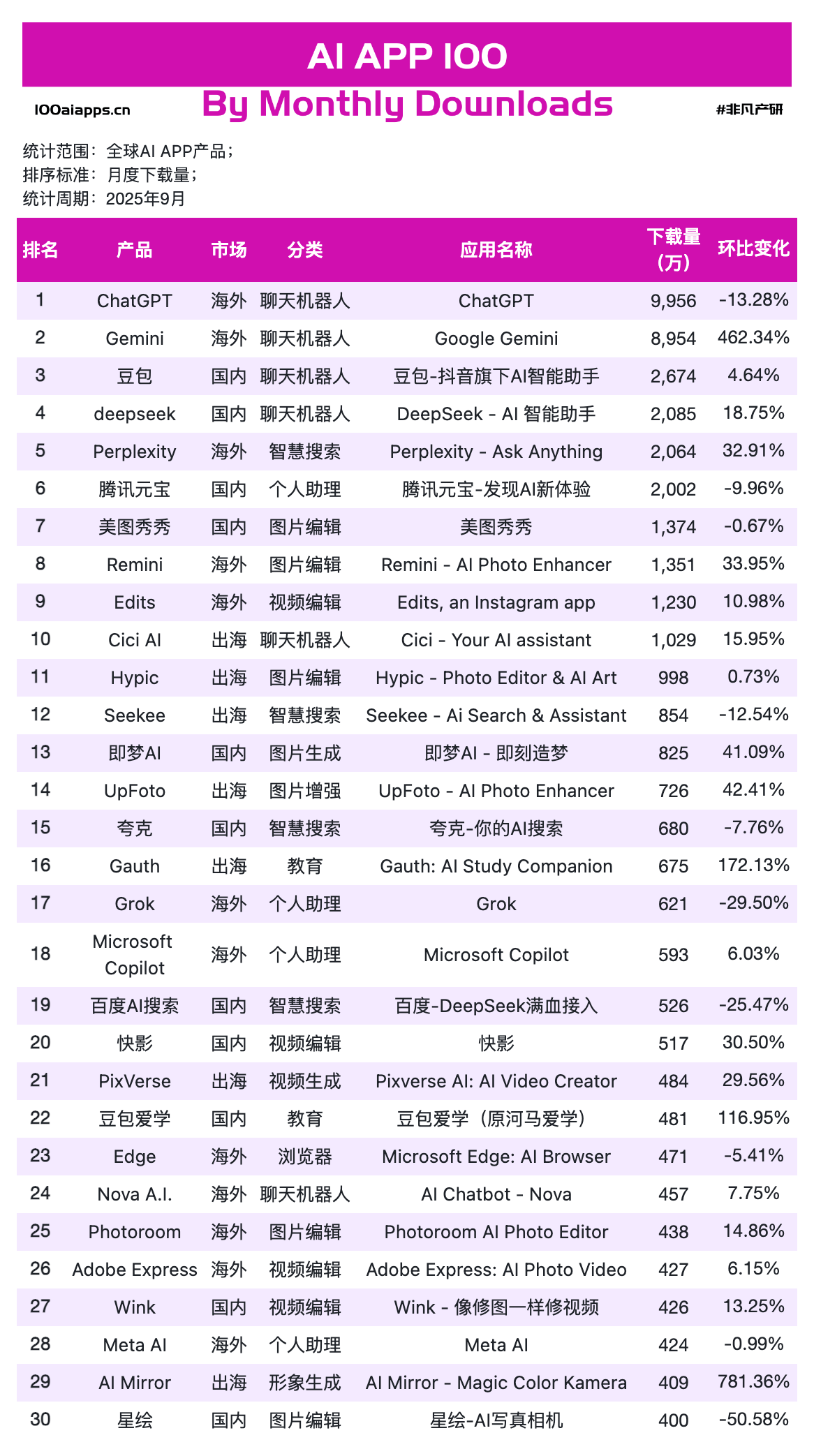
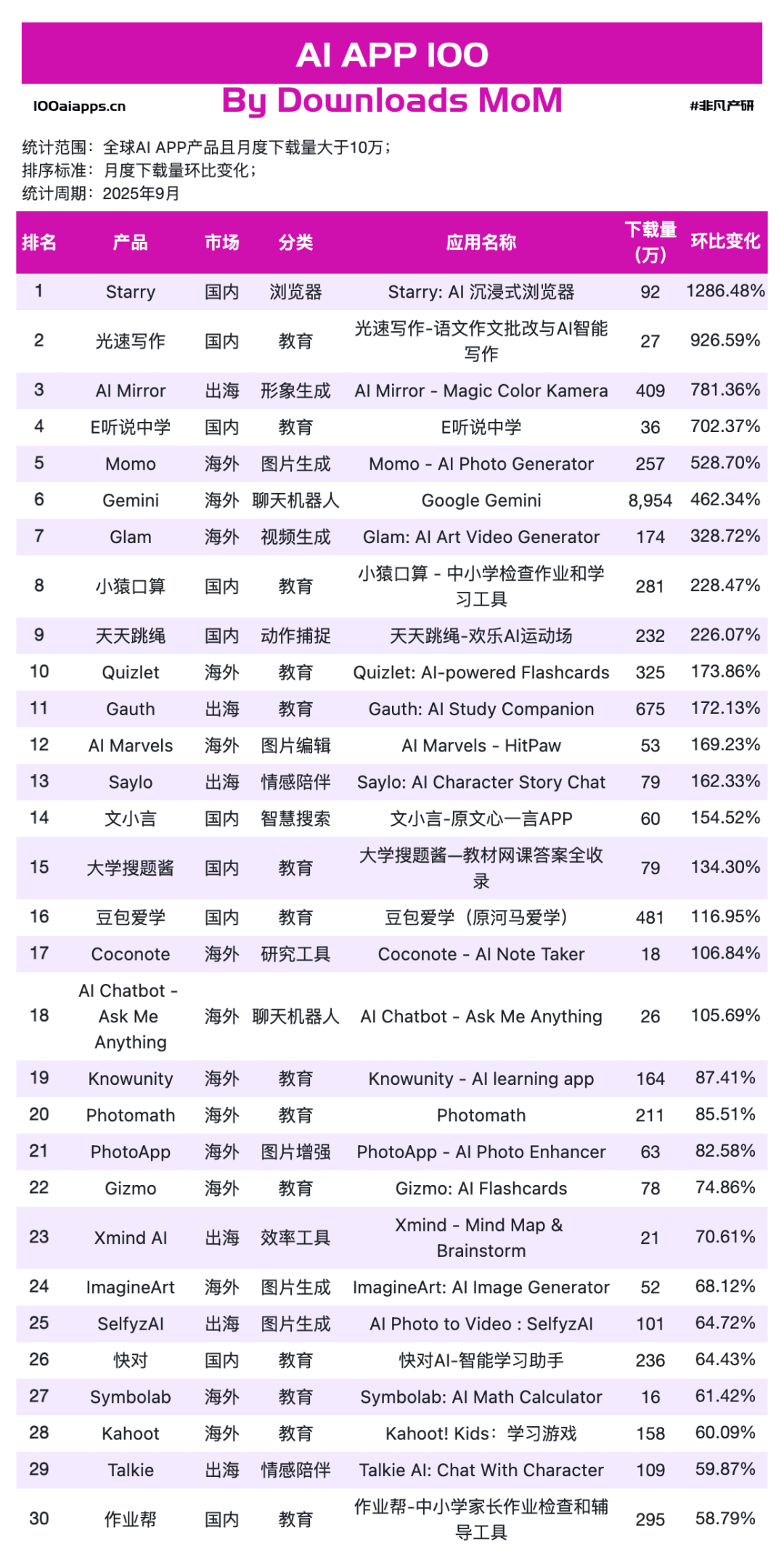
On one hand: heat is rising. Newer products and categories like Gemini, AI Mirror, and Lightspeed Writing pushed aggressive new-user acquisition.
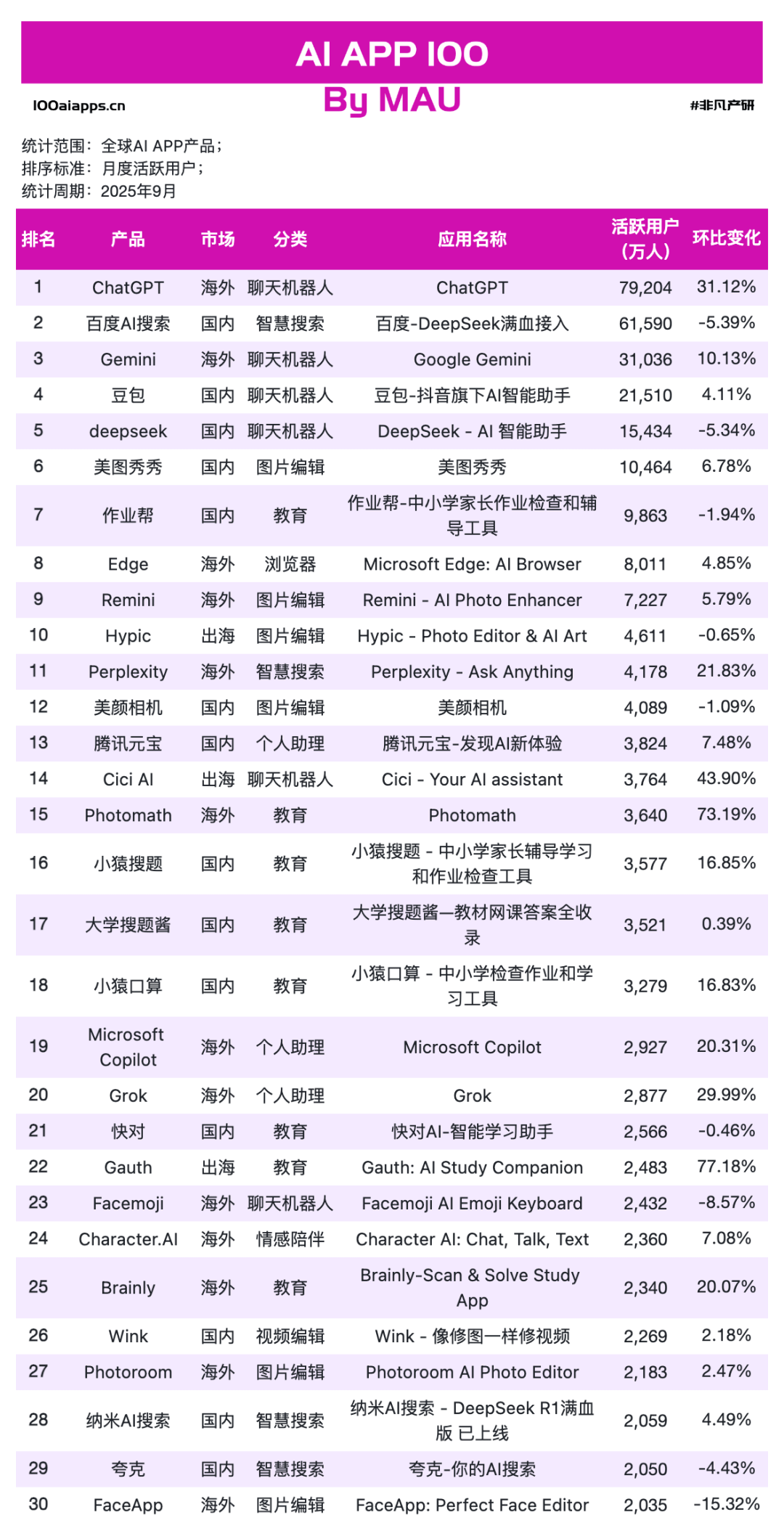
On the other hand: pace is slowing. Familiar names like ChatGPT, Baidu AI Search, and Tencent Yuanbao saw month-over-month download declines — but their monthly active users (MAU) kept climbing.
This is the classic tension between “hot” and “durable”: paid acquisition drives spikes in installs, but real use cases determine who keeps the traffic.
This report is based on Unique Research’s (非凡产研) September data for global AI apps (Top 100 by downloads and MAU). We break down: acquisition vs retention, category structure, market shape, and how top players are actually winning.
Global picture: Installs skew overseas, engagement is more balanced
Install volume and concentration
• In September, the global Top 100 AI apps generated roughly 557 million downloads total.
• 75.4% of those installs came from markets outside China; 24.6% came from China.
• The Top 10 apps alone captured 58.8% of all new installs.
Active user scale and structure
• The Top 100 apps reached a combined ~3.768 billion MAU.
• The Top 10 account for 66.1% of total MAU. Engagement is even more concentrated than downloads — but there’s still meaningful room outside the top tier.
• By region, MAU split was 58.1% outside China vs. 41.9% inside China. That’s far more balanced than the install split, which suggests that China’s “incumbent” apps are stronger at holding existing usage than purely driving fresh installs in September.
Category structure
• Installs: chatbots led with 48.1% share, followed by image editing / generation (11.4%), personal assistants (7.4%), AI search / smart search (7.4%), and video editing / generation (7.3%). In other words, “dialog + visual creation” is still the front door for new users.
• MAU: chatbots held 43.3%, AI search 19.5%, image editing 11.4%, and education 9.8%. Education shows up as a more stable contributor on the active side — reflecting frequency and habit.
Who is winning acquisition vs. who is winning retention
Biggest contributors to DOWNLOAD growth in September:
• Gemini: +462% month-over-month downloads, adding roughly +73.62 million incremental installs in a single month.
• Perplexity, Gauth, AI Mirror, Remini, DeepSeek, Doubao Study (豆包爱学), Jimeng AI (即梦AI), etc. each added millions of new downloads.
• ChatGPT: downloads were down 13.3% month-over-month. That does NOT mean usage is collapsing.
Biggest contributors to ACTIVE USER growth in September:
• ChatGPT: +188 million MAU, the single largest absolute MAU gain. This is what mature “retention + penetration” looks like.
• Gemini: +28.55 million MAU. Notice the gap: its MAU growth is meaningful, but nowhere near its download spike — conversion/retention is still catching up.
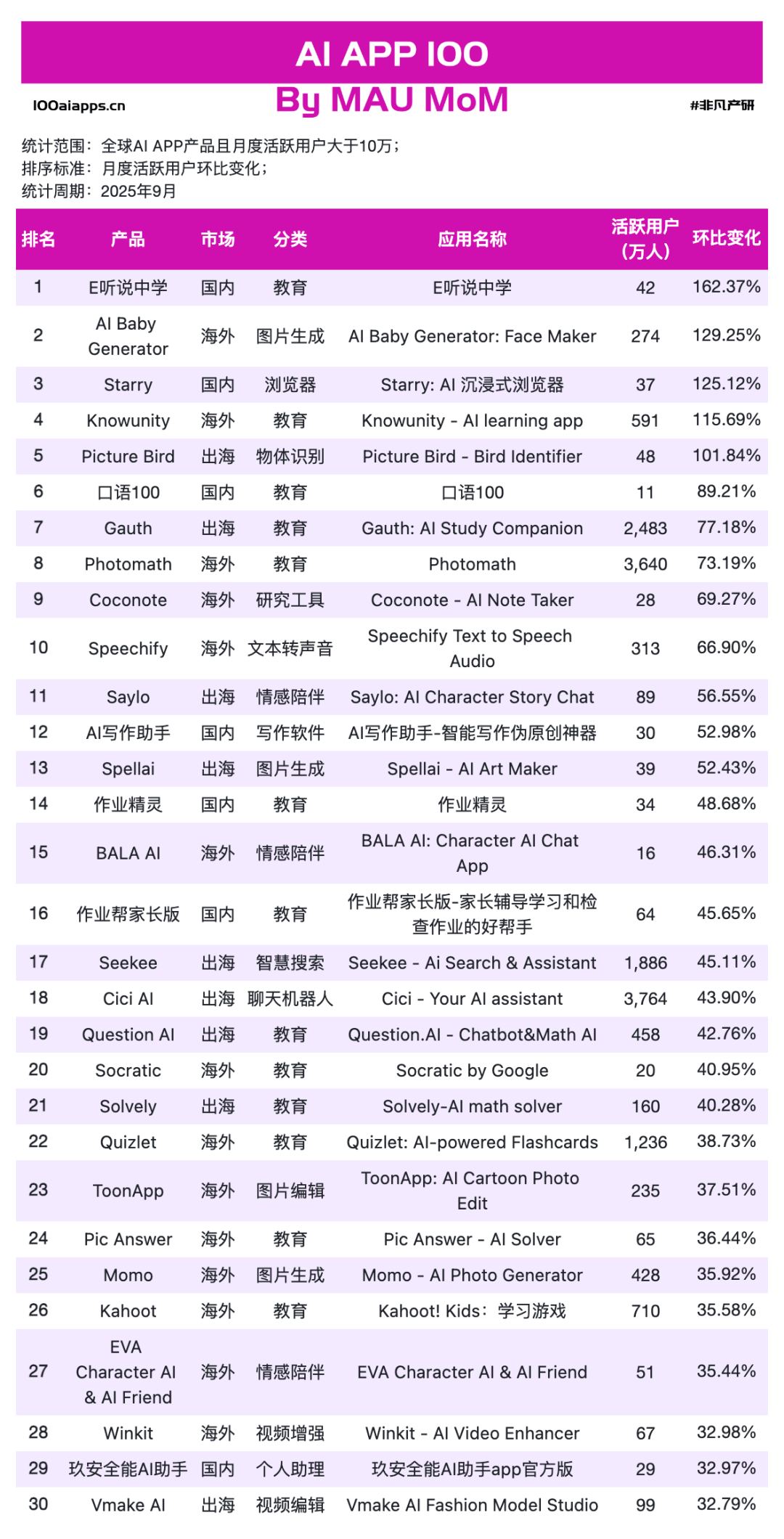
• Photomath, Cici AI, Gauth, Doubao (豆包), Perplexity, Meitu Xiuxiu (美图秀秀), Grok, Seekee, etc. all appear near the top of the MAU growth list. Education, imaging, and AI search show resilience on the engagement side.
Visible negative movers on MAU:
• Baidu AI Search: -35.09 million MAU
• DeepSeek: -8.71 million MAU
• Imaging tools like B612 / FaceApp / Airbrush also saw multi-million MAU pullbacks.
• ChatGPT, Tencent Yuanbao, Baidu AI Search, Grok all showed download declines.
How to read this:
• Download spikes tend to come from channels, ad spend, and “new capability” hype cycles.
• MAU growth tends to come from high-frequency, repeatable problems (homework help, daily search, utility editing). That’s why education, AI search, and stable imaging tools still rank well on the MAU side.
• When you see “downloads down, MAU up,” you’re usually looking at a product that’s deepening usage among its existing base while dialing back aggressive user acquisition.
China snapshot: ByteDance + Meitu + DeepSeek + Tencent dominate installs; Baidu AI Search dominates MAU
China downloads
• Total: ~144.97 million downloads in September. Top 10 players captured 80.0%.
• By category: chatbots 34.8%, image editing 14.3%, personal assistants 14.1%, education 10.7%, AI search 9.1%.
• By company share: ByteDance 30.3%; Meitu 15.0%; DeepSeek 14.4%; Tencent 13.8%; Alibaba 5.5%; Zuoyebang (作业帮) 4.4%; Baidu 4.0%.
Leaders in incremental downloads:
• DeepSeek, Doubao Study (豆包爱学), Jimeng AI (即梦AI), Xiaoyuan Mental Math / Xiaoyuan Homework (小猿口算 / 小猿搜题), Tiantian Tiaosheng (天天跳绳, a jump-rope training app), Kuaiying (快影, a fast-cut video editor), Doubao (豆包), Zuoyebang (作业帮), KuaiDui (快对), Starry.
• Education tools and imaging tools stand out as acquisition engines.
• Clear declines: Xinghui (星绘), Tencent Yuanbao (腾讯元宝), Baidu AI Search (百度 AI 搜索), Quark (夸克), Xingye (星野) all pulled back.
China MAU
• Total: ~1.628 billion MAU in September. Top 10 players captured 84.3%.
• By category: AI search 41.8% + chatbots 24.4% + education 15.0% + imaging 9.1%. Daily AI search usage is the #1 driver of active scale.
• By company share: Baidu 39.0%; ByteDance 15.3%; Meitu 10.7%; Zuoyebang 10.1%; DeepSeek 9.5%; Yuanfudao (猿辅导) 4.2%; Tencent 2.3%.
Leaders in incremental MAU:
• Doubao (豆包), Meitu Xiuxiu (美图秀秀), Xiaoyuan series (小猿搜题 / 小猿口算), Tencent Yuanbao (腾讯元宝), Jimeng AI (即梦AI), Tiantian Tiaosheng (天天跳绳), etc.
• Education + imaging tools benefit from “use it, leave it, come back tomorrow” frequency — plus back-to-school season, homework scanning, mental math, etc.
• Biggest MAU drops: Baidu AI Search, DeepSeek, Zuoyebang, Quark, etc.
How to read this:
• China’s download landscape looks like a paid-acquisition chessboard controlled by platform-scale players: ByteDance, Meitu, DeepSeek, Tencent.
• But on the active side, Baidu AI Search is overwhelmingly dominant. That makes China’s MAU structure very different from its download structure: daily-entry, search-style behavior beats one-off creative tools for sheer recurring usage.
Category view: three steady growth engines, two high-elasticity plays
Three “stable growers”:
Chatbots
• The #1 category for both downloads and MAU.
• The top end is splitting into two models:
– ChatGPT showing disciplined, mature retention.
– Gemini proving that brand strength + channel firepower can still brute-force installs in a single month.
• In China, Doubao (豆包) and DeepSeek have meaningful scale on both install and MAU sides.AI Search / Smart Search
• 19.5% of global MAU and 41.8% of China MAU.
• Daily query frequency gives this category very high stickiness, even if some individual players show negative growth in a given month. A dip in Baidu AI Search MAU is more about share shifts than the “death” of the category.Education
• Almost 10% of global MAU.
• In China, usage is heavily driven by back-to-school timing, homework solving, step-by-step math, and exam prep.
• Xiaoyuan (小猿), Zuoyebang (作业帮), Gauth, Photomath all keep showing up in the MAU growth charts.
• This is the category behind the headline: education apps contributed more than 30% of net MAU growth in September.
Two “high-elasticity” plays:
Imaging (image editing / generation / enhancement; video editing / generation)
• Extremely high download volatility.
• Apps like Remini, Meitu Xiuxiu, UpFoto, AI Mirror, Wink rotate in and out of the top depending on hype cycles and ad spend.
• Short-term peaks are driven by trends and paid traffic. The slope of the decline depends on:
– depth of feature set, and
– how well the app chains those features into real creator workflows.Personal Assistants / Emotional Companions
• Upside is very sensitive to “buzz + ads.”
• Downside comes fast if there’s no strong, recurring use case to absorb those new users.
• Grok, Character.AI, Saylo, BALA all show how retention depends on content supply and the mechanics of coming back every day.
Product-level signals
• ChatGPT
Downloads are cooling, but MAU is still climbing hard. That suggests acquisition is getting more rational while existing users go deeper. This is classic mature-product behavior.
• Gemini
A massive install spike in one month essentially planted its flag on mobile. But its MAU lift is far smaller than its download spike. Translation: onboarding and retention are not solved yet.
• Perplexity
Positive on both downloads and MAU. Among AI-native “ask-and-answer / search” products, it’s one of the clearest spillover winners right now.
• DeepSeek / Doubao
DeepSeek is making real progress on the download side. Doubao is showing steady, everyday usage on the MAU side.
• Education apps (Photomath / Gauth / Xiaoyuan / Zuoyebang)
Back-to-school demand + habitual, high-frequency usage (scan the homework, get a step-by-step answer, check mental math, prepare for quizzes) = sustained MAU contribution. The monetization path here is very “outcome-driven”: parents and students pay for results.
• Imaging apps (Meitu, Remini, UpFoto, AI Mirror)
Downloads are spiky, but return value depends on how deep the tool actually goes — editing, enhancement, AI restyling, video generation, etc.
Meitu Xiuxiu’s noticeable MAU lift inside China shows that a “veteran” imaging tool can still keep compounding if it keeps productizing AI capabilities.
Install spikes ≠ engagement winners
Put September’s two leaderboards side by side:
• Download leaderboard: Gemini, AI Mirror, Gauth, Perplexity
• MAU leaderboard: ChatGPT, Photomath, Doubao, Cici AI, Gauth, Perplexity, Meitu Xiuxiu
Notice how little overlap there is. Gauth and Perplexity are rare “dual winners,” showing both strong new-user intake and meaningful ongoing usage.
This gap — installs vs. active use — is the real signal. It’s telling us which apps are hype-driven acquisition vehicles, and which ones have carved out daily, repeatable jobs in people’s lives.
About Unique Research (非凡产研)
Unique Research is an independent intelligence group focused on the global AI market. Our September 2025 “AI Top 100 Apps” includes two full leaderboards:
• Top 100 AI apps by downloads
• Top 100 AI apps by MAU
Both are broken out for global and China markets.
Our influence and adoption
Unique Research’s data and insights are now used and cited by leading investment institutions, brokerages, academic teams, and media in and outside China as a core input for market analysis, investment decisions, and trend forecasting.
Our partners and citation sources include (but are not limited to):
• Investment banks / brokerages: Guojin Securities, CSC Financial, Huayuan Securities, Haitong Securities
• Media: China Securities Journal, TMTPost, Jiemian News
Our philosophy is simple: only data that survives scrutiny from serious operators is worth anything long-term.
We believe in openness. We make three public commitments:
The AI Top 100 will remain permanently open and free. The full methodology and raw data are published and can be fully replicated.
All ranking inputs must come from independent third-party tracking providers. We do not accept self-reported metrics from companies as evidence.
The AI Top 100 ranking system is strictly neutral. We do not sell ranking positions, accept pay-to-influence, or take money to alter results.
How to use the AI Top 100
• If you’re an investor / analyst:
This leaderboard is a clean, back-testable baseline. You can plug it straight into your model building, pipeline scouting, and cross-checking.
• If you’re an AI founder / product lead:
You can locate your true competitive set, see who’s actually scaling, and replicate our methodology to stress-test your own traction story.
• If you’re a researcher / student:
Because it’s fully open, this dataset is a free foundation for academic work, market studies, and thesis projects. We encourage derivative research.
Accessing the data
All charts, rankings, and underlying data from the AI Top 100 are available at 100aiapps.cn.
Everything you see there can be copied and is free to use for personal study, research, and other non-commercial purposes.
For commercial use, please contact Unique Research in advance.
We also welcome teams featured in the ranking to cite their position (with proper attribution) in pitch decks, hiring materials, and go-to-market narratives — as third-party validation of real traction.