
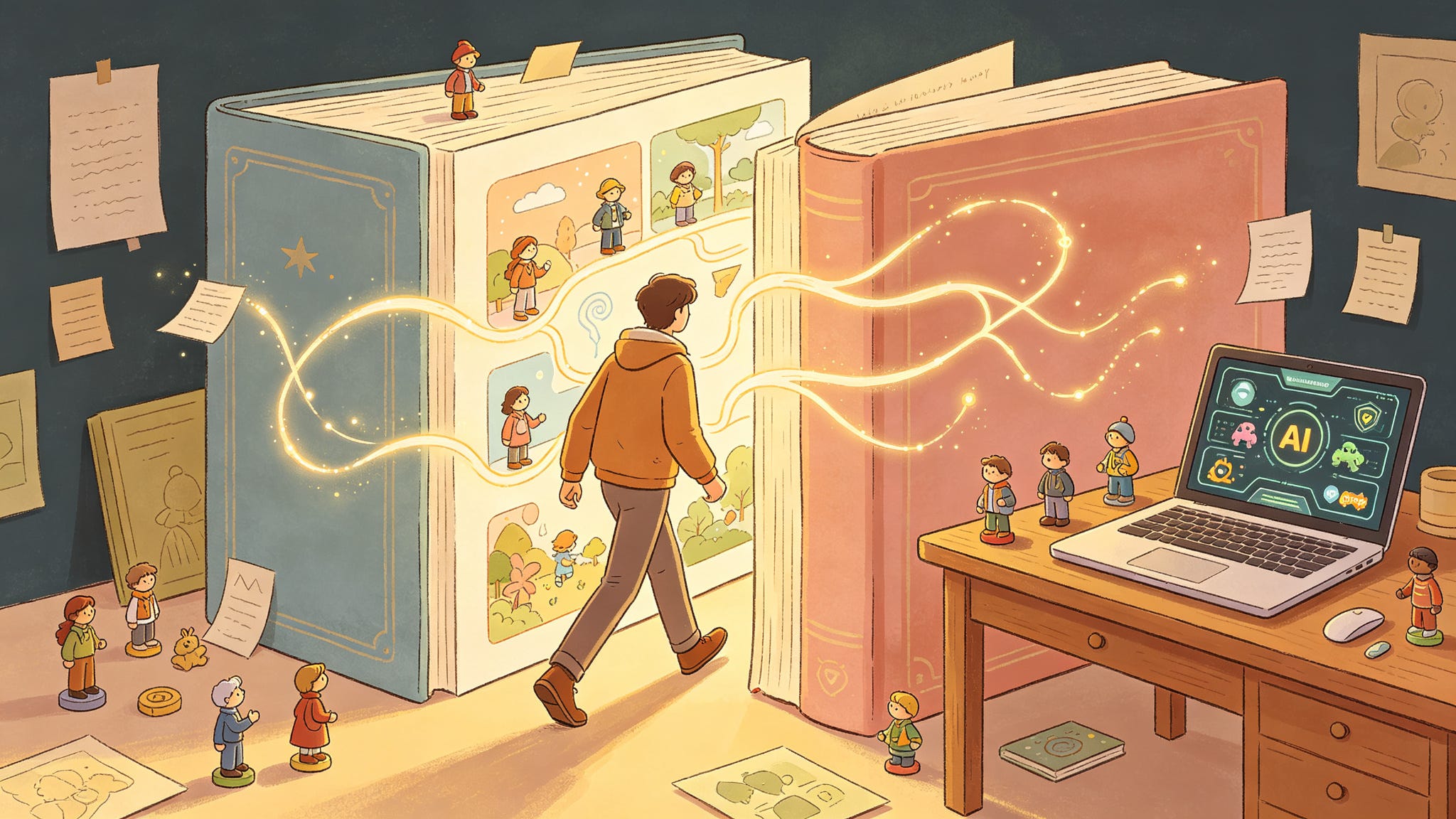
What people remember is never the tool — it’s the character.
In May 2026, Li Zhe made a decision that surprised many in the industry: he shifted roughly 85% of his company’s workforce toward AI games and interactive entertainment.
Why the surprise? His company, Elser.AI (Xinying Ciyuan), had always been perceived by the outside world as an AI anime generation tool company. The tools were doing well. Why suddenly bet almost all the chips on a direction that sounds heavier?
Li Zhe holds a Master’s degree in Computer Science from the University of Science and Technology Beijing. He is the co-founder of Elser.AI, having previously led the comic-drama tool business and content overseas expansion, and now heads interactive film-games.
When I asked him why the pivot, his answer contained no grand phrases like “trillion-dollar track” — only the most authentic anxiety of a tool company.
“Users might come because of a new model, and they might leave because another platform integrates the new model faster. They come and go in waves. Relying solely on generation capability makes it very difficult to build a long-term relationship with users.”
Li Zhe spent most of his earlier career on the comic-drama business, so he feels the ceiling of tools most directly. When making comic dramas, the team first got stuck on the word “stability.”
“AI can make a single image or a single shot faster and faster, but to stably complete an entire work is still quite difficult. Characters, scenes, props, voices — they all need to be consistent across dozens of shots.”
ElserStudio was born to solve this problem, connecting scattered production processes into a single pipeline. But after partially solving the production problem, a more heart-wrenching question surfaced: now that the work is made, why would users come back?
Tool people feel this pain most acutely. Your users have no loyalty to speak of — whichever company integrates the new model first, users flow there, like patients in a waiting room following whoever calls their number fastest.
Tool companies are essentially middlemen for models. When a model generation changes, users vote again, and your previous generation’s accumulation resets to zero.
“Comic drama solved how content gets made, but didn’t fully solve why users come back,” Li Zhe said.
Interactive film-games are closely related to comic dramas, but add three things: player choices, character relationships, and world state. Users don’t just finish consuming content — they leave their own experiences inside it.
“So for me, this isn’t suddenly switching to a new track, but continuing to solve the problem that wasn’t fully solved during the comic drama phase.”
I asked him to explain what they’re actually doing to ordinary users without using terms like “AI games” or “Agent.”
He thought for a moment and said: “Simply put, I want to make a product that lets people walk into stories.”
In the past, when watching videos, how the story develops is already fixed — you just follow along. In the product he’s making, you can meet characters, investigate clues, decide who to trust. What you’ve done will be remembered, and subsequent character relationships and stories will change accordingly.
Further on, you’re not just playing stories written by others. If you have an idea — even if it starts as just one sentence — you can first create the characters, world, and a few key choices, turning it into something playable.
Interactive film and television is not a new concept. Orange games, interactive movies, live-action interactive film-games — they’ve all had their moments of popularity, then faded. Why hasn’t it become a mainstream content format after all these years?
Li Zhe’s answer was straightforward: “The biggest problem is still that the math is very hard to make work.”
He walked me through the calculation. For ordinary film and television, shooting one extra shot has a relatively estimable cost. For interactive content, adding one choice may mean an extra storyline, an extra batch of assets, and every path still needs to be tested.
“Too few branches, and users feel it’s just a video with a few buttons added in the middle. Too many branches, and production costs become unbearable. Both sides are difficult.”
So after AI appeared, which line item in the calculation changed most? Production costs? Branch content capacity? Character asset reuse? Or real-time content generation?
“All of these calculations will change. If I had to pick just one, I think the most important is iteration cost.”
He gave me some numbers. When the team early researched AI short drama creation, they found that a two-to-three-minute piece of content often took three to five days, requiring switching back and forth between seven or eight tools. Note that this was just a single-line short drama.
Interactive film-games have even larger content volumes. If every branch had to be redone using traditional methods, the math definitely wouldn’t work. AI connects script breakdown, characters, storyboarding, video, and audio — and existing assets can be reused.
The change is: creators dare to try more paths now, and can fix things when they go wrong. In the past, making branched content was like having to repave an entire road for every fork you repaired. Now you can at least lay down a temporary path first and see how it runs.
“In the past, a work was finished once delivered. Now you can operate, test, and update while running — this change in the calculation is the biggest.”
As for real-time generation, which many people are enthusiastic about, his attitude was rather cool.
“I don’t think at this stage we need to generate all content in real time. First make a small world complete, then continuously add content based on player feedback — that might be more practical.”
Many so-called AI interactive content on the market today is essentially just a few pre-made branches, letting users choose A, B, or C. Is this AI-native?
When Li Zhe looks at this question, he first divides it into two categories.
AI-Enabled is about making original processes more efficient and lower-cost — for example, using AI to generate visuals, but the gameplay is still the original choose-one-of-three. This has value, but it hasn’t produced new game mechanics.
“What I understand as AI-Native is that because of AI, things players couldn’t do before, they can do now.”
For example, players can communicate with characters in their own words, and characters can understand. The world can remember what they’ve done, and subsequent relationships and local storylines will change accordingly — not all responses are pre-written.
It sounds beautiful, but how far is it from productization?
“Making a demo that makes people’s eyes light up is already possible now. The hard part is making it into a product that users can play for months without the characters falling apart — that’s quite difficult.”
Demos are fireworks; products are hearth fires. Anyone can set off fireworks, but a hearth fire has to burn for months without going out.
“I think the biggest bottleneck isn’t single-turn dialogue, but long-term state,” Li Zhe said.
For a character to remember the user, it’s not just a matter of stuffing all chat logs into the model. What’s worth remembering, when to recall it, whether that memory will conflict with the main storyline — all need judgment. Character relationships, quests, and other characters’ states also need to change together, and once the volume gets large it becomes very complex.
Then there’s controllability. Characters can say things that weren’t pre-written, but they can’t suddenly lose their memory, switch personalities, or reveal future plot points ahead of time.
So their approach is to separate character settings, world rules, player state, and output checks. “Deterministic systems manage facts and rules; probabilistic models are responsible for natural expression.”
When a model times out or gives an unqualified answer, there also needs to be a fallback plan — the game can’t just get stuck there.
He sees the freedom issue even more clearly. AI can generate anything — could that actually lead to no rules, no challenges, no gameplay?
“Yes, this risk is very obvious. Anything goes sounds like high freedom, but it might quickly stop being fun. Because without limits, there’s no cost.”
His solution: “Put freedom in expression and process; put rules in facts and outcomes.”
Players can investigate using different methods, can organize their own language to persuade characters, but what’s already happened can’t be arbitrarily changed. Quests need completion conditions, and characters won’t change their basic stance just because a player says something casual.
In his words — “AI is responsible for increasing possibilities; the system is responsible for not letting it run away.”
This also means the creator’s job changes. In the past, screenwriters wrote “what happens next.” In the future, they also need to design “what things might happen in this world.” Character goals, relationships, knowledge boundaries, what players can do, what changes after they do it — all need to be designed in advance.
“The skeleton is set by humans; AI grows more details inside it.”
So is more interaction always better? Not necessarily.
“If the product just requires them to choose once every minute, that interaction has little value.”
The right moment is when the user has already formed their own judgment — when they start to suspect a character, want to follow a clue, or when both choices have costs. When a character has just appeared and emotions are building, let the user watch quietly.
“Not every interaction needs to change the ending, but important interactions must let players see the consequences.”
After AI drove down the cost of individual shots, a common imagination was: making content is about to become dirt cheap.
“Materials getting cheaper doesn’t mean good content gets cheaper,” Li Zhe said. This is his most direct feeling after working on comic-drama tools and interactive film-games.
He gave an example. When making video tools, the team internally broke content and visual quality into 205 evaluation line items. AI can give many results at once, but which ones are usable, what’s wrong, why something needs to be redone — still requires human judgment.
Interactive film-games add another layer: “Does the character sound like themselves? Can clues form a closed loop? Do choices have actual impact? Do different paths conflict with each other?”
Cost didn’t disappear — it just moved house. From the studio to worldbuilding, story design, system testing, and user operations.
“So what’s really expensive now, I think, is the ability to put content design and system testing together.”
A great worldview that can’t be played — no good. Stable programming but nobody likes the characters — also no good. People who can simultaneously understand stories, rules, and user feedback will become increasingly valuable.
Team structures are also changing. The early prototype of Elseland was completed by the CEO working with 17 Agents in 49 days. When ElserStudio restarted, five people took about two months to make the first version. These practices changed his judgment about teams: in the past, many positions had to queue and hand off; now screenwriters can directly do storyboarding and prototyping, and planners can also participate in implementation.
But he doesn’t buy into the “one-person company” narrative.
“’One-person companies’ can make very strong prototypes, but that doesn’t mean one person can do everything for a commercial product.”
A more realistic form is small teams of two to three, five to six people — each with one particularly strong long board, while using Agents to also handle several adjacent things.
Elser.AI now has both creation tools and is working on consumption and community. If everyone can create content, is the hardest problem for platforms “nobody produces,” or “produced content nobody watches”?
“I think in the long run, the harder one is produced content nobody watches,” Li Zhe said.
After AI appears, content volume is definitely not the problem — it will even quickly become excessive. But users’ time hasn’t changed. Why should they watch your stuff?
This is also why he values retention so heavily. Model gaps will get smaller and smaller going forward — users can generate content with anyone. What really needs to be considered is: do users have their own projects, characters, and assets here? Do they have audiences? Do they have orders? Can their works generate value?
“Especially when the next underlying model undergoes a major change, users still willing to come back and continue the same project, the same character — that retention is the most representative.”
On the business model side, he broke DramaFork into three calculations: creation side, consumption side, platform side — calculated separately.
The creation side can charge by generation quota, professional capabilities, or subscription, “but I don’t want it to end up just selling model calls.”
What he cares more about is whether anyone plays the work after it’s made, and whether creators can get revenue sharing, orders, and co-production opportunities.
“Help creators solve the problem of making money, and they’ll naturally be willing to keep creating here.”
The consumption side can early charge by work, chapter, or IP interactive project. Once users have built up accumulation in character relationships and world state, subscriptions, items, and character entitlements become viable.
What about advertising? “Advertising can be a supplement, but it’s not suitable to become the core too early, because interactive experiences fear being interrupted most.”
Going in a circle, it finally comes back to those two questions: “Can creators make money, and are users willing to come back.”
Toward the end of the conversation, the topic landed on IP. Li Zhe’s judgment runs counter to the mainstream narrative.
“The more AI can generate, the more important IP becomes. Because ordinary content gets more and more plentiful, what users ultimately remember is still characters, relationships, and worlds.”
The logic is actually not complex. Generation capability is like tap water — every home can connect to it. The cheaper the water, the less valuable the well. But the potted flower the user has been raising for three years at home is valuable.
Models can be changed, tools can be changed. “But how a character speaks, what they’ve experienced with the user, who around that world is continuously creating — these things won’t disappear just because a model updates.”
So characters, scenes, props, and styles shouldn’t be redone from scratch for every work — they should continuously accumulate. A world can first be made into comics and comic dramas, then grow into interactive film-games and character companionship. AI has shortened these paths, but what’s really valuable is still the world itself.
So will the boundary between film and games disappear? If AI can generate visuals and plot in real time, is there still a difference between the two?
“It will get harder and harder to distinguish, but I think the boundary remains. This boundary isn’t about whether the visuals are AI-generated, but about how much control the user actually has.”
When watching a movie, users are willing to follow the director — rhythm, shots, emotions are all arranged by the author. When playing a game, users have to do things — their judgments need to change state, and they need to bear the consequences.
In the future, the same IP might have two entry points simultaneously: you can watch the director’s edited version, or you can enter at key points and make your own choices.
“More author control means it’s more like a film; more things players can change means it’s more like a game.”
Near the end of the interview, I asked him: if Elser.AI really succeeds three years from now, how does he hope the outside world understands it? A tool company, a game platform, or something else?
He chose “something else,” but the landing point was very small.
“I hope that when people mention Li Zhe in the future, they won’t think ‘another person making AI tools,’ but that we really made interactive film-games work, and also helped a batch of small teams and young creators make their own worlds.”
“Three years from now, if users still remember what characters they met here, what stories they experienced — I think that would be pretty close to what we want to do.”
Models will continue to change generation after generation. Generation will continue to get cheaper time after time. AI concepts trending on hot searches will continue to update crop after crop.
But humans are stubborn creatures: what they remember is never the tool — it’s the character.
Guest: Li Zhe, Co-founder of Elser.AI (Xinying Ciyuan)
Background: Master’s in Computer Science, University of Science and Technology Beijing; previously led comic-drama tools and content overseas business; now heads interactive film-games
Q1: Elser.AI’s earliest impression to the outside world was as an AI anime generation Agent. Now your products have clearly started extending toward interactive stories and AI games. Why did this change happen?
Li Zhe: I was involved more in the comic-drama business earlier, so I feel this change relatively directly. When making comic dramas, we first encountered a problem: AI can make a single image, a single shot faster and faster, but to stably complete an entire work is still quite difficult. Characters, scenes, props, voices — they all need to be consistent across dozens of shots.
ElserStudio was solving this problem, connecting originally scattered production processes. After partially solving content production, I started thinking about another question: now that the work is made, why would users come back?
When we made tools, we saw it clearly: users might come because of a new model, and they might leave because another platform integrates the new model faster — they come and go in waves. Relying solely on generation capability makes it very difficult to build a long-term relationship with users.
Interactive film-games connect closely with comic dramas, but they add player choices, character relationships, and world state. Users don’t just finish consuming content — they leave their own experiences inside it. So for me, this isn’t suddenly switching to a new track, but continuing to solve the problem that wasn’t fully solved during the comic drama phase.
Q2: When did this business truly start being treated by the team as an independent direction? Was it because you saw technological changes, or had you already seen some kind of demand from user behavior?
Li Zhe: I truly started treating interactive film-games as an independent business in May 2026. At that time, I used our tools to replicate many classic game CG clips and live-action interactive film-drama plot clips. I judged that AI games would be the next hot track, and then started advancing this content. The company shifted roughly 85% of its workforce to AI games and interactive entertainment.
Technological change was certainly one reason. Multimodal models, Coding Agents, and long context developed very quickly — for the first time, small teams could put scripts, characters, visuals, programming, and interaction together. The early prototype of Elseland was completed by our CEO working with 17 Agents in 49 days, which also let me intuitively see that some mechanisms that were impossible or very costly in the past can at least start running now.
But what really influenced my judgment was user behavior. Comic drama solved how content gets made, but didn’t fully solve why users come back. Interactive film-games can let users continue a character, a relationship, and a world. Technology makes this possible; user demand makes it worth doing — both are there.
Q3: Without using terms like “AI games,” “interactive film-games,” or “Agent,” how would you explain to an ordinary user what you’re actually trying to make now?
Li Zhe: Simply put, I want to make a product that lets people walk into stories. In the past, when watching videos, how the story develops is already fixed — you just follow along. In the product we’re making, you can meet characters, investigate clues, decide who to trust. What you’ve done will be remembered, and subsequent character relationships and stories will change accordingly.
Further on, you’re not just playing stories written by others. If you have an idea — even if it starts as just one sentence — you can first create the characters, world, and a few key choices, turning it into something playable. This is what I find interesting about AI entertainment.
Q4: From your perspective, are AI video, AI anime, and AI games actually three different tracks, or will they eventually converge into the same new content format?
Li Zhe: My judgment is that in the short term, they’re still three tracks. Video first needs to look good; anime has higher requirements for character and style consistency; games add another layer of rules, feedback, and playability. Production processes differ, and the reasons users pay also differ.
But going forward, the assets underneath them will get closer and closer. The same character, the same world — can first be made into comics and comic dramas, and can also continue into interactive stories and games. Video solves expression; games solve action and feedback; AI brings down the production cost in between.
So I think in the end, they don’t necessarily need to be distinguished so clearly. Users can watch a segment when they want to watch, enter and make choices when they want to participate, and can even continue modifying this world when they want to create. Content will connect up, but each experience still has its own value.
Q5: Interactive film and television isn’t a new concept. Orange games, interactive movies, live-action interactive film-games have all existed in the past. Why hasn’t it truly become a mainstream content format after all these years?
Li Zhe: First, the big premise: interactive content isn’t something nobody did in the past, nor something nobody liked. The biggest problem is still that the math is very hard to make work.
For ordinary film and television, shooting one extra shot has a relatively estimable cost. For interactive content, adding one choice may mean an extra storyline, an extra batch of assets, and every path still needs to be tested. Too few branches, and users feel it’s just a video with a few buttons added in the middle. Too many branches, and production costs become unbearable. Both sides are difficult.
There’s also the problem that interaction often interrupts viewing. Users have just entered an emotional state, and immediately you make them choose once — after choosing, they can’t see any change, and this experience doesn’t work. So the reason interactive content was hard to scale in the past wasn’t that the concept was problematic, but that cost, content capacity, and interaction effects never all worked at the same time.
Q6: After AI appeared, which line item in the calculation of interactive content changed most critically? Production costs, branch content capacity, character asset reuse, or content that can be generated in real time based on players?
Li Zhe: All of these calculations will change. If I had to pick just one, I think the most important is iteration cost.
When we early researched AI short drama creation, a two-to-three-minute piece of content often took three to five days, requiring switching back and forth between seven or eight tools. Note that this was just a single-line short drama. Interactive film-games have even larger content volumes. If every branch had to be redone using traditional methods, it definitely wouldn’t work.
AI connects script breakdown, characters, storyboarding, video, and audio — and existing assets can be reused. Only then do creators dare to try more paths, and can fix things when they go wrong. Our interactive film-game platform DramaFork currently also hopes to continuously reduce iteration costs — creators only need to have brilliant ideas, and DramaFork can help them land interactive film-games.
Real-time generation is certainly important, but I don’t think at this stage we need to generate all content in real time. First make a small world complete, then continuously add content based on player feedback — that might be more practical. In the past, a work was finished once delivered. Now you can operate, test, and update while running — this change in the calculation is the biggest.
Q7: If in the future AI can dynamically generate plot, are creators ultimately “writing stories,” or “designing a world that can continuously grow stories”?
Li Zhe: I think both need to be done, but creators will increasingly look like they’re designing a world.
Stills still need to be written. Why a character does something, what the main conflict is, what the work ultimately wants to express — these can’t all be handed to the model. AI can temporarily generate a piece of dialogue, but it doesn’t know what this work is actually trying to say.
At the same time, creators also need to design character goals, relationships, knowledge boundaries, what players can do, what changes after they do it. Simply put, in the past the main thing was writing “what happens next”; in the future, you also need to design “what things might happen in this world.” The skeleton is set by humans; AI grows more details inside it.
Q8: Is more interaction always better? How do you judge when users should participate, and when they should be allowed to watch quietly?
Li Zhe: Interaction isn’t always better. When making products, we’ve also been thinking: why should users click at this point? If the product just requires them to choose once every minute, that interaction has little value.
I think the right moment is when the user has already formed their own judgment. For example, they start to suspect a character, want to follow a clue, or when both choices have costs. At that point, letting them participate makes them feel the choice is related to themselves.
When a character has just appeared and emotions are building, let the user watch quietly. In “Huntian Bi’an,” we place viewing, investigation, voice, puzzle-solving, and key choices at different positions. Not every interaction needs to change the ending, but important interactions must let players see the consequences.
Q9: Many so-called AI interactive content today is essentially just a few pre-made branches, letting users choose A, B, or C. What kind of product do you think counts as truly AI-native interactive film-games?
Li Zhe: When I look at this question, I first distinguish between AI-Enabled and AI-Native.
AI-Enabled is about making original processes more efficient and lower-cost — for example, using AI to generate visuals, but the gameplay is still the original choose-one-of-three. This certainly has value, but it hasn’t produced new game mechanics.
What I understand as AI-Native is that because of AI, things players couldn’t do before, they can do now. For example, players can communicate with characters in their own words, and characters can understand. The world can remember what they’ve done, and subsequent relationships and local storylines will change accordingly — not all responses are pre-written.
But this doesn’t mean handing everything to the model. Main storyline facts, character motivations, and world rules must be stable. Simply put, AI is responsible for increasing possibilities; the system is responsible for not letting it run away. Being able to combine these two things — that’s what I think is truly AI-native interaction.
Q10: If a character can long-term remember users, change relationships based on user behavior, and even generate plot that didn’t exist in the original script, how far is this experience from true productization? What’s currently the biggest technical bottleneck?
Li Zhe: Making a demo that makes people’s eyes light up is already possible now. The hard part is making it into a product that users can play for months without the characters falling apart — that’s quite difficult.
I think the biggest bottleneck isn’t single-turn dialogue, but long-term state. For a character to remember the user, it’s not just a matter of stuffing all chat logs in. What’s worth remembering, when to recall it, whether that memory will conflict with the main storyline — all need judgment. Character relationships, quests, and other characters’ states also need to change together, and once the volume gets large it becomes very complex.
Then there’s controllable generation. Characters can say things that weren’t pre-written, but they can’t suddenly lose their memory, switch personalities, or reveal future plot points ahead of time. So we separate character settings, world rules, player state, and output checks. The model is responsible for understanding and expression; things that truly change world state still need to be confirmed by the system.
Q11: If AI can generate anything, could that actually lead to no rules, no challenges, no gameplay? How should generation freedom and game rules be balanced?
Li Zhe: Yes, this risk is very obvious. Anything goes sounds like high freedom, but it might quickly stop being fun. Because without limits, there’s no cost.
My consideration is to put freedom in expression and process, and rules in facts and outcomes. Players can investigate using different methods, can organize their own language to persuade characters, and might also generate some side branches that weren’t originally written. But what’s already happened can’t be arbitrarily changed. Quests need completion conditions, and characters won’t change their most basic stance just because a player says something casual.
So AI isn’t taking rules away. On the contrary, rules need to be clearer — it’s just that players have more ways of doing things within the rules.
Q12: AI generation has strong randomness, but games require stability. How do you turn a probabilistic model into a system that’s truly playable?
Li Zhe: First, a basic idea: you can’t let a single model answer decide everything. That would definitely be unstable.
In a game, world settings, quests, clues, items, character relationships, and player progress all need to be stored separately. Each time you call the model, you only give it the information it truly needs at that moment. After the model answers, the system still needs to judge again: does it conflict with previous facts? Did it spoil anything ahead of time? Can it trigger the next step?
Key states can’t be directly changed by a single natural language sentence. Also, there must be a fallback plan. If the model times out or gives an unqualified answer, the game can’t just get stuck there — it still needs to be able to proceed.
In other words, deterministic systems manage facts and rules; probabilistic models are responsible for natural expression. Freedom will be a bit less, but the product first needs to be playable, testable, and able to run stably.
Q13: Compared to making an ordinary AI anime, what new steps does the production process add when making a truly playable interactive work?
Li Zhe: Simply put, ordinary AI anime mainly manages one timeline; interactive film-games also need to manage many states.
When making anime, you have script, characters, storyboarding, video, audio, editing — and finally play it out in order. When making interactive works, screenwriters also need to consider where to place choice points, and how quests, clues, items, and character relationships change after a player does something. Then every path needs to be tested — will getting stuck happen if you go in different orders? What if the player inputs something unexpected?
So it’s not about adding a few buttons after the finished film is done. Interaction must enter the production process from the very beginning — screenwriters, planners, and programmers need to consider together from the start what players can do and how the system responds.
Q14: After AI quickly drove down the production cost of individual shots and assets, what’s the truly most expensive part now?
Li Zhe: It will shift, and it definitely will shift. Materials getting cheaper doesn’t mean good content gets cheaper. This is a very direct feeling I’ve had after participating in comic-drama tools and interactive film-games.
When we made video tools, we internally once broke content and visual quality into 205 evaluation line items. AI can give many results at once, but which ones are usable, what’s wrong, why something needs to be redone — still requires human judgment.
Interactive film-games add another layer: Does the character sound like themselves? Can clues form a closed loop? Do choices have actual impact? Do different paths conflict with each other?
So what’s really expensive now, I think, is the ability to put content design and system testing together. A great worldview that can’t be played — no good. Stable programming but nobody likes the characters — also no good. People who can simultaneously understand stories, rules, and user feedback will become increasingly valuable.
Q15: How many people will AI film-game teams become in the future? Which positions will clearly merge, and which abilities will instead become more valuable?
Li Zhe: I think teams will definitely get smaller, but won’t end up with just one person. “One-person companies” can make very strong prototypes, but that doesn’t mean one person can do everything for a commercial product.
We have two relatively intuitive examples ourselves. The early prototype of Elseland was completed by one lead creator working with 17 Agents in 49 days. When ElserStudio restarted, five people took about two months to complete the first version.
These practices changed my judgment about teams: in the past, many positions had to queue and hand off; now screenwriters can directly do storyboarding and prototyping, and planners can also participate in implementation — position boundaries will merge a lot.
But going forward, aesthetic judgment, worldview and character design, interaction systems, testing, and operations will become more important. A more realistic form might be small teams of two to three, five to six people. Each has one particularly strong long board, while using Agents to also handle several adjacent things.
Q16: Is the hardest problem for platforms “nobody produces,” or “produced content nobody watches”?
Li Zhe: I think in the long run, the harder one is produced content nobody watches. After AI appears, content volume is definitely not the biggest problem — it will even quickly become excessive. But users’ time hasn’t changed. Why should they watch your stuff? This is harder.
I value retention relatively heavily because when we made tools, we saw with our own eyes users coming because of a new model and leaving because another platform integrated the new model faster — they come and go in waves. Model gaps will get smaller and smaller going forward; that’s not the fundamental problem.
What really needs to be considered is: do users have their own projects, characters, and assets here? Do they have audiences? Do they have orders? Can their works generate value? Tools make content, the consumption side gives real feedback, and the community then lets creators form relationships with each other — these things need to connect up.
Especially when the next underlying model undergoes a major change, users still willing to come back and continue the same project, the same character — that retention is the most representative.
Q17: What’s your view on the value of IP in the AI era?
Li Zhe: I’ve always had a judgment: the more AI can generate, the more important IP becomes. Because ordinary content gets more and more plentiful, what users ultimately remember is still characters, relationships, and worlds.
For content products, I’ve previously talked about several long-term moats: content copyright assets, user data, ecosystem community relationships. Models can be changed, tools can be changed. But how a character speaks, what they’ve experienced with the user, who around that world is continuously creating — these things won’t disappear just because a model updates.
Characters, scenes, props, and styles shouldn’t be redone from scratch for every work — they should continuously accumulate. A world can first be made into comics and comic dramas, then develop into interactive film-games and character companionship. AI has shortened these paths, but what’s really valuable is still the world itself.
Q18: What business model is most suitable for interactive content in the future?
Li Zhe: First, the big premise: I don’t think there will be just one business model. For DramaFork, the creation side, consumption side, and platform side — three calculations need to be separated.
Taking the interactive film-game platform DramaFork I’m currently responsible for as an example, what it first needs to solve is letting people without game development experience also start from an idea and make interactive film-games that can continue to be edited and truly experienced.
The creation side can charge by generation quota, professional capabilities, or subscription, but I don’t want it to end up just selling model calls. What I care more about is whether anyone plays the work after it’s made, and whether creators can get revenue sharing, orders, and co-production opportunities. Help creators solve the problem of making money, and they’ll naturally be willing to keep creating here.
The consumption side can early charge by work, chapter, or IP interactive project. Further on, once users have built up accumulation in character relationships and world state, subscriptions, items, and character entitlements become viable.
Advertising can be a supplement, but it’s not suitable to become the core too early, because interactive experiences fear being interrupted most.
So in the long run, I’m more optimistic about continuously operating around a world, then connecting up subscriptions, content payment, and creator revenue sharing. Specific charging methods will change, but two questions won’t change: Can creators make money, and are users willing to come back.
Q19: If AI can ultimately generate visuals, plot, character reactions, and world changes in real time, will the so-called “film” and “game” of the future become harder and harder to distinguish? Where is the final boundary between the two?
Li Zhe: It will get harder and harder to distinguish, but I think the boundary remains. This boundary isn’t about whether the visuals are AI-generated, but about how much control the user actually has.
When watching a movie, users are willing to follow the director — rhythm, shots, emotions are all arranged by the author. When playing a game, users have to do things — their judgments need to change state, and they need to bear the consequences.
In the future, the same IP might have two entry points simultaneously: you can watch the director’s edited version, or you can enter at key points and make your own choices. So it’s not that films will all become games in the end, nor that games will all become real-time films. More author control means it’s more like a film; more things players can change means it’s more like a game. Specifically how far to go still depends on what the content is suitable for.
Q20: If Elser.AI truly succeeds three years from now, do you hope the outside world understands it as an AI anime production tool, an AI game platform, or a new type of entertainment infrastructure that lets everyone create and enter their own fantasy worlds?
Li Zhe: I would choose the third one. But the term “entertainment infrastructure” is rather large — it still needs to land on the products we’re making now.
ElserStudio solves how professional creators can stably produce novels, characters, shots, and generation processes. Works like “Huntian Bi’an” verify how users enter stories and make choices. DramaFork goes one step further, letting people without game development experience also start from an idea and make their own interactive stories.
For me personally, I hope that when people mention Li Zhe in the future, they won’t think “another person making AI tools.” But that we really made interactive film-games work, and also helped a batch of small teams and young creators make their own worlds.
Three years from now, if users still remember what characters they met here, what stories they experienced — I think that would be pretty close to what we want to do.