
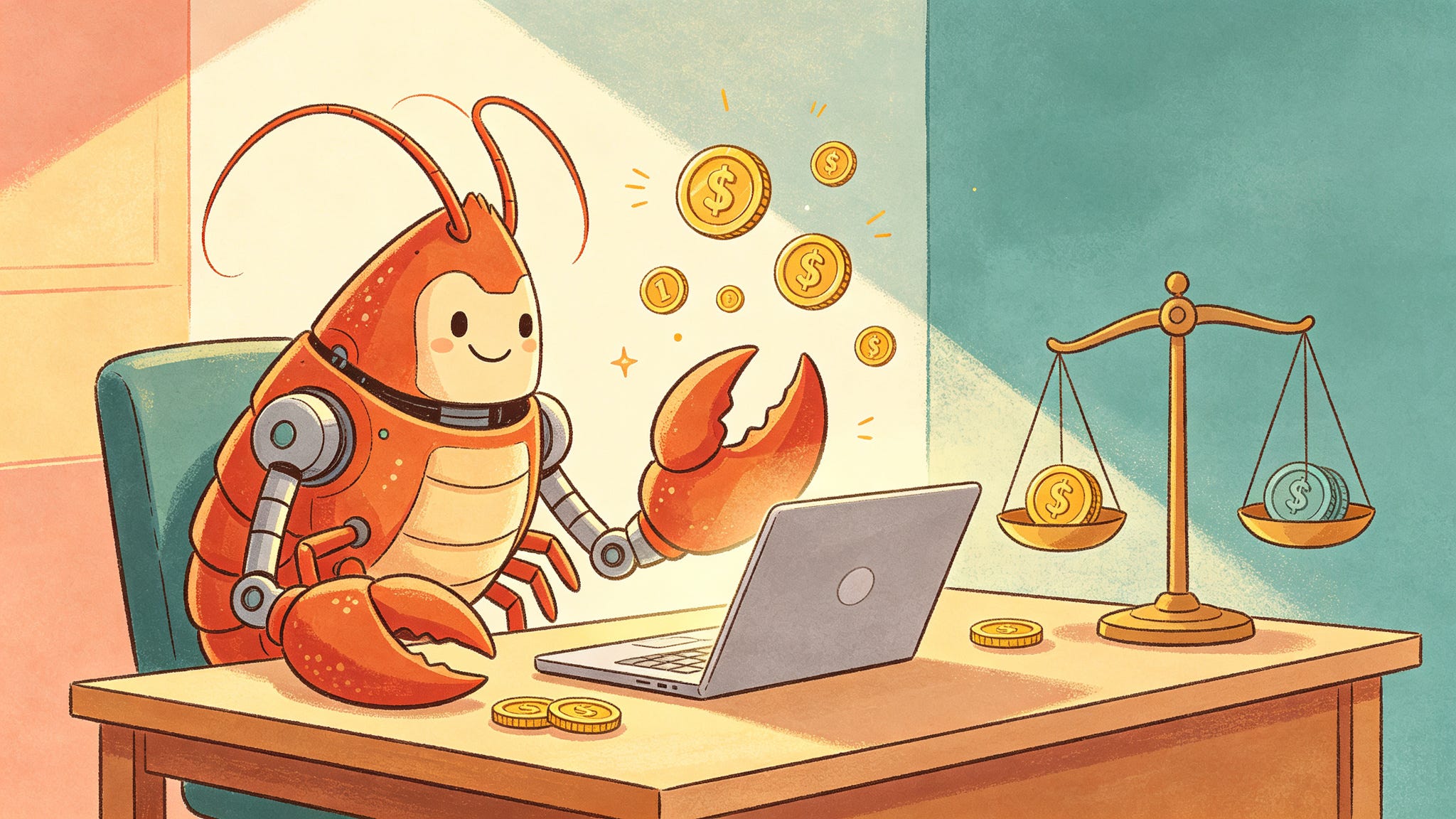
Editor's note: "Lobster" is the source's nickname for an OpenClaw agent. The prices, consumption figures, earnings and model assessments below are the author's and quoted speaker's historical statements, not independently verified benchmark
s or current price quotations. The source uses the colloquial Chinese unit "kuai," rendered here as "yuan," without explicitly identifying the currency; amounts marked with $ retain the source's notation.
Original · Unique Research · 2026-02-23
When Chen Caimao said his lobster was already capable of making money autonomously, I quietly glanced at my bill: "Today's usage: $47."
This happened last month. I deployed my first OpenClaw on a Mac mini, configuring it step by step by following online tutorials. Recently, I spent 3,000 yuan on a secondhand MacBook Air M2 and started raising a second lobster.
Two lobsters, with different divisions of labor. But the problem is that both of them are burning money, yet neither has begun making money for me.
At first, I used Claude 3.5 Sonnet, thinking, "I'll test the waters first and upgrade the model once this works." After several days, however, my lobster had not managed to complete even one full web-crawling task—not because the model was not smart enough, but because I still did not know how to ask questions.
Chen Caimao's exact words were: "If you think the lobster is hard to use, either you haven't bought a MacBook Air, you aren't using the best model, or you're just bad at it."
At the time, all three applied to me.
Here is how I divide the work now:
The lobster on the Mac mini: runs scheduled tasks, stays online 24/7, and is left undisturbed
The lobster on the MacBook Air: goes everywhere with me, handles ad hoc tasks, and tests responses at any time
Chen Caimao said, "Not every place is home," and now I understand. The Mac mini is "home"—stable but fixed in place. The MacBook Air is a "portable apartment" that comes with me wherever I go.
But even after putting all the hardware in place, the problem was still not solved.
I use Claude 3.5 Sonnet because Opus is too expensive—$15 per million input tokens and $75 per million output tokens.
The problem with Sonnet, however, is its "good enough" attitude. Ask it to write a crawler, and it will run, but there will be no exception handling, no logging, and no anti-scraping strategy. I have to tell it over and over: "Add a try-catch here" and "Add a sleep there."
A task that could have been finished in 10 minutes gets dragged back and forth for an hour. The tokens are burned, and no time is saved.
Chen Caimao's exact words were: "There is no substitute for Claude Opus 4.6. A good product has only one drawback: it is expensive—very expensive."
He burns 100 million Opus 4.6 tokens every day, plus more than a billion tokens from lower-tier models working alongside it. At his usage level, that amounts to several hundred dollars a day.
But he added: "You can obtain provisions from some 'other' places."
I am beginning to understand what that means. The hardware investment has already been made; if the model does not keep up, the money spent on the hardware is being wasted. The 3,000 yuan for the MacBook Air is a one-time investment, but the daily $47 in token usage is an ongoing cost—and if the output cannot justify the input, it is a pure loss.
Chen Caimao introduced a concept: everyone who uses OpenClaw is a ruthless capitalist.
What does that mean? You have hired an intern who is online 24 hours a day and always on call, but you have to pay by the token. Every line of code it writes, every information search it performs, and every passage it generates burns your money.
If the work you assign it is worth 10 yuan but you burn 20 yuan in tokens, then you are simply a complete sucker.
Conversely, if the work you assign it is worth 1,000 yuan but you burn only 50 yuan in tokens, then you are a successful capitalist—you have extracted surplus value.
I now have two lobsters running, burning a combined $50–60 every day. The problem is that their output has not yet caught up.
Chen Caimao's answer is: Agent Skills is ALL YOU NEED.
A three-step approach:
Do not let go and leave it unattended from the outset. For the first task, stay beside it and watch every operation at every step. The process is extremely painful, but this is a necessary break-in period. You are teaching it "what is right," while it is learning "what you want."
Once you have successfully run the perfect process for the first time, break it down into reusable components. Standardize every stage: how data is acquired, processed, and output. Write it as Agent Skills so it can be invoked directly next time.
Once the Skills have been crystallized, routine tasks simply run automatically. Each day, you only need to send one instruction. The lobster automatically invokes the Skill chain, and the result arrives in your email a few minutes later.
I am now moving from step one toward step two. The lobster on the Mac mini has crystallized some Skills for scheduled tasks. The lobster on the MacBook Air is still in the break-in period—it follows me everywhere and handles all kinds of ad hoc needs, but it has not yet formed a reusable playbook.
Chen Caimao made a point that I have contemplated repeatedly: a large model is more like an "animal" than a "machine."
As a probabilistic model, a large model is inherently random when executing tasks and cannot perform well every time. Run the same task today and tomorrow, and the results may differ. Sometimes it writes better; sometimes worse.
At first, I could not accept this premise. I thought AI should be stable and predictable, like a program where input A always produces output B.
But the reality is that it makes mistakes, behaves randomly, and "has ideas of its own."
Chen Caimao's analogy was vivid: humans cannot do everything well every single time either, can they?
It took me a long time to learn to accept this "uncertainty." My current approach is to have the lobster run the same task three times, then select the best result. Alternatively, I break the task down finely enough that every step can be verified quickly.
Think about it another way: if the lobster were an intern, you would not fire it because it failed to do something well once. You would teach it patiently, correct its mistakes, and give it time to grow.
The lobster is the same.
Of Chen Caimao's three iron rules, the last is the most painful: or you're just bad at it.
What does being "bad at it" mean?
It does not mean you cannot write code or configure an environment. It means you do not know how to ask questions, break down tasks, crystallize experience, or judge whether the output is good.
My state during the first two weeks was a textbook example of being "bad at it": I threw a task at the lobster, it gave me a result, I sighed at that result, and then I spent another 20 minutes explaining what was wrong. After an hour of going back and forth, the tokens were burned, yet no time was saved.
Now that both Macs are in place, the real threshold is only beginning to emerge. Hardware problems can be solved by spending money, and model problems can also be solved by spending money. But "ability" is something money cannot buy.
At the end of his sharing session, Chen Caimao mentioned Paul Graham's "Taste for Makers".
He said: management is extremely demanding. If you cannot ask the right questions and identify the one thing for which "doing one thing is more important than doing one hundred other things," then you are a failed manager. You need a basic ability to judge whether an output is good.
That is OpenClaw's real threshold. It is not technology or configuration; it is taste.
I now burn $50–60 in tokens every day, and the investment in both Macs has already been made. The lobsters have not yet started making money for me, but I have begun to see a glimmer of hope—some repetitive tasks are being crystallized into Skills, and some automated processes are beginning to run.
I am filling in Chen Caimao's three iron rules one by one:
MacBook Air purchased
Considering an upgrade to Opus 4.6
Ability? Still working on it
I took many notes during that sharing session, but these three sentences left the deepest impression: