
Original · Unique Research · 2026-07-15
Editor's note: The interview and its judgments belong to the original Chinese author and the interviewee, Sun Linjun (孙林君), Chairman and CEO of Zhishi Intelligence (实在智能). This English rendition translates the full article in source order, including the opening case study, six analysis sections, and all fifteen Q&A items. All company and person names are preserved as source attributions. Industry figures and client examples are speaker claims, not independently verified findings.
AI Industry Observation
From 20,000 Technical Documents to Organizational Reinvention: How Zhishi Agent Took on Manufacturing's Hard Nut
"What truly changes an enterprise through AI is not adding one more tool, but helping the enterprise absorb AI and complete deep organizational reinvention."
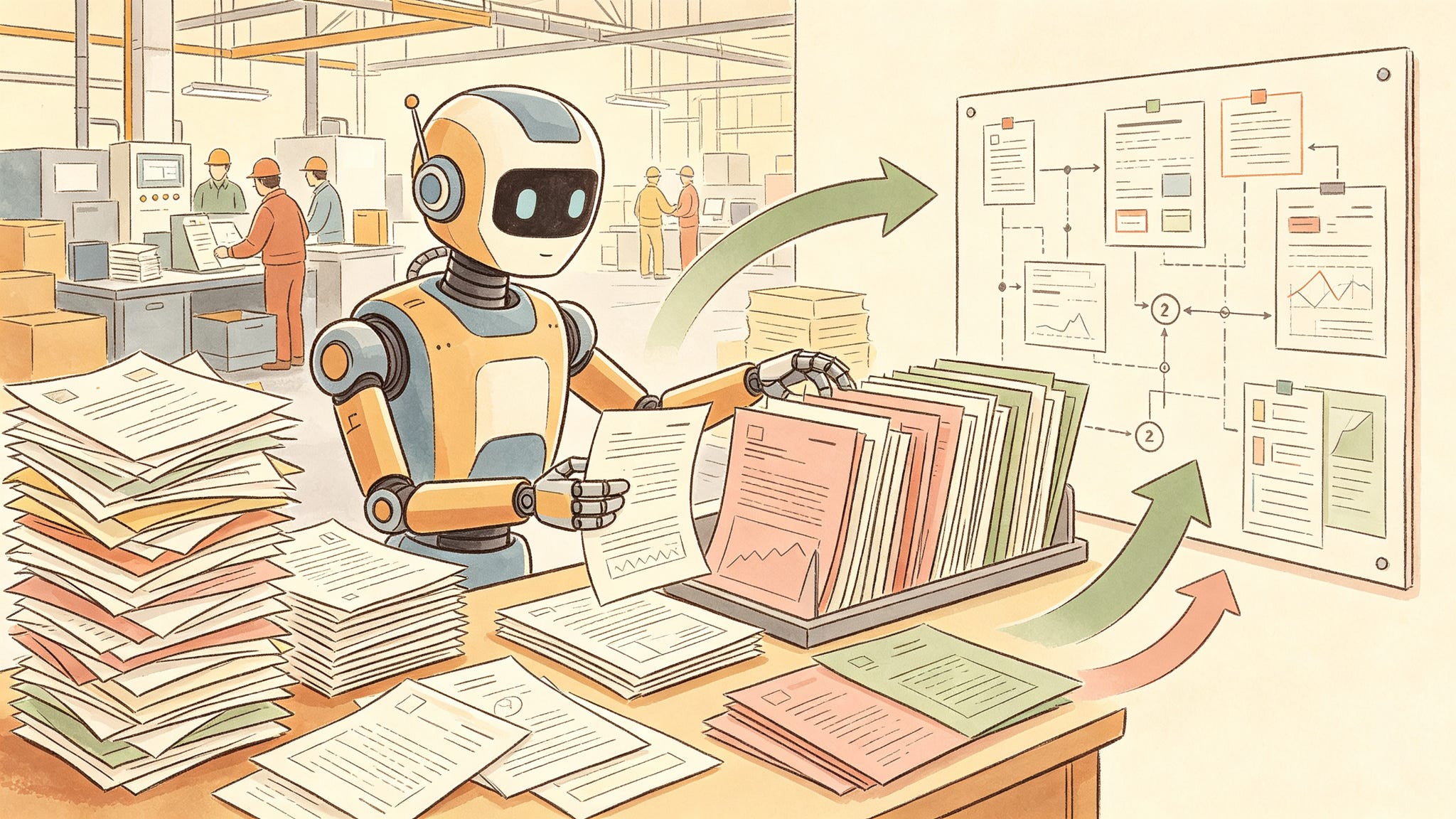
A large manufacturing enterprise's first step was a seemingly insignificant thing: breaking down and structuring over 20,000 historical technical documents from one department, so engineers could pull up design materials for a product from ten years ago in seconds. Two years later, the same logic had spread to over a dozen core departments, running everything from HR attendance to expense reimbursement, with cross-department adoption rates exceeding 70%.
The product that ran this playbook step by step is Zhishi Agent (实在Agent) from Zhishi Intelligence (实在智能). The person driving this is Sun Linjun (孙林君), Chairman and CEO of Zhishi Intelligence. We spoke with him — from AI+RPA to general agents, from digital employees to enterprise organizational reinvention, and also delved deeper into the ins and outs of this manufacturing case.
I. Where Is the Inflection Point: From "Hands and Feet" to "Brain"
If you didn't use an official introduction, how would you explain what Zhishi Agent does to an enterprise client? Sun Linjun's answer: "We make digital employees — upgrading from the 'blue-collar' digital employee to the 'white-collar' digital employee. Just like a person needs not only a brain but also hands and feet. Our previous digital employees were more 'hands and feet,' executing repeatedly by rule; now it has a 'brain' that can understand tasks, plan autonomously, and complete more complex work."
This thread runs through Sun Linjun's nearly 20-year career path — from intelligent decision-making, intelligent customer service, and operations scheduling at Alibaba, to today's Zhishi Agent. He summarizes this main line as "the continuous maturation of big data and AI," and what he has been doing is letting AI go from "can understand" to "can do."
In this wave of large models and agents, the biggest change is that robots have gotten smarter. "In the past, RPA was 'you teach it how to do it, then it can do it'; now an Agent is 'you tell it what to do, it figures out how to do it itself.'" Payment models have also changed, from software licensing to "seats + Tokens" — like hiring an employee, paying by role and capability.
"AI that only answers questions is a tool; AI that can operate systems, complete processes, and deliver results is an employee."
II. Zhishi Agent Must Be Able to Touch Enterprises' Old and Legacy Systems
Sun Linjun's definition of a digital employee is concise: "Chatbots only talk, traditional RPA only does, digital employees can both talk and do, and also think."
The difficulty lies in enterprises' existing systems. He uses manufacturing as an example — a 175-trillion GDP scale, many enterprises built up bit by bit over decades, with massive IT system investments but outdated architectures, incomplete interfaces, and piles of data silos. Tearing down and rebuilding is unaffordable in cost and risk. So Zhishi Agent must work directly on these old systems, without modification or rebuilding — this is also why the product insists on "cross-system collaboration without relying on APIs": enterprises don't pay for interface development, and data and business processes still run through.
To truly withstand production environments, Sun Linjun lists a series of hard metrics: task understanding (understanding instructions), multimodal capability (reading screens and documents), stable system operation ability (actually doing work), exception handling (knowing what to do when problems arise), self-healing ability (can repair itself), and human-machine collaboration (knowing when to call a human). Together these determine how heavy a workload a Zhishi Agent can carry.
III. Between Human and Machine, Who Makes the Call
At Alibaba, Sun Linjun built intelligent decision-making rights-protection customer service and credit model systems — a model product serving hundreds of millions of consumers. "Judging whether a user is creditworthy looks like a single decision point on the surface, but behind it are thousands of data indicators and billions of records. When data volume far exceeds what human business experts can see, machine decision quality surpasses humans."
This observation later became his direct reason for starting a company. He discovered at the time that the larger the data volume and model parameters, the better the results, without overfitting — "this is consistent with today's large model Scaling Law." Five or six years later ChatGPT appeared, and the large model era officially began.
Which decisions should be handed to AI? Sun Linjun's approach is to treat AI like a person: one category of work is deterministic, rule-based, repetitive and trivial, naturally suited for machines; another category relies on human accumulated know-how, which in the past could only be done by people, but as large models become more intelligent, it can gradually be handed to agents. But things involving authorization and needing responsibility for results still require human sign-off.
What risks do enterprises worry about most? Sun Linjun ranks them: safety is first, the baseline for enterprise survival; next is accuracy, which must meet production requirements; then controllability and stability — when problems arise, can they be caught in time. "These risks can be managed through technical means and institutional design; we shouldn't stop eating for fear of choking."
As for how human-machine collaboration will evolve, his judgment is clear: humans will move from process executors to goal definers, strategy formulators, and exception handlers. "Humans give goals; agents are responsible for decomposing goals and completing tasks. Humans become agents' managers and collaborators."
IV. Enterprise Agent Adoption Is Stuck on Cognition, Not Technology
Zhishi Agent has already served clients in manufacturing, telecom operators, e-commerce, cross-border, finance, energy, transportation, and other industries. Sun Linjun noticed a counterintuitive phenomenon: when enterprises deploy AI, the first blocker is often the very first step, and it's not about technology.
"Many people don't have AI thinking and find it hard to fully embrace AI. Technology isn't the hardest part; what's hard is organizational cognition and determination."
From PoC to production environment, another hurdle is accuracy and stability. "Large models have hallucinations and accuracy ceilings; this is undeniable." But enterprises demand extremely high stability, requiring deep understanding of AI to produce reliable digital employees — this is the barrier from Zhishi Intelligence's eight years of engineering accumulation: "We're not making a Demo, but a digital employee that can go to production."
How to measure whether a digital employee truly creates value? Cost reduction and efficiency gains are surface-level. "The deeper value is improving the enterprise's competitiveness in the market. Things only large companies could do before, small companies can now do with AI."
V. "Three Highs and One Low": Fewer People, Stronger Organization
After enterprises deploy many digital employees, what will the organization look like?
Sun Linjun summarizes it — three highs and one low: high digital employee density, high knowledge accumulation level, high enterprise digitalization level, and low labor cost. Employees' functions will shift from executors to creators and managers of digital employees.
The change has a sequence: first frontline execution roles change, which matches current AI development; managers' decisions rely more on experience and multi-dimensional perspective, so change comes slower. "But when frontline digitalization accumulates to a certain level, it inevitably affects how managers decide — from 'managing people to work' to 'managing people + digital employee collaboration.'"
Is there a ceiling on human efficiency improvement? "Definitely." Large models aren't free; the cost limit of Tokens is electricity bills, but for many enterprises this is already a significant expense, so there's definitely an ROI ceiling. He judges that future enterprise scale will shrink, but what they can do becomes more complex — fewer people, but each person commands more digital employees, and the organization's overall capability is actually stronger.
VI. From One Department's Knowledge Base to Organizational Reinvention: A Manufacturing Giant's Three Years
The opening case is worth expanding. It is one of the deepest-scenario deployments of Zhishi Agent so far, going through three steps.
Step one, entering from a single-point scenario. Zhishi Agent first helped the client build a knowledge base for one department, structuring and depositing over 20,000 historical technical documents, letting engineers quickly retrieve design materials for specific products. This step solved the most basic pain point — knowledge hard to find, experience hard to retain.
Step two, expanding from single department to multiple departments. Zhishi Agent covered over a dozen core business and functional departments of this enterprise, taking on more scenarios: HR attendance, process experience assets, expense reimbursement, meeting minutes... Cross-department adoption rate reached over 70%. Digital employees were no longer one department trying it out, but truly "regularized" into the establishment.
Step three, from tool to organizational reinvention. At this point, Zhishi Agent was no longer just a work tool, but integrated into the enterprise's operational processes — external key information could be automatically cross-referenced and queried to support business decisions. The enterprise's way of working was also reinvented: people no longer spent time on repetitive retrieval and form-filling, but focused energy on decision-making and exception handling.
Sun Linjun emphasizes that the meaning of this case is not how much labor was saved, but validating one thing: digital employees can go deep into manufacturing's most complex scenarios, completing the full journey from single-point efficiency to organizational reinvention.
From "Doing It Yourself" to "Directing Digital Employees"
Over the next three years, Sun Linjun judges that enterprise-grade AI Agents will reinvent enterprises worldwide — Agents will become the main force of enterprise operations, workflows will be completely reshaped, and a batch of enterprises competitive around AI will emerge.
Facing competition from large model vendors, traditional software vendors, RPA vendors, and vertical Agent companies in the same arena, he believes the long-term barrier is not solving users' single-point problems, but whether you can provide deeper solutions that fit clients' development stage — helping clients build digital employee systems at low cost across the whole enterprise, and giving clients AI thinking and the ability to harness agents.
To enterprises introducing AI Agents, his advice is don't go to extremes: every time a phenomenal product appears, some people shout "disrupted" and others shout "useless." Technology boundaries are indeed expanding, but limitations are always there. What enterprises should look at is whether AI can solve their problems faster, better, and cheaper.
His advice to AI entrepreneurs follows the same logic: find clients' essential pain points, distill commonalities, co-create with multiple clients, do more data validation, don't dig too deep into one vertical scenario — "now is a stage where horizontal capabilities quickly eat vertical ones"; no matter how deep you dig, you might be covered in one wave by general capabilities.
"What truly changes enterprises through AI is not giving them one more tool, but whether it helps them absorb AI and complete deep organizational reinvention, becoming advanced enterprises of the new era. Digital employees aren't here to take jobs; the human role changes from 'doing it myself' to 'directing digital employees to do it' — this isn't layoffs, it's an upgrade in how everyone works."
Selected Interview Q&A
Q1. Without an official introduction, how would you explain to someone unfamiliar with Zhishi Intelligence what you're doing now?
Sun Linjun: We make digital employees, and we're upgrading digital employees from "blue-collar" to "white-collar."
Just like a person needs not only a brain but also hands and feet. Previous digital employees were more "hands and feet," executing repeatedly by rule; now it has a "brain" that can understand tasks, plan autonomously, and complete more complex work.
Q2. From intelligent decision-making and customer service at Alibaba to AI+RPA and agents at Zhishi Intelligence — is there a common main thread behind these roles?
Sun Linjun: The main thread is the continuous maturation of big data and artificial intelligence.
Big data is the foundational raw material of AI; AI maturation makes scenario implementation possible. From Alibaba's intelligent decision-making, intelligent customer service, and credit models to Zhishi Intelligence's AI+RPA and agents, what I've been doing is letting AI go from "can understand" to "can do," from assisting decisions to autonomous execution.
Q3. From traditional RPA to the large model and Agent era, what's the biggest change?
Sun Linjun: The biggest change is that robots have gotten smarter.
Past RPA was "you teach it how, then it does it"; today's Agent is "you tell it what, it figures out how." But when Agents use RPA as a foundation, costs are lower and operation is more stable.
It can self-correct and take on high-value work that previously required human experience. The business model also changes, from traditional software licensing to a "seats + Tokens" model, like hiring an employee and paying by role and capability.
Q4. Why is the real inflection point for enterprise AI not answering questions but completing work?
Sun Linjun: This is the marker for a robot truly becoming a digital employee, and the foundation for the Agent boom.
AI that only answers questions is still a tool; AI that can operate systems, complete processes, and deliver results starts becoming an employee.
This leap is the inflection point for enterprise AI moving from "assistant" to "main force."
Q5. What's the difference between a real digital employee and a chatbot or traditional RPA?
Sun Linjun: A real digital employee isn't just chatting with people, nor just repeating actions by rules humans designed in advance.
It can master industry know-how like a person, think based on specific situations, simultaneously drive tools and interfaces, operate various software, and complete work end-to-end.
Simply put, chatbots only talk, traditional RPA only does, and after upgrading to an RPA-based agent, digital employees can both talk and do, and also think.
Q6. Why is "operating enterprise existing systems" the key to digital employee deployment?
Sun Linjun: Taking manufacturing as an example, many enterprises have been built up bit by bit over decades, investing heavily in IT and digital construction.
But these systems may have outdated architectures, no interfaces, and many data silos. People work using these systems; tearing them down is neither realistic nor low-risk.
So our solution can't be a castle in the air; it must let clients achieve intelligence on existing systems at minimum cost. Digital employees can directly operate these old systems without modification or rebuilding — this is the key to enterprise AI deployment.
Q7. What capabilities must a digital employee have to truly enter enterprise production environments?
Sun Linjun: First is task understanding, being able to understand instructions; second is multimodal capability, being able to read screens and documents; also stable system operation ability, being able to actually do work.
Beyond that, exception handling, self-healing, and human-machine collaboration are needed. When problems arise, know what to do; when errors occur, self-repair; and know when to stop and ask a human for confirmation.
These together determine how large an organizational role the digital employee can take on.
Q8. Your experience building credit models and intelligent decision rights-protection customer service at Alibaba — how did it affect your understanding of AI decision-making?
Sun Linjun: We witnessed and participated in the rise of big data and AI applications.
The credit system model served hundreds of millions of consumers. Judging whether a user is creditworthy looks like one decision point on the surface, but behind it are thousands of data indicators and records at the scale of hundreds of millions or billions.
Rights-protection intelligent decision-making is similar. When data volume far exceeds what human business experts can access, machine decision quality can surpass humans.
Back then we already found that larger data volume and model parameters meant better results, without overfitting. This is consistent with today's large model Scaling Law, but we were mainly focused on business objectives at the time and didn't explore it further. Five or six years later, ChatGPT marked AI officially entering the large model era.
Q9. Which work in enterprises can be handed to AI, and which must retain human confirmation?
Sun Linjun: Human work can be divided into two categories.
One is deterministic, rule-based, repetitive, and trivial work — this "blue-collar nature" work is naturally suited for robots. Otherwise, having people work like machines long-term is itself a waste of human resources.
The other is work relying on industry know-how and experience. As large models get more intelligent, this part of work can also increasingly be realized through agents.
In the future, people can put more energy into building and managing agents, doing more creative work. But work involving authorization, responsibility, and major result confirmation must remain human.
Q10. After digital employees start modifying data and triggering business actions, what do enterprises worry about most?
Sun Linjun: The first concern is safety risk — the foundation of enterprise survival.
Second is accuracy, which must meet production requirements; also controllability and stability — when a digital employee has a problem, can the enterprise catch it in time.
These are all key factors in whether digital employees can truly deploy. But I want to emphasize that these risks can be managed through technical means and institutional design; we shouldn't stop eating for fear of choking.
Q11. What is the most common blocker when enterprises deploy AI Agents?
Sun Linjun: Many enterprises encounter difficulties right at the start, because many people don't have AI thinking and find it hard to truly embrace AI.
The result is that AI only works at single points, unable to bring deep change to the enterprise.
What enterprises really need to think about is how to thoroughly transform themselves with AI. This means changing people's thinking, job functions, and organizational collaboration, giving employees the ability to harness and build agents, and embedding digital employees into the enterprise's operational processes.
Technology isn't the hardest part; what's hard is organizational cognition and determination.
Q12. Why do so many AI projects stay at PoC and struggle to enter core business?
Sun Linjun: The hardest hurdle to cross is accuracy and stability.
Large models have hallucinations and accuracy ceilings, which can't be denied. But enterprise AI deployment demands very high stability and accuracy; you must have deep understanding of AI to build stable, reliable digital employees.
Otherwise you can only do demos, hard to truly enter production environments and create value.
This is also the engineering capability barrier formed by Zhishi Intelligence's eight years of accumulation: we're not making a Demo, but a digital employee that can go to production.
Q13. For traditional enterprises introducing digital employees, where should they start?
Sun Linjun: Start with high-value work.
Agents can help enterprises break through bottlenecks in existing work and truly improve production efficiency.
I know a manufacturing enterprise that previously had bottlenecks in product prototyping, unable to digest a large volume of prototyping demand. After standardizing 80% of the prototyping process through an agent, this bottleneck was cleared and capacity was greatly increased.
This case greatly boosted the enterprise's confidence in deploying AI. First run it through in a high-value环节, then gradually expand to other scenarios.
Q14. Is there a digital employee case at Zhishi Intelligence itself that can be shared publicly?
Sun Linjun: We are our own best case.
Zhishi Intelligence's marketing department used Zhishi Agent to build an AI marketing agent — essentially letting a digital employee do the marketing department's work directly.
It can automatically collect hot topics across the web, extract viral strategies, generate marketing content, and distribute to over 20 platforms including Xiaohongshu and WeChat Video Account, running the entire chain automatically.
In the past, one marketer could write at most three to five pieces of content a day; now the agent can produce over a hundred. And it's not machine-flavored filler — it's RAG retrieval-augmented generation based on our product knowledge base, customer case library, and web hot-topic library, with factual support, viral structure, and emotional tone.
Internally we call this method the "viral formula":
Marketing positioning × real-time trends × structured knowledge × viral strategy.
Behind it are four knowledge bases: product and enterprise knowledge base ensures no hallucinations; customer and scenario library makes it understand client pain points like a top salesperson; hot-topic library keeps up with external changes; strategy library teaches it how to write high-conversion content.
The biggest significance of this case isn't saving a few people, but proving that digital employees can do not only repetitive "blue-collar" work but also "white-collar" work requiring creativity and judgment. We ran it through ourselves before daring to tell clients about it.
Q15. After digital employees enter enterprises at scale, what will organizations look like?
Sun Linjun: Future enterprises will enter the era of human-machine collaboration, with "three highs and one low" characteristics:
High digital employee density, high knowledge accumulation level, high enterprise digitalization level, but low labor cost.
Employees' functions will also change, from executors to creators and managers of digital employees. Humans set goals; agents decompose tasks and complete work; humans handle authorization, exceptions, and creative problems.
Enterprise scale may shrink, but what they can handle becomes more complex. Fewer people, but each person commands more digital employees, and overall organizational capability is actually stronger.
This isn't layoffs, but an upgrade in the human role — from "doing it myself" to "directing digital employees to do it."
Conclusion
Sun Linjun believes that enterprises introducing AI should neither be superstitious nor blindly follow.
The emergence of every phenomenal agent product means the boundary of AI capability has expanded one step, but enterprises must also see its limitations.
Ultimately it comes back to first principles: can an AI product actually work, where is its capability boundary, and can it solve the enterprise's real problems faster, better, and cheaper.
"What truly changes enterprises through AI is not giving them one more tool, but helping them absorb AI and complete deep organizational reinvention, becoming more competitive enterprises of the new era."