
Original · Unique Research / 非凡产研 · 2026-07-25 · Chinese source: https://mp.weixin.qq.com/s/NGliexnZ8a5IGDwej6nTIQ
Editor's note: This is a complete English rendition of the source interview transcript from the WeChat Official Account. The "98%/2%" framework is Liang Wei's creative analogy, not a measured statistic. All cost, viewership, and box office figures are attributed to Liang Wei or the source article. Source images are not processed per task scope.
---
AI Industry Observation
When AI can complete 98% of film production, the remaining 2% is worth more
"AI didn't create that temperament. It just magnified what was already there onto a stage with hundreds of millions of views."
The Chopstick Brothers' new song "Xiaoyao Xian" (逍遥仙) MV is out.
Comments quickly split into two camps. One asks: why does Xiao Yang's face look different again? The other, after realizing it, is more shocked: this footage was made by AI?
Many people cover their eyes while complaining, yet can't help sharing. Within 4 hours of launch, views hit 40 million, topping Weibo's entertainment chart. According to Liang Wei (梁巍), the first two MV episodes accumulated about 200 million views, related topics about 1.8 billion, and user-generated derivative videos exceeded 1,500.
The person behind this MV is a veteran filmmaker with over a decade in traditional film, having worked on nearly 200 theatrical releases. Not some tech-enthusiast team.
His name is Liang Wei, co-founder of MovieFlow. Marketing, distribution, investment, production—he's worked the entire film industry chain. Now he wants to redo the industry with AI.
We talked to him at length. He said many things people in the industry are unwilling to put on the table.
Liang Wei entered the industry right at China cinema's best moment.
During his film marketing years, he marketed 50-60 films a year. Later he moved to investment and production; films, series, animation, comics added up to dozens more. In his words, his previous company "basically worked through the whole chain: marketing, distribution, investment, artist management, cinemas."
He also fully lived through that cycle later nostalgically recalled. "From Huayi Brothers' IPO in 2009 to 2019, that was the golden decade as I understand it."
In October 2009, Huayi Brothers listed on the ChiNext, becoming "China's film and entertainment first stock." A decade later in 2019, national box office hit 64.266 billion RMB (National Film Administration data)—the peak Chinese cinema has never returned to. Liang Wei remembers the industry's mood then: "One step from world #1."
Then came the second half everyone knows. Box office never returned to that number after 2019; 2024 full year was only about 42.5 billion. In April 2026, Huayi Brothers was filed for restructuring by creditors, standing at the edge of delisting.
An era drew a circle with the same company.
Liang Wei's own turning point also came in 2024. That year, a film he was involved in hit problems halfway through shooting and was shelved. During the hiatus, he started rethinking: what exactly went wrong with this industry?
In November 2024, he first truly got his hands on AI video tools. Generating the first frame, his first reaction was like many filmmakers': "not quite there," and he almost gave up.
What was AI video level at the time? March 2023, the "Will Smith eating noodles" video went viral—noodles piercing his mouth, eerie motion, a standing joke about AI. February 2024, Sora released a demo: neon-lit Tokyo street, a stylish woman in a black leather bag walking toward the camera; the whole industry went silent for a few seconds. (Incidentally, that Sora which once stunned the whole industry was shut down in March 2026.)
Liang Wei didn't bet immediately. He and his team researched from November 2024 to June 2025—eight full months—before formally launching MovieFlow.
He later said the biggest problem with traditional film is efficiency. "No matter how fast a film is, it takes at least a year; slow ones take seven or eight, even ten or twenty years."
Someone who's worked on nearly 200 films decided to personally put an end to this old mechanism.
The "Xiaoyao Xian" project started over a meal.
The Chopstick Brothers were planning a concert; Liang Wei asked: is there a new song before the concert? There happened to be "Xiaoyao Xian." He pitched a proposal on the spot, and put it absolutely:
"Since we're doing it, let's do it thoroughly: no live-action shooting, no motion capture, not even dedicated photos—100% pure AI generation."
Character appearances didn't need new shoots. Xiao Yang and Wang Tali's past film and TV work already left enough facial material. Xiao Yang referenced his look from the last year or two; Wang Tali's character needed to be "younger and more charming," referencing his "Little Apple" era. The final characters settled into two: Xiao Dabao and Wang Xiaoshuai.
The real contrast is in time. Pre-production creative discussions took at least three weeks—building characters, art assets, defining character looks, story, and script; Xiao Yang provided the story skeleton, young directors filled in details. The two MVs' combined generation time was about a week-plus.
"Three weeks of arguing, one week of generation. What really takes time is never 'generation' itself. Technology isn't the hardest part; creativity and decision-making are."
After the MV went viral, derivative works spread uncontrollably. Netizens threw Xiao Dabao and Wang Xiaoshuai into all kinds of worlds—Avatar, Titanic. The team initially kept everything open. Xiao Yang and Wang Tali's thinking was also: if people are enjoying it, let them play.
But Liang Wei didn't dodge the gray area. He acknowledged: strictly speaking, early derivatives had copyright flaws, involving actors' likenesses and character images. Next step they'll do officially licensed derivatives, unifying character assets so creators can continue playing within compliance.
This kind of candor is rare amid today's ubiquitous "AI mythology."
As for why a Chopstick Brothers MV specifically blew up, Liang Wei gave a precise summary:
"Middle-aged people not selling misery or being sentimental, very seriously 'creeping you out'... this is the Chopstick Brothers' own soul; AI just magnified it."
AI didn't create that temperament. It just magnified what was already there onto a stage with hundreds of millions of views.
After the MV, Liang Wei started doing the math. This is his most unsparing part as an industry veteran.
The slowest link in traditional film is not shooting.
"From an idea or script, through meetings, completing the screenplay, director creative communication, deciding whether to do a project in pre-production often takes one or two years. Slower, three, four, five years."
Shooting is actually the fastest segment in the whole chain—two or three months, or five or six. Then post, waiting for a release slot, marketing. Money goes in; payback periods are measured in years.
Marketing is another black box. Liang Wei says sometimes a film's marketing budget matches its production cost. During the hottest Spring Festival seasons, "without a 100-million-RMB marketing budget, a film can hardly enter the Spring Festival slot." Great if it makes money; fail once and the risk is terrifying.
More absurdly, before many productions start shooting, no one has seen what the film will finally look like. The director shoots by imagination; departments work by experience; everyone's bet is on "we'll see when it's cut." Liang Wei describes this in four words:
"Most of the time it's 'working blindfolded.'"
This mechanism ran in the golden decade because the market was expanding, box office rose every year, and however inefficient it was, growth covered it. After 2019, audience attention, entertainment habits, content distribution all changed; the lid was lifted.
Liang Wei's judgment is direct: traditional film's "high-investment, long-cycle production mechanism is increasingly hard to adapt to today's market."
Liang Wei is now pushing something he calls "film industry FDE." The term is borrowed from Silicon Valley's Palantir—not just selling tools, but sending people on-site to help deliver results.
Applied to a film set, the first step is called a "pre-viz reel."
For a 100-minute film, before shooting starts, use AI to run the full 100 minutes. The director, producer, and department heads see the entire film in advance, then decide which shots to shoot live, which not to shoot, and which empty shots to generate directly with AI.
Everything previously done "blindfolded" suddenly becomes visible.
Once visible, shooting schedules can be rearranged. Liang Wei's example is concrete: an actor originally needing 100 days might compress to 80; another originally 50 days might only need 30. Can't wait for sunset during shooting, it rains, AI fills in; after shooting, you realize you need a hand close-up—no need to call the actor back.
How much savings? His estimate: at least 10%, thoroughly done can save 30%. According to Liang Wei, for a 20-million-RMB live-action production, savings range from 2 million to 6 million. They send two or three people on-site, compute billed at cost. Assume service costs 500,000 and savings are 2 million—net savings 1.5 million, ROI crystal clear.
"Before, a person could bill 100 days; now maybe only 80. Hotels used to be 100 days, now 80. What AI cuts isn't abstract cost—it's concrete revenue days on each person. To truly drive full-process AI-ification, it must be pushed by the film company boss, the producer—i.e., the 'number-one person.' Enterprise AI is a 'number-one project'; the film industry can call it a 'producer project.'"
He also spoke up for directors. On most sets, the director only spends 30-50% of time actually creating; the rest is coordinating production problems of hundreds of people: locations, schedules, weather, emergencies. Someone who should be making artistic decisions spends most of their time as a project manager.
"AI's real value isn't making directors busier—it's liberating productive power."
This is worth thinking about for everyone worried about "AI putting creators out of work": the first things it may take away are precisely the jobs that shouldn't have been done by creators in the first place.
So where exactly does AI stop substituting? Liang Wei used an old film-set role as analogy: the first assistant director.
On professional sets, before the director arrives on set, the first AD has already organized lines, blocking, and scheduling, even shot a take for the director to see. The director arrives and does only three things: decide whether to use it, where to change, whether it's acceptable.
"AI should reach this level: block the scene first, but the final decision is human."
Following this logic, he spoke the most core passage of the interview:
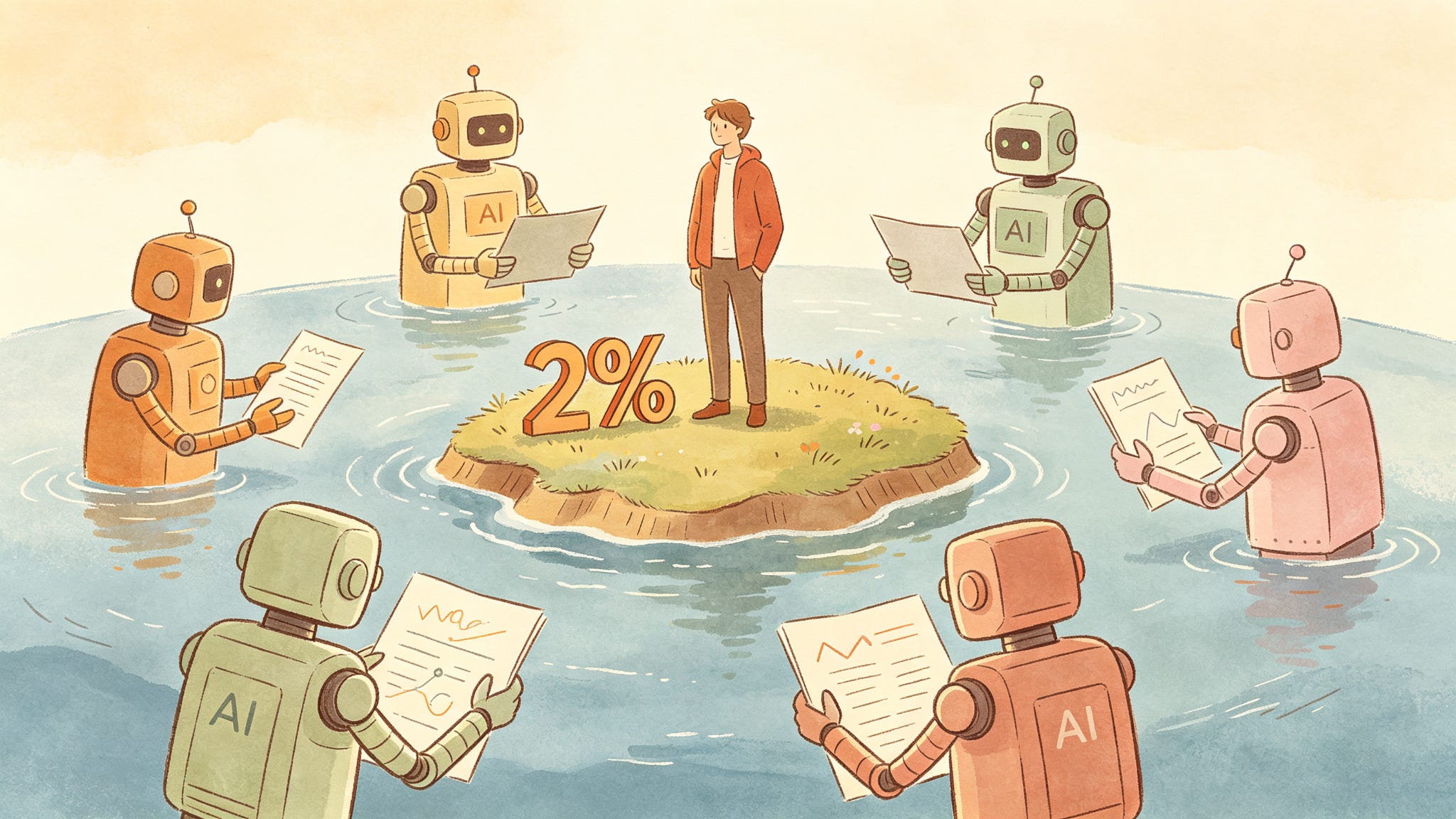
"The middle 98% of production, AI can potentially complete; the opening 1% and closing 1% are what humans truly create and are responsible for."
That opening 1% is the desire to express—what do you actually want to say. The closing 1% is judgment and sign-off, ultimately deciding what the work looks like and being accountable for it.
He says too many people are stuck at the opening. "In the past many people said 'I want to shoot a story' or 'I want to make my novel into a film,' but because production was too hard, they never acted." His response is blunt:
"No more excuses now. You can start today."
And the closing 1%, AI can never replace. "AI won't take responsibility for people."
Everyone understands the theory, but can ordinary people reach it? Liang Wei gave two cases, one small and one large.
The small one is in Yunnan. According to Liang Wei, there's a biology postdoc who was just a video hobbyist, posting relatively rough videos on Douyin about dinosaurs and biology, but his stories and scripts were well-written. After the team provided compute and creative support, the documentaries he made—"many shots already approach BBC documentary quality."
In the past, an ordinary knowledge worker wanting to make imagery like Planet Earth was almost unimaginable.
The large one has already been validated by box office. A24's film The Backrooms: the director was born in 2005, started posting short films on YouTube at 16, built an audience over years, and got the chance to direct a feature at 20. A24 gave him about $10 million budget, paired with a seasoned producer like James Wan and an industrial team.
When Liang Wei cited it in the interview, the film hadn't been released yet. The Backrooms opened in North America on May 29, 2026; global box office quickly surpassed $350 million—35x budget. A young person first proved he had an audience with short films, then the industrial system supplemented capability. This path is no longer theoretical.
Liang Wei's own platform plans the same: "Make five episodes first; if they perform well, do a sixth; if not, stop—let the work and audience feedback speak."
The right to trial and error has been decentralized from a few to everyone.
He summarized: everyone gets the chance to try and express; the industry actually becomes fairer. Of course he also poured cold water on the hype. Tickets issued don't mean everyone gets in. "AI will make much execution work simple, but it won't automatically turn a person into a creator." Without accumulation, you don't know what "good" is. Tools flatten the production threshold, making "whether you have something to say" the only remaining threshold.
At the interview's close, Liang Wei named three things people must hold onto:
The desire to express, judgment, and accountability for outcomes. Then the last sentence. "Between good tools and good works, there's no necessary connection." If you're a filmmaker, a creator, or just someone who's always had a story to tell—AI took 98%; what's the 2% that's yours?
---
Wu Wei: Let's start with the name MovieFlow. Does it aim to improve film efficiency, or use AI to make films better "flow"?
Liang Wei: When we named it, we meant making films flow. Let more people not just watch films, but participate in film creation. AI gave everyone this opportunity.
Wu Wei: You've done film marketing, distribution, investment, and production, worked on 200+ theatrical films. Why move from traditional film to AI?
Liang Wei: I did marketing and distribution more; after 2016 more investment and production. Films, series, animation, comics—dozens; during marketing years, 50-60 films a year. The previous company basically worked the whole chain—marketing, distribution, investment, artist management, cinemas—and fully lived through China's golden decade.
Wu Wei: What truly triggered your pivot to AI video?
Liang Wei: In 2024 we were shooting a film; halfway through problems arose, project shelved. During that time I started rethinking film efficiency. Around November 2024 I first truly touched AI. Like many filmmakers, generating a frame or video, thought "not quite there," almost gave up.
Wu Wei: Runway and tools back then generated only 3-5 seconds, more like demos, hard to enter real production.
Liang Wei: But AI video developed too fast. February 2024 Sora first showed the umbrella girl on Tokyo streets; in under two and a half years it went from the "Will Smith eating noodles" level to many frames almost indistinguishable from AI generation, approaching live-action. We researched from November 2024 to June 2025, about eight months, before formally launching MovieFlow.
Wu Wei: You've lived the whole film industry chain. What's the core problem with traditional film now?
Liang Wei: The biggest core problem is low efficiency. From an idea or script, through meetings, completing screenplay, director creative communication, pre-production deciding whether to do a project often takes one or two years. Slower, three, four, five years.
Wu Wei: Shooting is actually the relatively fast middle segment.
Liang Wei: Right. Pre-production prepares funds and collaboration; actual shooting might be two or three months, or five or six. Then post, waiting for slot, marketing. No matter how fast a film is, at least a year; slow ones seven or eight, even ten, twenty years. After capital investment, the whole payback cycle and production efficiency are very low.
Wu Wei: Marketing is also a big expense.
Liang Wei: Sometimes a film's marketing cost matches production cost, and matches box office targets. During the hottest Spring Festival seasons, without a 100-million-RMB marketing budget, a film can hardly enter Spring Festival. Great if it makes money; fail once and risk is enormous.
Wu Wei: You see 2009-2019 as China cinema's golden decade.
Liang Wei: Right. Huayi Brothers' 2009 IPO to 2019 is the golden decade as I understand it. 2019 China box office exceeded 62 billion RMB, one step from world #1. But after 2019 audience attention, entertainment, content distribution all changed; traditional film's high-investment, long-cycle mechanism increasingly can't adapt to today's market.
Wu Wei: After the Chopstick Brothers' new MV launched, viewers covered their eyes while complaining; focus shifted from "why does Xiao Yang's face look different" to "this was made by AI?" MovieFlow first appeared in public credits. How did this start?
Liang Wei: Xiao Yang and Wang Tali are very willing to embrace new tech. Our generation grew up with Youku, Tudou—shooting DV, uploading, slowly entering film. Old Boys was that era's work. They were planning a concert; I asked if there was a new song. Xiaoyao Xian happened; we talked over a meal. I said let's try, but since we're doing it, thoroughly: no live-action, no motion capture, no dedicated photos, 100% pure AI generation.
Wu Wei: How were character looks determined?
Liang Wei: Their past work already left enough facial material. Xiao Yang referenced his recent look; Wang Tali's character needed younger, more charming—referencing his Little Apple era. Final characters: Xiao Dabao and Wang Xiaoshuai.
Wu Wei: What really takes time isn't "generation" itself.
Liang Wei: Right. Pre-production creative discussions at least three weeks—building characters and art assets, defining character looks, story, script. Xiao Yang gave story and core skeleton; young directors Yan Chuan (阎川), Ke Le (可乐) and others filled details. The two MVs' actual production time combined about a week-plus, done in about a week, then continuously adjusted.
Wu Wei: The outside world always feels AI video is endless "card draws."
Liang Wei: When professional creators are present, it's not blind card draws. Everyone knows what they want and don't want; judgment is fast. Tech isn't hardest; creativity and decision-making are.
Wu Wei: How are the numbers on this project?
Liang Wei: First two episodes cumulative about 200 million views, related topics about 1.8 billion. Derivatives we can find with some views exceed 1,500. People put Xiao Dabao and Wang Xiaoshuai into Avatar, Titanic, and all kinds of worlds.
Wu Wei: You were fully open to derivatives at first.
Liang Wei: Right. Xiao Yang and Wang Tali also thought, since people enjoy it, let them play. But strictly speaking, early derivatives had copyright flaws involving actors' likeness and character images. Next we'll do official derivatives, unifying character assets, so creators continue under authorization and compliance.
Wu Wei: Xiaoyao Xian's temperament is very Chopstick Brothers.
Liang Wei: Middle-aged people not selling misery or being sentimental, very seriously "creeping you out." Some say it's cringey but can't look away; enjoy watching, can't help complaining. This is the Chopstick Brothers' own soul; AI just magnified it.
Wu Wei: You've repeatedly proposed "AIdeo." How is it different from AI video or AI short drama?
Liang Wei: AIdeo is AI plus Video; it's our name for AI-native imaging content. The name itself isn't most important; what's important is AI imaging isn't a short-drama derivative, nor traditional video plus an AI tool—it becomes a new content species.
Wu Wei: Why an independent species?
Liang Wei: Every media underlying-technology shift births new content forms. Film cameras brought film and documentary; digital cameras lowered cost, changed production and broadcast, gave rise to TV and variety; smartphones let everyone shoot, giving short video and live streaming. AI multimodal generation redefines "shooting" itself; new content types that didn't exist will inevitably appear.
Wu Wei: So AIdeo isn't just cost reduction.
Liang Wei: Right. Everyone sees cost reduction first because AI video starts entering traditional film, advertising, gaming, MCN, short-video production. But it ultimately redoes creation, production, distribution, interaction, feedback, and commercialization. Future audiences won't agonize over "is it AI-generated," just as nobody rejects animation today because it's computer-made. Tools change; ultimately audiences watch works.
Wu Wei: Will pure live-action films become fewer?
Liang Wei: I think so. In the future, if a film used no AI at all, it would be rare—like "pure ancient-method production"; some may pursue it, but not mainstream. AI-native content and traditional film will long coexist, but AIdeo forms an independent industry chain and distribution mechanism.
Wu Wei: Can AI truly give ordinary people a film-industry team?
Liang Wei: Yes. Our generation shot with DVs, had to buy equipment, find people, solve sound and meals—essentially a small crew. Today's Gen Z, using AI and MovieFlow workstation, one person can do it. Many talk One Person Company; we'd rather push One Person Studio.
Wu Wei: A one-person studio.
Liang Wei: Right. All multimodal capabilities become his tools for storytelling. Tools are quickly learned; whether you can make content well is another thing.
Wu Wei: Which ordinary people who couldn't enter film creation before have you worked with?
Liang Wei: In Yunnan there's a biology postdoc, just a video hobbyist, posting relatively rough Douyin videos but with good stories and scripts, about dinosaurs and biology, documentary-like. We provided compute, creative support, some collaborators. Now the documentaries he makes—many shots approach BBC documentary quality. In the past an ordinary knowledge worker making Planet Earth-like imagery was almost unimaginable.
Wu Wei: What's the most important ability for ordinary people to become good AIdeo creators?
Liang Wei: First is the desire to express. You truly have to want to say something. In the past many said "I want to shoot a story" or "make my novel into a film," but production was too hard, never acted. No more excuses now; you can start today.
Wu Wei: Second?
Liang Wei: Human judgment. After AI generates, deciding what to want and not want is still human. Aesthetics is part of it; more important is storytelling and expression judgment. Same story, different people tell it completely differently.
Wu Wei: Where does this judgment concretely manifest?
Liang Wei: How you articulate requirements, how you ask it to modify after frames come back, when to cut, whether to show it visually or keep sound off-screen—all human choices. AI can shoot two-shots, over-shoulders, objective shots; tech gets stronger. The real threshold isn't generating the shot, it's what you want to express in this moment.
Wu Wei: You often compare AI video tools to first assistant directors.
Liang Wei: Right. On truly professional sets, before the director arrives, the first AD has organized lines, blocking, scheduling, even shot a take for the director. The director arrives and most importantly decides whether to use it, where to change, whether final is acceptable. AI should reach this level: block the scene first, but the final decision is human.
Wu Wei: So AI can't replace the head and tail of creation.
Liang Wei: One end is text, desire to express, creative drive; the other end is ultimately deciding what the work looks like. The middle 98% of production, AI can potentially complete; the opening 1% and closing 1% are what humans truly create and are responsible for. The third ability is accountability for goals and results—ability to decide and control.
Wu Wei: Models get stronger; will the application layer thin out and eventually be eaten by large models?
Liang Wei: These two-three months application-layer heat dipped because with coding improvement, people feel software got simpler. But AI video and coding have a fundamental difference: no matter how Harness, Loop, knowledge bases, Agents develop, ultimately you must deliver content.
Wu Wei: Whether code runs has clear standards; content doesn't.
Liang Wei: Right. Code usable and runnable is the standard. What's "good" content has no uniform answer. Whether the Chopstick Brothers MV is good isn't decided by a one-click tool; it requires directors, producers, and people who truly feel content to co-create. AI replaces and elevates efficiency, not removes professional creators. For me, content is always more important than tools.
Wu Wei: So you're cautious about so-called "video Agents."
Liang Wei: Many are just surface capabilities. Some say one person can complete short dramas and ads, but if they could truly deliver stably, why haven't they received lots of commercial orders? Real orders remain with professional teams that deliver content to standard. A video Agent is more like a first AD; if the director arrives and sees what was shot is completely unusable, it means it lacks professional capability.
Wu Wei: Professional capability also includes assets and context.
Liang Wei: Right. From day one we emphasized Memory, context, and asset consolidation. Ideally, a director hands text to the workstation; the tool first produces the whole scene, then the director tells it by voice how to modify. What MovieFlow achieves now is maybe only 10% of what I envision.
Wu Wei: Can director style be encapsulated as a Skill?
Liang Wei: Yes, but authorization must be respected. Now many people directly use a director's name to describe style without any authorization or fee; I'm strongly against it. If Feng Xiaogang or Wong Kar-wai formally encapsulated their aesthetics, story judgment, and creative experience as a Skill with clear authorization and per-use fees, that's reasonable. Just learning his work often learns the "skin," not the "filling inside." Everyone uses the same lighting, and you're tired of it in a week.
Wu Wei: Like Xiaoyao Xian, a high-level Music AIdeo—roughly what's the cost?
Liang Wei: Pursuing extreme effect, repeatedly adjusting and card-drawing regardless of cost, about 40,000 to 50,000 RMB per minute. This case itself pursues highest quality.
Wu Wei: What about normal, stable delivery content?
Liang Wei: After assets built and team in sync, cost drops significantly. Truly stably deliverable content can reach about 3,000 to 5,000 RMB per minute, including all costs: labor, compute, tokens, card draws.
Wu Wei: Video production has clear diminishing marginal cost.
Liang Wei: Right. Once character, scene, style assets are consolidated, no redo next time. The third Xiaoyao Xian already cost less than the first. Models keep improving, tokens keep dropping; production gets faster and cheaper.
Wu Wei: When will ordinary people reach this level?
Liang Wei: My older kid is ten, loves WWII planes, already uses MovieFlow to make plane-themed videos. Writes storyboards himself, no one systematically taught him. Watching films and videos, he naturally knows what the next shot needs. As long as one has desire to express, aesthetics, and judgment, they can start. Technology itself isn't as hard as imagined; what's hard is whether you have your own creativity.
Wu Wei: In Xiaoyao Xian, Xiao Dabao and Wang Xiaoshuai already feel like independent characters. How does the actor-character relationship change in the AI era?
Liang Wei: I often tell Xiao Yang, Xiao Dabao is both you and not you. The part that is you: generated from your face; the part that isn't: like other roles you've played in films, he's an independent character. The difference is, AI-era characters can be quickly copied and continuously produced.
Wu Wei: Commercialization first solves rights.
Liang Wei: Right. Some ad agencies have already signed commercial cooperation with stars but lack the ability to generate star likeness; we help them do model whitelisting, asset building, and full production. The premise must be authorization obtained. Domestic and international models all have review to avoid unauthorized deepfakes.
Wu Wei: A cross-IP AI video may involve many rights simultaneously.
Liang Wei: For example, someone makes Brad Pitt's Babylon character fight Donnie Yen's Ip Man. To commercialize, at minimum you must resolve Babylon character rights, Ip Man character rights, Brad Pitt's likeness authorization, and Donnie Yen's authorization. Once rights are bought, the creative logic is the same as buying a script, character, or IP license.
Wu Wei: AIdeo also changes product placement.
Liang Wei: Traditional placement must be negotiated before shooting—whose car, how many shots, how to show it. In the future, after a work performs well, brands can enter later, replacing the drink in a scene with Genki Forest, replacing the distant car with a different brand. Commercialization shifts from upfront investment to post-hoc settlement, even pay-per-play.
Wu Wei: Brands can also open compliant assets to creators.
Liang Wei: Right. Xiaomi, Huawei and other brands can put product assets on the platform; creators call them into content. Whose creativity is good and spreads well, the brand pays by performance. AI will redo traditional film and entertainment's production, marketing, investment, and commercial placement.
Wu Wei: Beyond film, short dramas, and MVs, which commercial scenarios has AI video already started creating value in?
Liang Wei: The market is huge. Next to our Beijing office is an e-commerce company spending hundreds of millions annually on short-video materials and ad buying, originally about 50 people shooting and editing continuously. Much content can now be directly generated; future team may keep at most 15, at least a two-thirds reduction.
Wu Wei: E-commerce and ad-buy materials have clearer SOPs.
Liang Wei: Right. True content creation has no fixed SOP, but ad-buying, e-commerce, founder IP, product introduction are more standardized, can be encapsulated. MovieFlow workstations are also used by many large-enterprise marketing departments. Every enterprise needs to introduce products and tell corporate stories; even the most traditional enterprises need video.
Wu Wei: Enterprise historical materials can also become assets.
Liang Wei: Founders' photos, stories, corporate culture from ten or twenty years ago can all be consolidated into enterprise asset libraries. Marketing staff turn over, but enterprise video assets, workstations, and production processes should persist. We package film-grade capability into workstations; enterprises can form their own SOPs or we help customize.
Wu Wei: Different content corresponds to different business logic.
Liang Wei: Like a bowl of noodles—some made by Michelin chefs, some convenience-store instant. A 2-3 second ad-buy video needs to stop people and drive orders; it suits standardization. High-quality content has another set of value. AI won't make all videos the same; it makes each demand more efficiently served.
Wu Wei: Traditional film and animation are highly labor-intensive. After AI, what's the most irreplaceable role in industrial-grade content?
Liang Wei: In the extreme, one person can do it, but that person needs three capabilities simultaneously. The minimal professional small team is three: writer, director, editor.
Wu Wei: AI can write scripts too; why can't writers be replaced?
Liang Wei: AI can certainly write long text in a day, but high-level professional story creation still needs revision. "Writer" here isn't just writing words; it's the story's originating impulse and creative source. This source won't be replaced.
Wu Wei: The director's value is choice.
Liang Wei: The director makes judgments on creative essence, deciding what to want and not want. AI can give infinite possibilities, but someone must determine the final direction.
Wu Wei: Many don't realize editing is so important.
Liang Wei: Editing is the final creation. One cut point directly changes audience psychology and audiovisual feeling. The director shot lots of footage; whoever holds the edit decides what audiences see and don't see, how the story holds together. That's why there are "director's cuts."
Wu Wei: Will cinematography, lighting, art, sound roles disappear?
Liang Wei: Professional capability won't all disappear, but part will be internalized into large models. Future you may still need DP, art director, sound director, but no longer huge numbers of first ADs, second ADs, and runners under each department. Top professional judgment remains; lots of execution work reduces.
Wu Wei: Actors?
Liang Wei: Future actors may not come to set daily, but confirm AI character performances at home via computer and phone. In Xiaoyao Xian, after AI performs Xiao Dabao and Wang Xiaoshuai, Xiao Yang and Wang Tali confirm; if something's off, the actor acts it out on their phone and the motion or expression is swapped in. Part of the set migrates to the cloud.
Wu Wei: Fully virtual characters with no real prototype will also appear.
Liang Wei: Definitely. Game characters are already virtual. Actors have two paths: one is offline physical performance—theater, concerts, live performances, cultural-tourism NPCs; face-to-face human interaction is always needed. The other is assetizing one's image and performance ability, participating in content production in the cloud. Traditional film and AI film will long coexist.
Wu Wei: Will AI make everyone do short content, with no one pursuing long-form?
Liang Wei: No. The AIdeo era will definitely produce better features and stronger series, and definitely produce its own Empresses in the Palace and long-form hits—just not yet truly born.
Wu Wei: How do ordinary people enter mainstream industry from small works?
Liang Wei: First shoot your own story. If it resonates, expand; stronger resonance, chance to enter cinema screens and mainstream distribution. Everyone gets the chance to try and express; the industry becomes fairer. After MovieFlow's distribution platform launches, creators make five episodes first; if they perform well, do a sixth; if not, stop—work and audience feedback speak.
Wu Wei: This is a bit like A24's The Backrooms.
Liang Wei: Right. The Backrooms director was born in 2005, started making a few-minute YouTube shorts at 16, built audience over years, got the directing opportunity at 20. A24 gave about $10 million budget, paired with seasoned producers like James Wan and an industrial team. Young director has creativity and proved he has audience; professional team supplements industrial capability.
Wu Wei: So AI lets film companies test more content at lower cost.
Liang Wei: In the past a film company shot ten films or twenty series a year; future it might shoot three live-action films, five live-action series, and simultaneously produce 100 AI features, seeing which truly perform. Good projects get more investment; works can first stand out in AI video, then get live-action opportunities.
Wu Wei: Cinemas themselves may also change.
Liang Wei: Don't fixate on the "cinema" location; more important is collective viewing and offline experience. AIdeo can be in cinemas, concerts, cultural-tourism spaces, offline theaters. Films don't have to be 120 minutes; 50 or 60 minutes can also work. The content industry's most important thing is innovation; don't limit works by length, structure, or whether it's AI-generated.
Wu Wei: You're now pushing "film industry FDE." How is it different from selling an AI video tool?
Liang Wei: A tool is always just a tool. Give you an IMAX camera and a full team, you still may not shoot Nolan's film. So we don't just introduce tools; we enter the client site directly, helping complete results and delivery.
Wu Wei: In a traditional film project, concretely how?
Liang Wei: Start with a "pre-viz reel" before shooting. For a 100-minute film, first use AI to run the full 100 minutes. Director, producer, department heads see the whole film in advance, decide which shots to shoot live, which not to shoot, which empty shots to generate directly with AI.
Wu Wei: Many sets before shooting couldn't actually see what the final film looks like.
Liang Wei: Right, most of the time it's "working blindfolded." After pre-viz, shooting schedules can be rearranged. An actor originally needing 100 days might compress to 80; another originally 50 days might only need 30. Everyone's cycle and cost can be rescheduled.
Wu Wei: AI also runs through shooting and post.
Liang Wei: During shooting, AI fills shots. Can't get sun, rain, sunset—AI fills it; after shooting an actor's shot, later needing a hand close-up, no need to call the actor back. Post can also replace and regenerate shots, even re-create the story.
Wu Wei: With full use, how much budget can be saved?
Liang Wei: At least 10%, more thoroughly can save 30%. For a 20-million-RMB live-action production, at least 2 million, up to 6 million. We may send two or three people on-site, compute billed at cost, plus project team labor. Assume service costs 500,000 and saves 2 million—net saves 1.5 million, ROI clear.
Wu Wei: But this touches existing interests.
Liang Wei: Right. Before, a person billed 100 days; now maybe 80. Hotels were 100 days, now 80. To truly drive full-process AI-ification, it must be pushed by the film company boss, the producer—the "number-one person"—with producers and directors willing to accept. Enterprise AI is a "number-one project"; film can call it a "producer project."
Wu Wei: Ultimately you hope the industry itself masters it.
Liang Wei: Right. FDE isn't permanent on-site. We help the set get the process running; ultimately we hope clients and industry practitioners master it themselves, then pull our people out. AI's real value isn't making directors busier—it's liberating productive power. On most sets, directors only spend 30-50% of time creating; the rest coordinates production problems of hundreds. Used well, AI should give directors more time back to creation.
Wu Wei: At the end, facing AI, what ability should ordinary people most preserve?
Liang Wei: First have your own desire to express and originating impulse. Second have judgment—know what "good" is. Third make decisions and be accountable for results. AI won't take responsibility for people.
Wu Wei: So reading, accumulation, professional training still matter.
Liang Wei: Of course. Without enough accumulation, you don't know what "good" is. AI will make much execution work simple, but won't automatically turn a person into a creator. Between good tools and good works, there's no necessary connection.
Wu Wei: Film industry practitioners shouldn't only see roles being replaced.
Liang Wei: Technology will change some roles and work methods, but also create new creators, new professions, and new content. Most important is to start early. Let films flow, let ordinary people make blockbusters—that's what MovieFlow wants to do.