
Original · Unique Research · 2026-07-27
Editor's note: The first-person report and its judgments belong to the original Chinese author. This English rendition retains the opening narrative, three themed sections, closing, and the complete panel transcript. Agricultural metrics, benefit figures, and customer claims are speaker self-reports attributed to the named founders, not independently verified findings. Company and person names are preserved as source attributions.
AI Industry Observation
A Model Grew Out of 76,000 Mu of Farmland
"The last mile of AI deployment looks like a technical problem, but when you walk it to the end, you find it's all people problems."
Three and a half years ago, a 1,000-square-meter single building at the Chengdu Horticultural Expo — probably one of China's earlier practice projects where AI deeply participated in full-process design from concept proposal to delivery and operation, with a complete on-site acceptance system.
That roundtable also surfaced a lot of industry truth. Xu Lianyun of Chunyun Smart Agriculture, guarding 76,000 mu of farmland, produced nearly 20 million in benefit increment in a single growing season; Sophie Yang of Eureka.AI turned "knowing the industry and knowing technology" into a product, signing in a month. Three people, three industries hard as nails — architecture, agriculture, enterprise services.
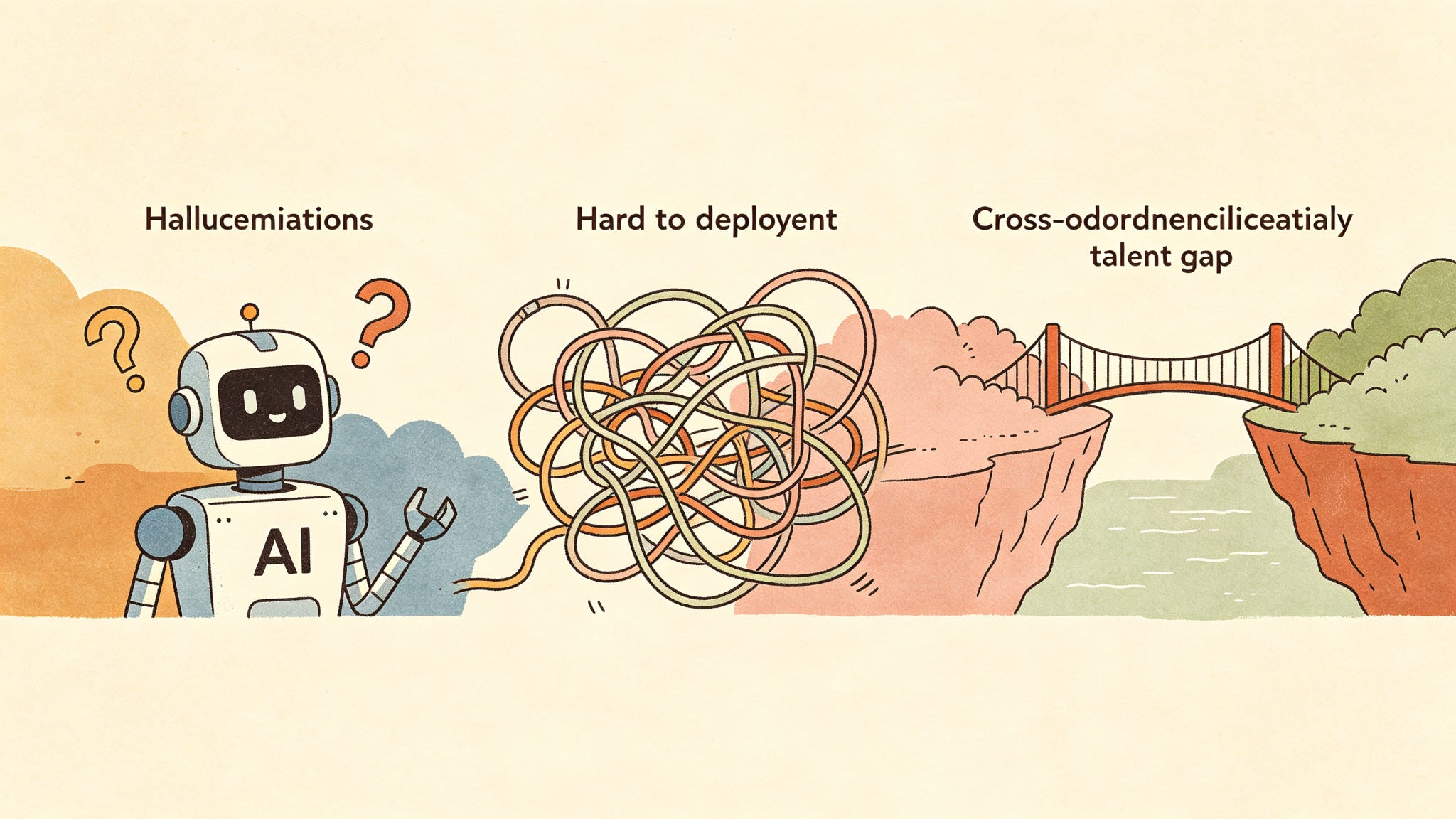
After listening, you find that the "AI is hard to deploy" everyone talks about has remarkably consistent sticking points, and remarkably consistent solutions.
The First Paying Customer: Not Found, but "Grown"
How did the first customer come about? Three companies, three paths, but one underlying logic.
Sun Zhixing says he was relatively lucky: "I had PMF before I started the company." His first two companies did consulting in construction; in his words, he was "a worker mining in a cave who came out and built the shovel." Mining meant a salary and meals; coming out and switching shovels meant eating better. The Chengdu project was purely because they were swamped, and that year large-model capability had also come online, so his team said, let AI try — and the client, after seeing the concept proposal, signed directly.
Xu Lianyun's first customer came through "proactive outreach." He first locked a seed user in a model market — a 76,000-mu farm, equivalent to two townships in area. The first-generation product was polished on this land, then he took this case to cut into neighboring long-tail large growers. Clear target profile, enthusiasm for new technology, plus agricultural policy pushing along — from not knowing each other to paying, only a little over a month.
Sophie's path was even more special: the customer was her product manager. "The customer pushes me along." The number-one person came to her with a real pain point; she translated that pain point into a product. After co-creating, they found it could be standardized and replicated, then served more people.
"Looking at the three paths together, there's a common point: not a single one did 'build the product first then find customers.' Either you're already in the industry and demand comes to you; or you first drill through a test plot and knock on doors with a real case; or you simply let the customer co-define the product. Put simply, AI startup's first order is a contest of how long you've soaked in the industry."
Why Dare Customers Use It: Interrogation-Style Acceptance
Getting the order is just the start. The real difficulty is: AI has hallucinations, accuracy is in doubt, who's liable when it errors — why would customers hand you real money?
Sun Zhixing's solution is harsh: not up to standard, no next phase, no payment trigger.
Before the contract kicks off, both sides freeze the acceptance metrics and process. Recognition rate, how hazard resolution flows, exactly how much cost is cut and efficiency gained, usage frequency — all quantified as a contract appendix. Testing is double-blind. "There's no emotional color in this." He can't speak in his own defense, and the buyer can't wink.
"Once delivered, it's been through interrogation." He said this calmly. Many industry solutions that look advanced are, in his words, "performative." Many current projects over-index on demo effect, lacking deployable, quantifiable long-term acceptance standards, making sustained validation of real value hard.
Early pilots were small; as deployment value kept validating, standardized projects for similar customers have seen clearly larger investment scales.
Xu Lianyun faces a different kind of problem. Farmland AI — no matter how smart the brain, if the eyes, ears, and nose don't work, decisions still go wrong. So his screening standards for sensor and field-scouting drone hardware suppliers are near-exacting: hardware that survives wind and sun in the fields, and a localized after-sales service system nationwide — neither can be missing.
Interestingly, he firmly refuses to make hardware. Why? To stay neutral. "If I made hardware, I couldn't plug in data from many excellent hardware companies; I could only be a little cerebellum, not a true farmland super-brain."
"Not doing hardware is to build a bigger brain. This tradeoff isn't obvious to most. More critical is the model. Xu Lianyun's model 'grew out of the fields, not the lab.' Veterans who'd spent decades on the 76,000-mu farm built the model with the team. Different plots, different varieties — only a model grown from that is truly useful. 'Even a general-purpose agricultural large model can't solve this pain point.'"
Results?
1) Labor cost reduction: field-scouting labor cost down about 70%;
2) Yield increase: per-mu yield of rice and wheat up 8%;
3) Ag-input savings: ag-input spending down 10%-15%, water use down about 20%;
4) Quality improvement: premium-rate produce up 10%+, branded agricultural-product premium about 5%.
The Most Expensive Asset: That "Industry-Literate Technical Person"
On organization and talent, the most resonant segment of the day arrived.
Industrial-AI companies usually have two groups of people: those who know AI, and those who know the industry. How do you twist the two together? This was the question host Wu Wei threw out — and one he'd "wrestled with for a long time" himself.
Sun Zhixing's answer is honest: the two groups are still separate, but cooperate well. The real difficulty is finding "cross-domain people." He himself came from the industry; on algorithm details he's no match for engineers, "but on this track, I'm the one who knows algorithms best." The two are hard to have together. "We also hope to find more people like us as soon as possible."
Xu Lianyun considers himself lucky. Before setting out, he'd already designed the organization: his CTO had worked in field-scale smart agriculture for nearly ten years, with an understanding of the industry no less than senior agriculturalists, and was technical by background. So delivering Product 1.0 to the full 76,000-mu farm quickly wasn't luck — it was "deep rooting in this industry."
He added one more trick: he hired an agricultural KOL with hundreds of thousands of farmer followers, who had served 2,600 farming households and over a million mu, sitting in meetings with the team every day, "slowly filling the limited gap."
Sophie said directly that this pain point is why she started her second company. In traditional high-barrier industries, there's always a gap between AI talent and vertical-domain people, and the bridge is usually only the boss. Her solution was to turn the "bridge" into a product — the now-hot FDE: a digital double that both knows the industry and can translate needs into technical language, and can quickly produce a demo. The pricing is interesting too — pay annually like hiring an employee, with token consumption billed transparently at list price.
"She also said something that made the entrepreneurs in the room smile knowingly: 'the common situation now is, my co-founder is worth more than I am.' The technical lead must understand the industry — today this isn't a bonus, it's the admission ticket."
In Closing
By the end, you find technology is already universal, China has the strongest supply chain, and the market is big enough. The real barrier is how deeply talent has tilled the industry.
Looking back at these three companies, what let a traditional architectural-design company transform into an AI solutions company for cities and infrastructure was having mined the industry three and a half years ago; a model grown out of 76,000 mu of farmland can't be replaced by a general-purpose model; double-blind acceptance written into contracts is backed by understanding of the industry.
"The last mile of AI deployment looks like a technical problem, but when you walk it to the end, it's all people problems. In your industry, has that 'industry person who knows AI best' appeared?"
More Conversation Details
Speakers
Zhizhu Cloud founder — Sun Zhixing (孙知行)
Chunyun Smart Agriculture founder & CEO — Xu Lianyun (徐连云)
Eureka.AI founder — Sophie Yang
Host
Unique Research founder — Wu Wei (吴畏)
Self-Introductions
Wu Wei: Let's do very quick self-intros so everyone knows what we're working on.
Sophie: Hello everyone, I'm Sophie, founder of Eureka.AI. In one sentence, Eureka.AI solves the enterprise side — whether large or small, focused on SMBs — the end-to-end last mile of AI deployment, combining various scenarios and products, including the well-known harness and the now-hot FDE, all turned into enterprise-side Agent applications that are efficient, controllable, and usable.
Xu Lianyun: Hello everyone, I'm Xu Lianyun from Chunyun Smart Agriculture. China's agriculture is moving from small plots to large plots; scaled planting has become mainstream, so agricultural robots, especially drone-based ones, are very mature. But the contradiction between scaled planting and refined management is growing — because in the fields, when farm machinery works, it lacks the eyes, ears, nose, and brain of agronomic sensing for crop-condition management. So this contradiction is prominent, and we go deep here, providing an Agent for the planting industry — main grain crops and cash crops rooted in real conditions.
Sun Zhixing: Hello everyone, I'm Sun Zhixing, founder of Zhizhu Cloud. We focus on AI solutions for cities and infrastructure. Early on we only did software and models, the soft side. Over the past year to eighteen months, we gradually took AI from the soft side into real scenarios to solve problems — devices, AIoT, including hardware from Jushen Intelligence. We have many commercial cases now. So we feel demand for hardware and scenarios is very urgent. We're gradually moving from software and models to comprehensive scenario solutions, but still focused on cities and infrastructure.
How Did the First Paying Customer Come About?
Wu Wei: Now concrete questions. First: how did your first customer come about? How did you solve the first paying customer?
Sun Zhixing: I may be lucky — we started the company because we'd already hit PMF. This is my third company. Customer demand came first, then we started. Maybe because of industry DNA — we did consulting in this industry; our first two companies were in it. We're pretty standard cave-miners who came out and built shovels: mining meant a salary and meals; coming out and switching shovels meant eating better.
Wu Wei: That's a lot of metaphors; concretely?
Sun Zhixing: Concretely, in urban construction, our first customer — three, three and a half years ago we were already using AI for design; GPT might not have been out, and "Mizhi" had just started, and we used it for design. This was one of China's earlier thousand-square-meter single-building practice projects where AI deeply participated in full-process design from concept to delivery, with a complete acceptance system — a 1,000-square-meter small single building at the Chengdu Horticultural Expo.
Wu Wei: Looking back, in landing the first paying customer, what do you think was the most important reason? Was the customer willing to try, did you use the latest tech early, or your past resources?
Sun Zhixing: Interesting. At first the customer didn't know we used AI, and we didn't dare say, because three and a half years ago acceptance — even now — is still being cultivated. So we couldn't say the whole design was AI-assisted. We were swamped, so as an experiment, and large-model capability had come up, and our team was interested, we said let AI try. We did a concept proposal; the client thought it was good and signed directly.
Wu Wei: Interesting. It wasn't until the second year of promotion that the customer found out — the Chengdu Expo was already over before they knew the building was AI-made.
Sun Zhixing: Right.
Wu Wei: Now customers probably don't care?
Sun Zhixing: Now it's the digital-transformation era; enterprises and customers, their workflows and methods, urgently want to embrace this.
Wu Wei: Great. Mr. Xu, we know you roughly; please tell everyone how the first paying customer came about.
Xu Lianyun: Actually when I started, I designed the whole commercial path. In practice, it's basically followed my path. My first strategy was to build a seed user in the model market — a very representative seed user with a 76,000-mu farm, equivalent to two townships. Our townships are 70,000 mu, yes. So with this user we polished our first-generation product; this case was already produced. Then I cut into neighboring cases and long-tail large growers.
First, a case to influence them, visiting on-site. Second, in screening, their scenario and scale match our profile very well. Third, the person is more enthusiastic about new tech than others. Plus government agricultural policy support. These factors combined produced our first real paying customer.
Wu Wei: So the first customer was one you actively chose.
Xu Lianyun: Active, starting from not knowing each other. It took about a month to turn them into a paying customer.
Wu Wei: That's fast — only a month.
Xu Lianyun: Because the scale wasn't big — a multi-million-yuan-a-year large grower, a few thousand mu. They took part of the land first to try.
Wu Wei: Where is it now? Almost delivered? Did the process take long?
Xu Lianyun: Since it just started, the first paying user took about 20 days to deliver. Because it involves hardware deployment — besides the brain, it needs eyes, ears, nose; hardware deployment in the fields takes some time.
Wu Wei: Good, we'll expand later. Sophie, I know your situation a bit; this question isn't sharply targeted, but can you trace back how you first convinced customers to use your product?
Sophie: My core label is serial entrepreneur. In the 1.0 state, before founding, my co-founder and I were at Kunlun Wanwei — late 2022, 2023, when China's large models just started, GPT just started. We co-did commercialization and deployment — among China's earliest teams doing frontier commercial landing, so we define ourselves as an AI Native team.
Back to Day One, my co-founder and I had an understanding: our positioning toward customers must change, because you're doing AI entrepreneurship. The reason to leave being a professional manager to start a company — the core logic is I'm bullish on AI. I felt AGI would surely arrive; then it was personal faith, technical faith. Looking at development now, it's gradually becoming a fact.
The PMF mentioned — when we started, my customer was my seed customer and my product manager. In the AI era, we feel it's not that I assemble a product and, understanding the market and track well enough, I can eat the market. Because competitors — in marketing scenarios, in advanced manufacturing — later AI software vendors or service providers are cross-domain application players.
So from first to second startup, the overall state has been customers pushing me. Customers tell me an idea; usually still the number-one person, or the business lead who really knows the pain point, tells me what they think about the product. That's why in the second startup we thought about the hot concept FDE — a real B-end need: can you truly understand the customer's pain point, respect it, turn it into a product, into AI language, make it truly usable, deliver 100% end-to-end — I think that's very important.
Wu Wei: So in your startup, many product launches are co-creation with customers?
Sophie: Definitely. They raise the need, you solve it; later you find it can be standardized and replicated, then you serve more customers.
Wu Wei: Is that the path?
Sophie: Yes. There's a step in between — we don't customize-deliver for customers; we fear a startup turning into a body-shop model. But in the AI era, everyone's Vibe Coding; many jokes about Vibe Coding now.
Wu Wei: Can't escape it. Let me challenge: is FDE another form of custom solution, or different?
Sophie: I think FDE's core positioning is a person — a digital double. For example, talking to customers in the industry — both bosses mentioned — the fastest actual closing time, our current experience, is signing in a month. Post-signing delivery depends on the customer's scenario; the higher the scenario barrier or product requirement or budget, some deliveries run half a year to a year.
I define this as enterprise-side Agent-ification 1.0. In 2.0, we need employees who read customer scenarios. This employee might be at a big company; before AI, there was a PDSA role. What's PDSA? Must understand pre-sales, talk with customers, and understand product logic, passing mined solution needs product-ized to the internal Solution team.
In the past, sales and product value exceeded PDSA. But in the AI era, one PDSA person covers the function of two or three. First, smoothly pass needs to front and back end; then product language smoothly converts Vibe Coding into code; even based on customer chats, quickly produce a demo to see if it's what the customer wants, because customers are impatient now.
Wu Wei: How should FDE be priced? How do you price it?
Sophie: We price it as standardized software — how much per year to hire this FDE employee. Tokens are extra; you want good tokens, consumed daily, talking with your SDE, and all traffic consumption fees are publicly transparent at list price.
Wu Wei: So the human part is annual or returns to per-day?
Sophie: If they have human needs. FDE is only part; we define FDE as an entry point — the entry for all enterprise needs, filtered by the FDE Agent. Imagine an enterprise really using an AI Agent software product; it must go through AI Consulting, discuss pain points, scenarios, what they want. The boss or customer may not articulate clearly, or can't convert to AI-understandable language.
Then FDE's first layer is filtering needs, clearly discerning what the boss wants. The second layer filters language — it permutes and combines good Skills from the market or our Skill plaza. Even clearer for me, the user perceives an Agent, but underneath it's a Skill plaza. Further below, it's our self-developed Harness system doing overall permutation. So finally FDE gives a Consulting solution.
Wu Wei: That sounds like implemented by an Agent, not a person?
Sophie: Yes, it's Agent-ified. A fully digital, AI-ified process.
How Does AI Land in the Industry?
Wu Wei: Mr. Xu, both of you take on hard but important bones. From your perspective serving your field's customers, what role does AI play? Including hallucination, low accuracy, security, liability issues — how did you solve them so customers finally say "OK, I can use this"? Including that pure software isn't the only solution; you may need hardware. Please talk about how AI lands in your industry.
Xu Lianyun: First, no matter how smart the brain, if the eyes, ears, nose aren't sensitive, decisions go wrong. So first, when integrating the hardware ecosystem — because we focus on brain capability building and integrate hardware ecosystems — we have high vendor requirements. Chosen vendors make sensors, field-scouting drones, DJI, Quanfeng, etc.; we screen suppliers by our own standards. First, ensure sensing accuracy.
Second, our model grew out of the fields, not the lab. Because our first seed user, 76,000 mu, is very representative; their agronomists, decades of experience, built the model with us. These things general models don't have — only a model grown from plot and variety differences has real guidance value. Not a so-called general industry large model; even a general agricultural large model can't solve this pain point. It must be based on localized plot and variety differences. So after our model is improved, accuracy is very high, and for neighboring users with the same plots and varieties, it produces strong guidance value and can go to market.
Wu Wei: So it's more about bundling this vertical planting model with sensors and drones as a solution?
Xu Lianyun: Software and hardware delivered together, but I integrate the hardware.
Wu Wei: How do data collection fit into this?
Xu Lianyun: Also dirty, tiring work. The core reason I don't make hardware is neutrality — I'm open, choosing the best hardware companies. If I made hardware, many excellent companies' data I couldn't access; I'd only be a cerebellum, not a true farmland super-brain. I must ensure full data fusion.
Wu Wei: That's our strategic positioning. So hardware vendors open interfaces and data to you?
Xu Lianyun: Yes, and you can choose. I choose the best hardware to work with — good value for money, survives wind and sun in the fields, stable quality, strong localized after-sales nationwide, etc., all factored in screening.
Wu Wei: How do customers measure the value you provide?
Xu Lianyun: First, scaled farmland has several pain points. One, the farmer can't timely and accurately know what disease, insects, water, moisture, seedling, or weed situation is on such a big land; can't find out accurately and timely. Before, people checked, but people are unreliable, no supervision.
Second, many new farmers aren't professional; they farm by feel, and badly need an authoritative model to guide and assist decisions.
Third, when doing scaled field operations, machinery quality — tractor speed, plowing depth — the farmer can't control, including drone spraying height, wind speed —
Wu Wei: Isn't there a standard manual for these?
Xu Lianyun: Right, so supervision is needed. Our Agent also ingests data from operational hardware; after all data comes in, operation-quality standards are in the large model, and it automatically identifies whether an operation is high-quality or has problems, forming alerts to assist.
Wu Wei: So customers feel your solution makes planting more worry-free, safer, more standard?
Xu Lianyun: Yes, and financing costs drop. The end result: labor cost drops, financing cost drops; under the same climate, yield rises. They'll have a mental ledger. So our model is subscription, but results take time to validate. Labor cost is felt once they use the product; yield takes a season, about four to five months.
Wu Wei: Any cost-down and efficiency-up data to share?
Xu Lianyun: Some. Annual benefit increment is nearly 20 million — labor, ag-input costs, and yield. One season. It's two seasons a year.
Wu Wei: I see, different trades. Like me hosting, knowing nothing about agriculture. So your metaphor is like someone doing annual health checks vs. never; health from a probability view is better.
Xu Lianyun: Yes.
Wu Wei: To construction. Mr. Sun, in this field, what do you feel isn't well solved yet, and how do you make customers feel the value?
Sun Zhixing: I feel our industry, cities and infrastructure, large spatial and engineering scenarios, is far from true digitalization and intelligence — very blank. Some experts think it's fairly smart, but we feel it's far from true AI Agents. Especially hardware — traditional hardware and sensors haven't connected true AI multimodal Agent capability and models; there's no successful end-to-end chain from front end to model to cognitive recognition to AIoT. At least the cost-reduction cases people talk about are all performances. Our industry may be traditional and backward; many advanced-looking companies do advanced-looking things, but they're performative.
So to truly reach cost reduction, efficiency, and problem-solving — to be combat-ready — the difficulty lies in true metric-based acceptance. What value, what problem solved, reaches the standard? Not just a performance.
Wu Wei: In your core business, for example, recent work includes hazard identification, enterprise-level vertical localized smart-brain deployment, professional-scenario Agent deployment, plus on-site hardware. We have research projects aimed at polar environments and extraterrestrial engineering for smart construction. These need very professional metric-based acceptance in the lab — testable. Many performative solutions haven't passed this hard, strict metric testing.
Sun Zhixing: We don't accept, don't meet standard, don't move to next phase, don't even trigger payment. So our delivered solutions, once delivered, have been through interrogation. We have both sides' agreed acceptance metrics, double-blind testing, no emotional color. We can't overstate; the buyer can't either. Before the contract kicks off, acceptance standards, process, and procedures are all frozen.
Wu Wei: This might normally need a third party, but your acceptance runs as experiments?
Sun Zhixing: Right. We built a toolkit and solution; it must withstand interrogation, withstand what both sides agreed — recognition rate, hazard rate, resolution flow, work-order flow embedded in the workflow. Cost reduction and efficiency gain — exactly how much efficiency, how much cost, usage frequency — all quantified as a contract appendix, as the basis for future acceptance. This is set at cooperation start, reflected in the contract, and evaluated at payment milestones.
Wu Wei: What's the cycle for this level of project now?
Sun Zhixing: Some short — four months; some long — half a year, but basically under half a year.
Wu Wei: Over half a year?
Sun Zhixing: Not over half a year.
Organization and Talent: How to Twist Two Kinds of People Together?
Wu Wei: First ask both about organization and talent. We can be seen as companies doing AI empowerment in industry, or AI companies focused on a specific industry. I believe both your companies may have two kinds of talent: AI and computer people; and industry people — ex-architectural designers, ex-farmers. How do you twist them together? Do you make A into B, or B into A? This has long troubled me. If I walked in knowing nothing, I couldn't do much. I also want to find another me to replicate.
Are these two groups still separate in your team?
Sun Zhixing: Still separate. Vertically deep industry know-how, and native computer, model-training, AI Native capability — the two teams are fairly separate.
Wu Wei: Do they fight?
Sun Zhixing: No, they cooperate and merge well. Finding someone like us isn't easy; we also hope to find more. Cross-domain, both vertical. Maybe the boss can — like me, maybe I'm not as deep in specific training details as an algorithm engineer, because I'm industry-born. But on this track I know algorithms best. These two are hard to have together.
Wu Wei: Mr. Xu, your view?
Xu Lianyun: I'm quite lucky. Entrepreneurship needs many factors; when I decided to set out, I'd already done the org design. My co-founder, my CTO, has nearly ten years in field-scale smart agriculture. His understanding of the industry is no less than senior agriculturalists, and he's technical by background — rare.
Second, our core product team has eight-plus years on this track. So there's no generation gap between AI and agriculture in our company. We could deliver Product 1.0 to the 76,000-mu farm quickly because we're deeply rooted. Rooted deep, first. Choosing matters more than effort; waiting to train later, the track may have cooled.
Wu Wei: The industry changes so fast now.
Xu Lianyun: Second, we hired a KOL influencer with hundreds of thousands of farmer followers, who's served over a million users. His accumulated agricultural knowledge is authoritative. He works intensively with our team — meetings, discussions — slowly filling the limited gap. That's our strategy and path.
Wu Wei: So best case, your talent is already ready, already deep in the industry and technical — a good foundation. Second, use traffic, channels, influencers to quickly enter the market.
Xu Lianyun: Yes, deliberately designed at design time.
Wu Wei: I won't ask too-deep industry questions; last question. Sophie, you work on this too. There are FDEs, large models doing ToB, and big-tech entry. How do startups PK against big tech?
Sophie: Actually I want to respond to that question, because it's why I started my second company. For example, number-one people now have a pain point, especially in traditional high-barrier industries — like both bosses, distressed that internal AI talent and their vertical product team have a gap. The bridge is, from our research, usually the enterprise boss — both of you, or your co-founder.
When we were serving in 1.0, many customers had this pain point. You find that talking to the number-one person is fine, but when projects sink into execution, two departments still have some cognitive gap; their state and professionalism differ.
FDE isn't a simple pre-sales consultant; we require it to both understand the industry and translate it into technical language — hard requirements. That's why Google and everyone talks about this concept, hot in globalization.
Back to Mr. Xu's org architecture — I feel it deeply. The real situation is your co-founder — one takeaway: your co-founder must understand the industry. First, the technical lead must understand the industry; it's lucky for a founding team. So the common situation now is my co-founder is worth more than I am.
I think in org building, first is the value of co-founder CTO; second, we now give CTO various KPIs — lead product, understand customer needs, and publicly build a personal brand.
Wu Wei: So I feel talent is now the first productive force of AI companies. Talent density, when going down to concrete industry service, may be how deep talent has tilled the industry — possibly the highest barrier. Other things, tech is universal, supply chain is strong across China, markets are big, overseas too, so many opportunities.