
Original · Unique Research / 非凡产研 · 2026-07-29 · Chinese source: https://view.inews.qq.com/a/20260729A09SH200
Editor's note: This is a complete English rendition of the source roundtable transcript. Speaker attributions and product claims are retained as the speakers' own statements. Source images are not processed per task scope.
---
AI Industry Observation
AI is Breaking Into Humanity's Last Decision Territory
"AI can compute personality analyses and compatibility advice for seven women, but guessing that one of them already has a girlfriend—that still takes a human."
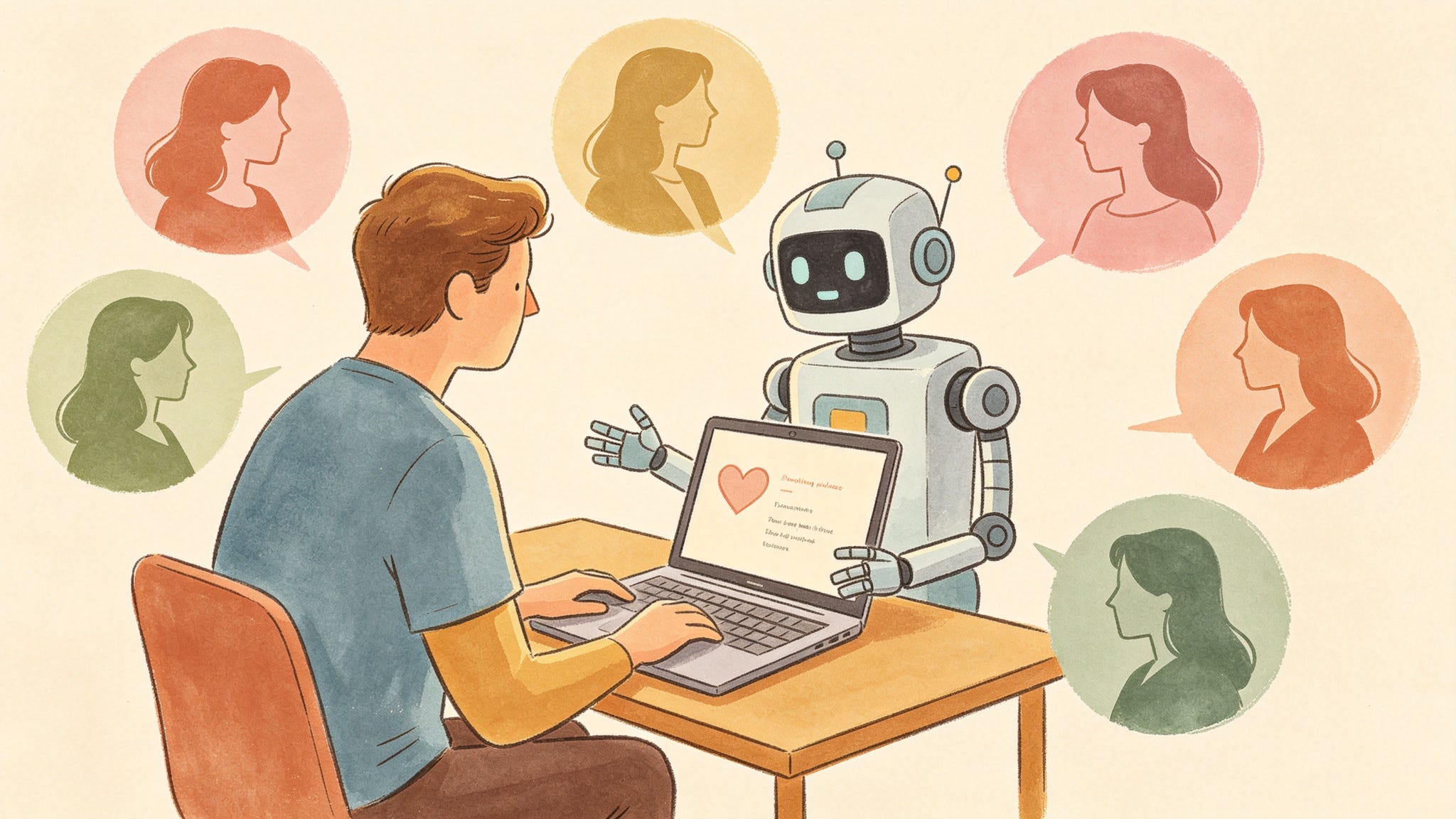
Li Zhenbin (李振彬) of DataSpace AI told a client's story. The client was simultaneously seeing seven women, agonizing over which to choose, so he fed all seven's information to AI and asked which was best. AI analyzed everything and gave advice roughly along the lines of "as an adult, of course you want them all"—correct but useless circular talk, unable to help him decide.
Later this person found Li Zhenbin. Li didn't look at the seven profiles; he asked one question: are you already dating someone? The client froze and asked how he guessed.
At a roundtable in the Shanghai Unique Research Awards, four people were all doing the same thing: using AI to take over judgments that used to require a group of professionals to collide—user research, investment decisions, consumer insight. Li Zhenbin was previously a Taoist, now doing destiny prediction; Xiao Jian (肖建) of Hongyuan Shuzhi (宏原数智) started in consumer insight; Sun Keqiang (孙克强) of Mizzen AI does user interview platforms; Li Shouguo (李守国) of Beta Data (贝塔数据) makes sales training tools for banks and brokers. Four tracks far apart, but today they answer the same question: can AI's judgments be trusted?
Xiao Jian has done consumer insight in Shanghai since 2014, among the earliest companies in China; after an A round last year he moved the company to Hefei. What he does now is "open-source business intelligence"—the idea is to crawl data from the whole web, first denoise, dedupe, de-water, then pull out KOL fans' real footprints over the past 180 days for cross-validation, avoiding being misled by orchestrated accounts. After this round of screening, he says only about 20% of data remains valid; the rest is noise.
Sun Keqiang takes another path. Mizzen AI uses AI hosts to find real respondents for first-hand interviews, now covering nearly 200 million people globally. Before, such in-depth interviews could only use human hosts, at most 30 people a month; now AI can do 200-300 in an eight-hour night, efficiency up over 600x. To ensure respondents aren't fabricated, the platform also synchronously analyzes the other side's expression, tone, motion, tagging confidence labels.
Li Shouguo's Beta Data serves banks, brokers, insurance—basically state-owned enterprises with the lowest fault tolerance. His method is to layer and grade data: official media at provincial-ministerial level and above are naturally high-credibility; self-media content needs separate QC; when AI must answer "off-syllabus" questions, it tags data credibility, even warns users to judge themselves, with a final human review backstop.
Li Zhenbin's "Master Jiji" (吉吉师父) is interesting; the concept is "Didi for fortune-telling"—users place orders, real masters take them via video, AI pulls ancient texts and birth-chart info in the backend to assist analysis. He calls this logic "biological intuition": machines handle logic, humans handle intuition; the two combined, data being 100% accurate matters less.
The four's product forms differ greatly, but on the accountability boundary the answer is surprisingly consistent.
Xiao Jian summarizes it as "scenario-driven": in the past brand research passed briefs and files between departments; R&D, marketing, sales each spoke their own language, and information distorted as it passed. Now they make the entire decision chain—from R&D to packaging to sales scripts—use the same underlying data; human judgment rests on this data foundation, forming an "evidence chain."
Sun Keqiang puts it more bluntly: "Everyone has an AI legion, but everyone is the CEO of that legion." AI doesn't make decisions; it consolidates internal information and first-hand interview data into a middle platform, helping product write requirement docs, helping marketing think up brand stories; the final call is still human.
"Li Shouguo's product directly presents upper/middle/lower strategies and their probabilities, but doesn't pick for the client. 'AI has already done the staff-officer part well; it just needs boundaries and rules; ultimately humans must take responsibility.'"
Li Zhenbin positions AI as a "referee": AI understands formal logics like Zi Ping Ba Zi and Zi Wei Dou Shu, but users don't chat directly with AI; they place an order and a real master takes it; AI in the backend fuses ancient-text knowledge, birth-chart info, and the master's intuitive judgment into a three-layer recommendation; the user picks whichever layer resonates.
Xiao Jian's explanation is direct: AI doesn't make mistakes; humans have emotions and cognitive bias, and client-side quality varies; numbers are always more objective than human semantic expression. A brand's real assets now live in every consumer's social media account—a real distributed ledger; using objective data to judge, business actions and KPI feedback align.
Sun Keqiang wins trust two ways: rare respondents—like 3D printing users, pregnant women over 40—must open cameras for multimodal verification, showing physical objects; at the same time qualitative interviews are directly converted into quantitative analysis, with every conclusion indexable back to the real respondent's own voice; clients see this traceability and are convinced.
Li Shouguo is more candid: "Today clients definitely don't trust AI conclusions; they trust high-quality databases, controlled rules, traceable sources." But he also mentioned a number: in financial sales, AI's understanding of client needs already exceeds 90% of human salespeople—it's unavoidable; the human brain can only process 3-4 dimensions of variables at once, while AI can compute 6-8 simultaneously. He estimates this trust-building takes about three more years.
Li Zhenbin's answer circles back to "human plus machine": AI provides logical analysis, the real master provides intuitive feedback; the two are compared against historical data to generate fused recommendations; one layer will always speak to the user.
Xiao Jian gave an example: before, researching cars under 150k RMB, you could only ask in 50k brackets; now clients ask for 10k brackets. Questionnaires can't probe that finely, but through consumers' real browsing behavior on car-pricing sites you can see: at 130k price point 38% consider it; at 140k the number drops to 4%. He calls this "scientific decision-making"—in the future AI takes over middle-layer execution like data and judgment; humans handle aesthetics, intuition, and delivery requiring emotional warmth; people with high EQ actually have an advantage.
Sun Keqiang thinks going forward, listening to user voice will be automated to the extreme: AI assists human questioning, distilling virtual personas from massive data. Once everyone has their own Personal Agent, interviewing may enter an agent-to-agent era, efficiency another step up.
Li Shouguo's judgment is more restrained: "In the digital domain, maybe in the end only responsibility and experience remain human; everything else, humans truly can't match machines."
Li Zhenbin's view is more aggressive. He says once AI can simulate "biological intuition," it may replace 99% of human prediction work. He even gave an uncomfortable scenario: if AI glasses hint the person across from you has a 99% chance of hitting you, you might choose to strike first. He opened a "philosophy academy" in Singapore specifically to amplify human biological intuition and extrasensory ability, but he admits long-term AI likely fully takes over such judgment.
"No matter how strong machines are, warmth, passion, and person-to-person interaction can't be replaced—like today's offline exchange." Placed next to Li Zhenbin's story, this is interesting: AI can compute personality analyses and compatibility advice for seven women, but guessing that one of them already has a girlfriend—that still takes a human.
---
Speakers
Xiao Jian (肖建), Partner, Hongyuan Shuzhi Technology (宏原数智)
Sun Keqiang (孙克强), Founder & CEO, Mizzen AI (觅深科技)
Li Shouguo (李守国), Founder & CEO, Beta Data (贝塔数据)
Li Zhenbin (李振彬), CEO, DataSpace AI
Host
Wang Chaochao (CC) (王朝超), Partner, Unique Capital
Wang Chaochao: This roundtable's theme is insight, decision, and high trust. AI is entering, in an unprecedented way, domains that used to require a group of professionals to collide—user research, investment decisions, consumer insight, prediction services—these things are now being redone with AI. Today we have four founders on the front lines redoing these; please briefly introduce yourselves.
Xiao Jian: Hello, Hongyuan Shuzhi started doing consumer insight in Shanghai in 2014, should be the first and only insight-based marketing company in China. We've completed two transitions: first, to open-source business intelligence; second, last year we did Series A and moved to Hefei, the AI innovation highland. So now we're committed to AI-native growth-agent methodology, using AI agents to turn high-quality data into business decisions and drive growth.
Sun Keqiang: Hello, I'm Sun Keqiang from Mizzen AI. We're a full-chain AI user-insight platform, hoping to help enterprises use the most authentic user voice to support better business decisions.
Li Shouguo: Hello, I'm Li Shouguo from Beta Data. We mainly do sales tools and sales-assistance Copilots; our bestseller now is an AI sparring tool. In complex sales, communication skill is very important, and it's like swimming or cycling—must practice repeatedly. So AI simulates virtual clients to help salespeople grow. We mainly serve banks, brokers, insurance—basically all state-owned financial institutions; close to 1,000 To-B clients.
Li Zhenbin: Hello, I'm Li Zhenbin, founder of DataSpace AI, a Singapore company. Our main product is called "Master Jiji." In short, it's like Didi—we do "Didi for fortune-telling," a human-plus-machine AI integrated destiny-prediction service.
Wang Chaochao: First question: in insight, decision, or high trust, the most fundamental and important thing is data. AI's high trust depends on data quality. In your fields, how is data obtained? What counts as trustworthy? When data has noise, bias, or errors, how do you handle it technically?
Xiao Jian: This is the bull's-eye. We often say "no input, no output." Many people using large models get hallucinations; the most important thing is insufficient input and constraints. Large models, to make sense and satisfy you, will naturally fit. We do commercial-grade decisions and open-source business intelligence, so data matters most. Our data cleaning is two steps:
First, denoise, dedupe, de-water from all web data. To avoid being led by commercial KOLs, we also track KOL fans' real footprints over the past 180 days to ensure data reliability. After denoising, maybe only 20% is truly valid.
Second, form an industry knowledge graph, parse relationships between objects to reason, returning to intent and human ontology. Also, from voice to traffic to sales, it must be validated with clients' real business systems. Finally we see whether the market is big, fast, winnable—this is a commercial closed loop.
Sun Keqiang: What Mr. Xiao introduced is more cleaning existing internet big data, which complements us. Mizzen AI is a full-chain AI insight platform; the core is obtaining primary sources (Primary Research). We use AI as hosts to find real respondents across industries, now covering nearly 200 million respondents globally—your users or competitors' users. This used to only be done by humans, high value but low efficiency. Now with AI, efficiency improves up to 600x; before one month could interview 30, now one eight-hour night can interview 200-300.
On ensuring data authenticity for us is ensuring this sentence comes from a real frontline user. On the platform, we combine multimodal user understanding—observing facial features, tone, motion, combined to analyze emotion and attitude, tagging confidence labels. Through this combined method we ensure consolidated data is real and reliable, thereby effectively supporting downstream business decisions.
Wang Chaochao: Mr. Xiao does whole-web data, Mr. Sun does first-hand data. Mr. Li, how do you achieve compliant data sourcing? This is the bottom line in finance, especially with state-owned enterprises; you can't get it wrong.
Li Shouguo: Our way of working is a bit different:
First, before AI, we had been doing financial institution digitalization, accumulating a huge database—fund, insurance, wealth management, macro market, millions of products' data, still keeping high-precision updates today.
Second, layer and grade and tag data. For example, official media at provincial-ministerial level and above are inherently high-credibility; self-media content needs layering, grading, even QC, careful classified use.
Third, users' Q&A today often goes "off-syllabus," and you must answer, so tag data credibility, even warn users to judge for themselves. Because we build sales Copilots for internal employees, not direct-to-client, it goes through sales's final judgment before use; this mechanism safeguards data accuracy and compliance bottom line. Although human judgment ratio is very low, sometimes this step is unavoidable.
Li Zhenbin: Has everyone used AI for prediction or fortune-telling? I previously cultivated on a mountain, studying destiny and fate trajectory; I found this data actually originates from real cases, continuously stored online—this is one data source for our product.
Second, direct AI answers have hallucinations or convergence, so we added an "accessory": like Didi, place an order, a real master takes it, giving advice in real time via video.
We define this as "biological intuition," integrating machine logic and real human intuition; combined with real situations, there's no issue of data being problematic.
Wang Chaochao: Data is just the foundation; you're essentially all converting raw data into actionable insight or judgment. In this process, how is AI's professional judgment obtained? Rule-driven, data-driven, or human-machine collaboration?
Xiao Jian: AI is itself a set of algorithms, both data-driven, rule-driven, and human-interactive. In our decision system, high-quality data is the premise, forming knowledge graphs for different industries and categories for structured analysis. Now is stock-competition era; we shifted from brand-driven to "scenario-driven." Before, big brands were elephants that couldn't turn; now small brands have opportunity.
Before, enterprise internal interaction relied entirely on briefs and files; research, R&D, marketing, sales each spoke their own language, causing information distortion. We make underlying data consistent, ensuring end-to-end decision chain is the same—R&D, packaging, sales scripts all use the same data underlying logic. On the data foundation, add human judgment to form an evidence chain; this is how we prove growth through evidence chains, continuously forming small business cycles.
Sun Keqiang: This is inspiring; our final conclusion is similar, but in product form we choose to help enterprises build a "middle platform." The premise for an enterprise to internally align and make consistent decisions is that shared context across departments is consistent. We consolidate internal information and first-hand sources on the platform, empowering downstream business departments.
A very important point: AI doesn't make decisions. At this stage and for the next three to five years, humans' core value is signing off on decisions under full context and AI advice. Everyone has an AI legion, but everyone is the CEO of that legion. Our second product, M analysis, is like an information service, giving recommendations based on the data layer, helping product write requirement docs, helping marketing write brand stories or edit videos.
Li Shouguo: I'll respond to Mr. Sun. I also think staff-officer and advice can go to AI, but final decision goes to humans. In our product we list upper/middle/lower three strategies with probability judgments, but don't interfere with which you use.
In heavily regulated finance, giving advice must rely heavily on the database; on the rules level, human experts still have value in the last 90 to 100 points; plus human verification control for compliance. So splitting decision into two layers: for staff-officer and advice, today AI already does very well, only needing to supplement boundaries and engineering rules; ultimately humans take responsibility.
Li Zhenbin: I'll share a real case: a client wanted to find a girlfriend, input info to AI, asked which of seven women suited him. AI comprehensively evaluated and gave advice like "as an adult, want them all," a generic answer that couldn help him decide. Later he found me; I told him he should stay with his current girlfriend, which made him wonder how I knew he had one.
This is the difference between human and AI judgment. AI can give great personality analysis and compatibility advice, but final decision must involve humans. In five to ten years, humans may become AI's "accessories," providing "biological intuition" that AI currently lacks.
Biological intuition is like "déjà vu," or walking and suddenly instinctively feeling someone behind you is staring. It's used alongside AI, providing intuitive feedback that AI logic can't.
Wang Chaochao: Why should clients trust AI conclusions? The cost of business decisions here is high; what mechanisms have you built to make clients trust what you deliver?
Xiao Jian: Actually AI's most important point is it doesn't make mistakes, while humans have emotions, preferences, cognitive flaws, and many client-side capabilities are uneven. Humans use thought and semantic expression, hard to reach consensus, but numbers are objective.
It's no longer the era of big authoritative media dominating; a brand's real assets live in every consumer's social media—a real distributed ledger. We judge based on objective data, align business actions, align KPI feedback, achieving rapid cycles. In current stock competition, small scenarios still have hundreds of millions of opportunities.
Sun Keqiang: AI core does two things to earn trust:
First, ensure sources come from the most authentic frontline users. To ensure rare respondents (like 3D printing users, pregnant women over 40) are real, we require opening cameras for multimodal video verification, showing physical objects and actions. AI is just a hook asking questions; all information is kept as video evidence.
Second, break the boundary between quantitative and qualitative. Because AI is efficient and has large underlying data, we can give quantitative analysis based on qualitative interviews, greatly increasing persuasiveness. Meanwhile, every conclusion can index back to the real respondent's own voice; this震撼 and certainty makes many clients repeatedly use our platform.
Li Shouguo: Conclusion: today clients definitely don't trust AI conclusions. They trust high-quality databases, controlled rules, traceable source tags.
But in financial sales, AI today already exceeds 90% of human salespeople's understanding ability—this is carbon-based life's helplessness. Complex communication involves not only family finances and products but client emotional state, relationship, channel and other dimensional variables. The human brain can only handle 3-4 dimensions; AI can compute 6-8 variable dimensions simultaneously. This verification process takes time, about three years, before they'll trust that AI conclusions are credible in this domain.
Li Zhenbin: We position AI as a "referee." AI understands formal logics like Zi Ping Ba Zi and Zi Wei Dou Shu, but users don't chat directly with AI; they place an order and a real master takes it via video. At this point AI in the backend pulls ancient texts and birth-chart info, plus the real master's biological-intuition feedback, and compares with historical big data, ultimately generating a three-layer fused recommendation. We give users choice; one layer always resonates.
Wang Chaochao: In three to five years, how do you think your field will be reshaped? Which links will be completely changed?
Xiao Jian: Marketing is professional work; in the future AI will basically take over all middle-layer execution. For example, a client doing cars under 150k—before research could only ask in 50k brackets; now clients ask 10k by 10k. Questionnaires can't probe this finely; through consumers' objective behavior on car-pricing sites, we found at 130k pricing there's 38% consideration; at 140k only 4%. This is scientific decision-making. Future AI handles data and judgment; humans mainly supplement aesthetics and intuition, and carry emotional work connecting physical delivery and the digital world; people with high EQ will have advantage.
Sun Keqiang: We'll automate listening to user voice to the extreme. Besides AI interviewing humans, we also do AI-assisted human questioning tools, and after consolidating massive data extract virtual Personas representing specific groups. In three to five years, when every individual has a Personal Agent highly involved in life decisions (like OpenClaw, Doubao), we may enter an era where AI directly interviews personal Agents (A2A), efficiently completing the business loop.
Li Shouguo: Back to the digital domain; maybe in the end only responsibility and experience remain. Experience is emotion and warmth; everything else can go to AI. In the digital domain it's truly "humans can't match machines."
Li Zhenbin: When AI one day can simulate biological intuition, I think 99% will replace human prediction work. Imagine if your AI glasses hint the person across has a 99% chance of hitting you—you might strike first; this scene is scary. We started a "philosophy academy" in Singapore, purpose training and amplifying individuals' "biological intuition" and extrasensory ability. But personally, I think AI has a high probability of fully replacing humans in the future.
Wang Chaochao: Today we talked about data, productization, and trust-building mechanisms. I agree with Mr. Shouguo: no matter how strong machines are, warmth, passion, and person-to-person interaction can't be replaced—like today's offline exchange, which AI can't replace.