
Original · Unique Research · 2026-08-06
Editor's note: The first-person report and its judgments belong to the original Chinese author. This English rendition retains the opening essay, six insight sections, closing reflection, and the full roundtable transcript. All named companies, products, and people are preserved. Company practices, ROI figures, and GitHub star counts are speaker claims, not independently verified findings.
AI Industry Observer
"AI transformation looks like a technology problem on the surface, a management problem underneath, and a human-nature problem at the deepest layer."
At Bai Shuang's (白双) company, there is no front-end engineer.
It's not that they can't hire one — it's that they don't need one. The UI designer finishes the prototype in Figma, and AI directly generates the page. For details that can't be faithfully rendered, the designer drops a comment in Notion, and AI picks it up and fixes it. After the front end is done, Codex writes the back end. For testing, an automated agent runs through personalized skills, and the engineer does a final check. For things that keep failing despite repeated fixes, the CTO steps in.
In this entire product development chain, humans only make judgments; AI does the delivery.
This sounds like bragging. But Bai Shuang's confidence comes from this: it's not a demo — it's daily life. Once AI makes a mistake, it won't make it again, because the error gets written into the development skill and becomes organizational memory. In plain terms: this intern was fired once, came back to life, and was suddenly given omniscience.
This is very different from most companies I've seen. Most bosses tell me "we're using AI," but when I look, employees are using ChatGPT as a search engine — asking "what does this bug mean?" and then going back to manually writing code. Is that using AI? That's rubbing shoulders with AI.
Tools Are Takeout, Employees Are Chefs
Wang Liqun (王立群) does B2B marketing; her client list includes large state-owned enterprises and Fortune 500 companies. She's seen this scene many times: executives are extremely anxious, knowing that without AI they'll be eliminated, but when actually told to act, they don't know where to reach.
She offered a distinction I think is spot on.
The difference between AI tools and AI employees is essentially a difference in "who calls whom."
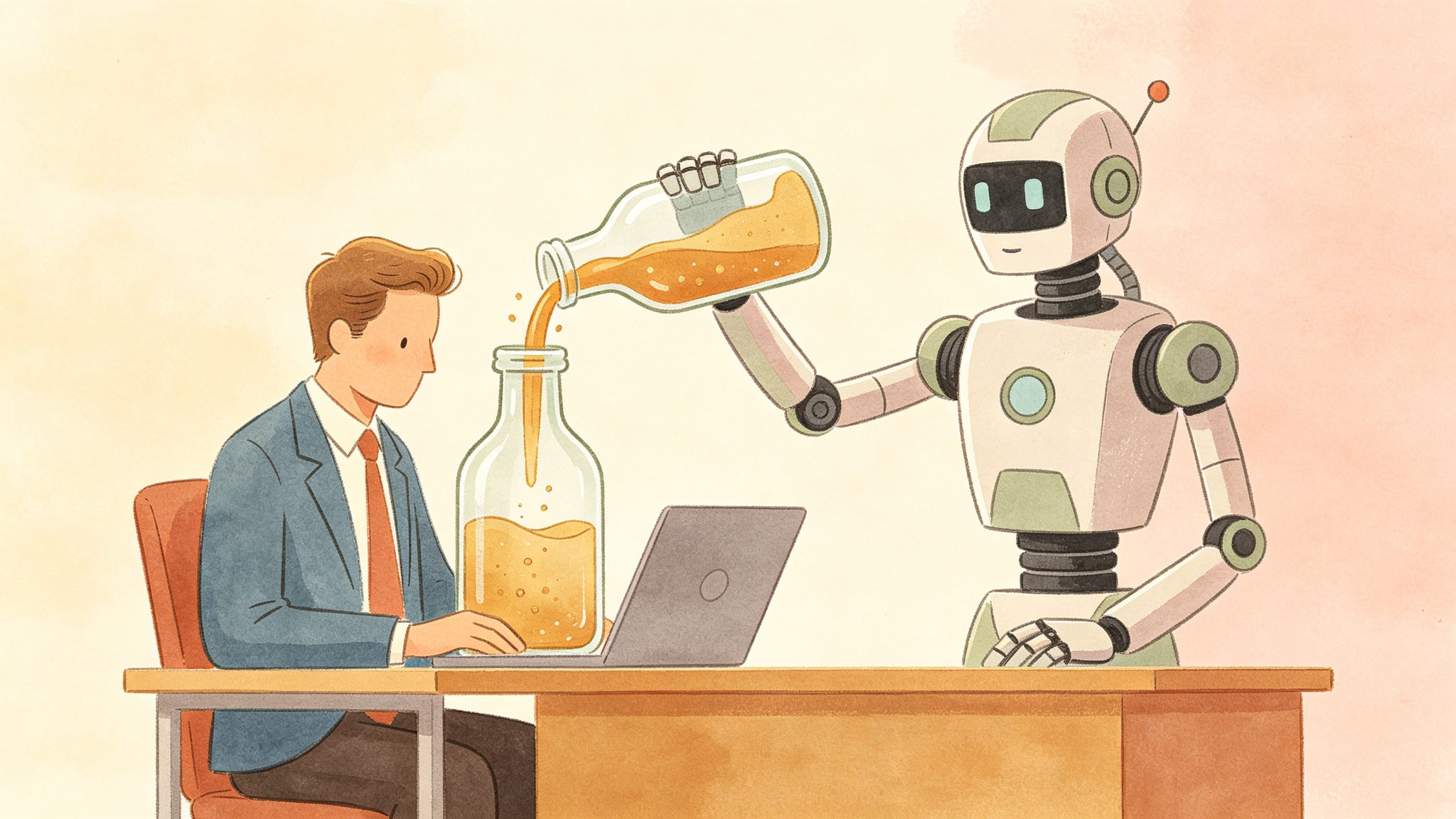
A tool only moves when you call it. The copywriter says "Codex, polish this for me," and after it's done, the byline still belongs to the copywriter — the delivering entity is the human. This is tool thinking: AI is your takeout, you place the order and it's delivered.
An employee delivers first, and you make the judgment. The AI writes the front-end page first, and the designer checks whether it's right; the AI produces the test report first, and the engineer assesses whether it's reliable. The delivering entity is AI; the human is the quality inspector. This is employee thinking: AI is your chef, and the dish is ready for you to taste.
The gap between the two — to put it mildly, saves each person two hours a day; to put it dramatically, triples the entire production line's human efficiency.
Jingling's company runs many internal AI workflows, and his feeling is more direct: the agent layer is already infinitely close to an employee form — "just missing a tiny bit of soul." After connecting to AI gateways like OpenClaw and Max, it's like a remote employee — it only works when you call it, and does nothing when you don't.
Where is the missing soul? Context.
"Bai Shuang used an analogy I found particularly piercing: when a company hires an intern and they don't convert after three months, it's often not an ability problem — it's that they don't understand the company's context. They don't know why this button is designed this way, what this field means for the business. After converting, after soaking in the business flow for a while, they truly integrate. AI is the same. AI without business-process context is a smart intern — it can do the work, but it doesn't hit the mark."
You might ask: just feed AI enough documents, right? Theoretically yes, but in practice, most companies' documentation is itself a tangled mess. Product docs don't match code comments, business rules don't align with system configurations, FAQs haven't been updated in six months. If you let AI learn in a "garbage in" environment, you only get "garbage out." So the context problem looks like an AI problem on the surface, but at its core, it's an enterprise informatization problem.
OPCs Are Flying, Big Companies Are Crawling
There's a counterintuitive phenomenon here.
The companies with the best AI employee deployment aren't tech giants — they're OPCs (one-person companies) with fewer than 10 people.
Wang Liqun observed this clearly. OPCs have simple business models, extremely high human efficiency, and business flows that are easy to decompose — AI replacement comes with no baggage. Bai Shuang's platform is a typical example: globally recruiting experts in segmented fields, who write their know-how into agents and subscribe/distribute them across various AI terminals. One person is a business line; AI is their amplifier.
But what about traditional big companies? They're anxious out of their minds and can't move.
Wang Liqun summarized three blockers. First, insufficient trust. Traditional businesses have near-zero fault tolerance — when AI can't be perfect on the first try, the enterprise bears the consequences. Who signs off? No one dares.
Second, organizational inertia. Large companies' architectures are designed for "people collaborating with people," not "people collaborating with AI." After switching, how do you evaluate, report, and promote AI employees? The HR manual doesn't have this chapter, yet the job postings still say "proficient in Office preferred."
Third, system complexity is severely underestimated. ERP, CRM, OA — various legacy systems where humans act as information porters. How does AI integrate into these SOPs? It's not solved by spending a few hundred thousand on a system; it's a long-term transformation. To be blunt, many companies' digital foundations are already shaky — adding AI on top isn't adding flowers to the brocade; it's adding snow to the frost.
Li Jinglin (李京林) added a perspective from organizational size. A 10-person team using AI has minimal friction. But at 50, 100 people, problems start surfacing. His company has just over 100 people, and internally they're already debating: should the group uniformly use Claude Code, or let each team choose? Some use Claude Code, some use Codex, some use Cursor — inconsistent code styles, and friction during handoffs.
It's like 10 years ago without AI — some people used Office, some used WPS, document formats incompatible. But back then it was just a format issue; now it's about code quality, logical consistency, and context transfer — the impact is much greater.
The Biggest Blocker: Nobody Wants to "Distill" Themselves to AI
Bai Shuang posed a question: "How many employees in an enterprise are willing to distill themselves to AI?"
Distill — this tech pun is well-deployed. In large model training, when knowledge transfers from a complex model to a smaller model, it's called distillation. Bai Shuang applies it to people: are employees willing to hand over their experience, judgment, and know-how to AI, let AI learn it, and then have AI do it better than they can?
The answer is likely: no.
"Bai Shuang has seen this phenomenon at big companies. Employees will secretly use AI to boost efficiency, but won't say it publicly, let alone deposit prompts and workflows as company assets. Why? Once AI learns it, their own irreplaceability disappears. 'AI saved me work' can be whispered, but 'I've taught AI my life's worth of expertise' is something nobody wants to say at the annual meeting. That's human nature — it has nothing to do with technology."
Even more brutal is another point: most positions' judgment is mediocre to begin with. Bai Shuang put it sharply: writing skills — if a person's judgment is mediocre, AI won't make you excellent; it will amplify your mediocrity. Who should write them? Only those with true know-how and continuous iteration ability. And these are precisely the people least likely to be eliminated in AI-native organizations — they'll become "feedback agents," continuously training AI and forming iterable company assets.
Bai Shuang added another cut: many enterprises' first reaction to AI transformation is dumping the work on the IT department. But IT understands technology, not business — asking them to write skills is like asking a chef to design a car. Not impossible, but it'll likely go off the rails. The ones who should write skills are the top business experts — those who've soaked on the front lines for ten years and know where every pit is.
So you see: AI transformation looks like a technology problem on the surface, a management problem underneath, and a human-nature problem at the deepest layer.
Li Jinglin corroborated this from another angle. He said teams not deep in AI are probably not yet at the "accountability" stage — they're still at the "ineffective" stage. Many companies bought tools, opened accounts, sent notifications, thinking they're doing AI transformation, but employees just keep working the old way and AI is a decorative piece. These teams don't need accountability mechanisms — they need to start doing the work.
100 People Plus AI Isn't Cutting to 30 — It's Doing the Work of 500
Li Jinglin raised a contrarian view I think is particularly worth expanding.
Now there's an unhealthy trend in the AI industry: everyone thinks AI is for layoffs. A 100-person product team, cut down to 30 with AI, ROI looking beautiful.
Li Jinglin doesn't see it that way. His exact words: "After adding AI to 100 people's combat power, can it achieve the combat power of a historically 500-person team — rather than cutting 100 down to 30?"
People are a resource, not a cost. This sounds like chicken soup, but it gets hard when you add numbers. 100 people + AI achieving 500 people's combat power — if ARPU stays the same, revenue goes up 5x. But cutting to 30 saves costs while potentially missing scaled growth opportunities.
His logic is clear: to truly reach 10M ARR, 20M ARR, 50M ARR levels, you can't do it with two or three people. OPCs now live like fighter jets among solo businesses, but saying they can take down Salesforce? Wake up. Ultimately, you need to scale human numbers first, then combine with AI, to get big results.
"The way to use AI isn't to reduce headcount — it's to replace people. Replace those who can't perform or can't work with AI, while maintaining headcount growth, and add AI to achieve a more efficient flywheel. That's the right answer."
Bai Shuang's platform logic is right here. What she recruits globally are "individuals with expert know-how and continuous iterative learning ability." Note this modifier — it's not enough to be an expert; you must also be able to iterate and structure your know-how. This kind of person is not the object of replacement in an AI-native organization; they are the core asset.
Think of it another way: customer success complexity grows linearly. Serving 10 customers vs. 100 customers requires a different order of magnitude in relationship management and memory management. AI can help you remember every customer's preferences, every project's progress, the context of every decision — that's the true moat of scale. 30 people serving 100 customers — service quality will definitely collapse. 100 people + AI serving 500 customers — everyone is actually more relaxed.
Harness: The Reins Are in Human Hands, but the Horse Has Already Bolted
When it came to AI governance, permission boundaries, and accountability mechanisms, several guests offered interesting views.
Wang Liqun believes that in the future enterprise, there will be a class of people called "builders" — AI constructors. If AI malfunctions within designed boundaries, find the builder; if the AI consumer misuses it, find the consumer. Unintended consequences beyond design scope are shared by the organization.
Chen Yefeng (陈叶峰) was more direct: AI has no sense of loss, no moral sense, and doesn't need to bear responsibility. Accountability can only land on specific people.
Bai Shuang used a word: Harness. This term is common in AI safety. But the Harness Bai Shuang means isn't the technical dimension — it's the organizational dimension.
She explained it vividly: the human-AI relationship is like riding a horse. A horse without reins runs wild; humans put reins on horses because humans want to harness the horse. The English word for reins is "harness."
How do you harness AI in an enterprise? Things that frequently go wrong in development — can they be internalized into skills, put into the process, so they never happen again? When merging new businesses, create new business processes, new roles, new AI positions based on AI-native thinking, continuously optimize, and deposit data as assets. That is harness.
Sounds abstract? In plain terms: turn "the pit we stepped on this time" into "a rule that automatically avoids it next time." Not re-teaching every new hire, but writing lessons into skills so AI remembers. A company's most valuable thing shifts from "human experience" to "iterable digital assets."
Chen Yefeng agreed with the metaphor but added: the rider is the human, AI is the horse, and the subject is the human in control.
He also mentioned an easily overlooked point: AI lacks the interpersonal relationships between people, and has no desires. In any organization, relationships between people are subtle — AI doesn't have this subtlety. AI has no desires, so it can't autonomously acquire or capture information; it needs human control and guidance.
His core philosophy is human force. AI employees currently only have a certain level of understanding and tool-calling capability; the information they access lives in the digital world, and context is largely missing. Why do you need humans? Because humans need to grasp these and feed them to AI.
This view forms an interesting echo with Bai Shuang's "distillation." On one hand, people don't want to distill themselves to AI; on the other hand, AI can't live without human feeding. It seems like a paradox, but the business world has always found balance within paradoxes.
"Li Jinglin's attitude toward 'accountability' is what I think is the most grounded line of the entire session: 'If an enterprise reaches the stage where it needs to hold AI accountable, congratulations — that's a good thing. It means the team has reached a very deep stage.' Under normal circumstances, most teams haven't reached the accountability stage because they haven't produced effective results yet. At this stage, there's no need to obsess over who takes the blame. When problems arise, do a retrospective. Big problems grow the team; small problems that don't affect survival just iterate."
The Organization Isn't Honest Enough, People Aren't Honest Enough
After listening to the entire roundtable, one feeling grew increasingly strong.
On AI employees, the technology has long been ready. Codex can write code, Claude can read documents, various agents can run workflows. What's stuck isn't that the model isn't smart enough — it's that the organization isn't honest enough, and people aren't honest enough.
Bosses want AI employees but aren't willing to restructure the organization. Employees want to use AI for efficiency but aren't willing to distill themselves. Everyone wants to find a new continent on the old map, but that probably won't work.
Bai Shuang said something at the end that left a deep impression. She said that most companies doing AI transformation based on their current architecture may find that the paradigm shift simply flips the table. Some publishers' product is books, but in the future it may no longer be books — it may be the author's digital avatar. The entire process and positions based on book publishing may no longer be needed.
The meal is still there, but the plate holding it has changed — and the people holding the plate must change too.
Bai Shuang's company can achieve fully automated product development not because they bought some magic tool, but because the CTO put thought into the top-level design of the entire process. Not letting developers each use Codex in small collaborations, but designing the business process at the company level, giving AI the context, and having humans make judgments.
Is this hard? Technically, no. But there aren't many people willing to do it.
At the end of the day, AI employees aren't a hiring problem — they're a management revolution. It's not the IT department's job — it's the top leader's project. It can't be solved by buying a tool — it requires reconfiguring people as resources and redesigning processes around AI as employees.
"Jingling says his 100-person team is still working through the switching friction between Claude Code and Codex internally. Bai Shuang says her organization has already achieved end-to-end automation. Where's the gap? Not the tool — the mindset. Harness thinking: the reins are in human hands, but the horse has already started running. Are you ready to put on the reins, or are you still standing there discussing 'will the horse get spooked'?"
More Conversation Details
Speakers
BISHENG Solutions Director Wang Liqun (王立群)
Leapility Founder & CEO Bai Shuang (白双)
DeerAPI CEO Li Jinglin (李京林)
EgonexAI Founder Chen Yefeng (陈叶峰)
Host
Unique Capital VP Huang Jingrui Jerry (黄璟睿)
Jerry: Please each introduce your business in one to two minutes. Starting with Ms. Wang.
Wang Liqun: I'll start. Hello everyone, I'm Wang Liqun from Beijing Data Pixel Intelligent Technology Co. The company is based in Beijing, but also has branches and R&D centers in Shanghai and Shenzhen. We've been building enterprise B2B agent development platforms since 2023, focused on the B2B market. Our clients over the past few years have mainly been large state-owned enterprises and Fortune 500 companies, helping them with AI transformation.
Bai Shuang: Hello everyone, I'm Bai Shuang — you can call me Shuangshuang. We're currently based at Mosu Space. The underlying logic of what we're doing is that we believe large models represent general-purpose services in the future, but there are still tremendous opportunities in professional services. Professional services are more driven by expert individuals — a multi-centric market. So we're currently globally recruiting individuals with expert know-how in various segmented fields who also have continuous iterative learning ability, building solo businesses on our platform. That is, their expert agents can be subscribed and distributed across various AI terminals, forming subscription-based services — which is what we call an OPC. We're more focused on expert-type OPCs. The business has seen good validation overseas; as the domestic model ecosystem matures, we may also enter the domestic market. Thank you.
Li Jinglin: Hello everyone, I'm Li Jinglin — call me Jingling. We're one of the earlier platforms in China doing model token compute aggregation, mainly in the token compute space, serving a very large number of Chinese AI applications going overseas, and witnessing the rise of AI in overseas markets over the past two or three years. That's about it, thank you.
Chen Yefeng: Hello everyone, I'm Chen Yefeng, founder of EgonexAI. We're an overseas AI startup focusing on large model and agent understanding, and product and project development around the human force philosophy.
We did two projects this year. One is Understand Anything — building knowledge graphs based on knowledge graph, code understanding, and document understanding, helping people better understand the relationships across an entire codebase. Because AI generates massive code documentation during long-task execution, we can't keep up and need to better clarify relationships. This project has gained 74,000 stars on GitHub, ranked around 200 globally — it's also this year's star project.
The other product revolves around person understanding — building user digital avatars and long-term memory, and centering new AI-based organizational forms, helping people quickly and precisely connect with another person from across the internet at critical moments. AI doesn't perceive the physical world well, can't receive real-world changes, and many information pheromones are missing — making input extremely important in collaboration. Without input, output degrades. Input is a direction we've always researched.
What Is the Most Essential Difference Between AI Employees and AI Tools?
Jerry: In your view, what's the most essential difference between AI employees and the AI tools and assistants we've discussed in the past? How do you judge whether it can truly become a collaborator in the organization — what's the core standard? Starting with Ms. Wang.
Wang Liqun: Actually, AI employees — or digital employees — differ significantly from AI tools and assistants. The core point is that AI employees have autonomy. They can have their own OKR goals, decomposed from organizational or company objectives, and then autonomously complete task orchestration or interact and collaborate with others.
AI tools and assistants, on the other hand, mostly require temporary or session-level invocation by humans, requiring active human interaction. AI employees have autonomy — that's the core difference.
Jerry: The core is, first, autonomy.
Bai Shuang: Let me just give examples. We don't do B2B, but discussing this topic is our way, as an AI-native company, of telling everyone how we use AI ourselves.
I strongly agree with the points just raised, combined with two examples from our company. The product development department has already fully achieved end-to-end automation, achieving AI autonomy and human-in-the-loop.
For example, after a UI/UX designer finishes a prototype in Figma, the entire task board has a process set up in Notion. Participants include the UI designer — after design, AI automatically develops the front-end page. For points that can't be faithfully rendered, the UX designer leaves a comment in Notion, and AI picks it up and modifies based on the comment. After the front end is complete, it enters back-end development — we use Codex. After development, there's an automated test agent with many personalized skills that runs tests based on this. After testing, the test engineer does a final check; for things that keep failing despite repeated fixes, the CTO does the final check.
This process deposits a lot of product-feature-specific experience. Once AI makes a mistake, it won't make it again — it adds cases to the development skill to ensure it has best practices, forming human-AI collaboration across the entire flow from front-end development to back-end testing to final launch.
What's very important in this process is that the CTO did the top-level design of the entire process first. Not letting any developer just use Codex in small collaborations — the company must have business process design. The human role is more about judgment; AI has the context of the entire business process, knows what its role is, and the result requires a human whose judgment exceeds AI to do the final check.
Another example: writing copy. When our copywriter says "Codex, polish this for me," that dimension is a tool — the delivering entity is still the copywriter. It's not like R&D where AI delivers first and humans judge.
So the delivering entity is different. If AI is truly to play a role in the organization, it must have context and know the business process. It's like when a company hires an intern who doesn't convert — they don't understand the company well enough, participating without context. When they convert, they understand the company's personalized business in the business flow and truly integrate, rather than existing as a general-purpose agent.
These are two examples I thought of for how to distinguish tool-level vs. employee-level.
Jerry: Sounds like human-AI collaboration, with AI taking a higher proportion — the last mile is guarded by humans.
Bai Shuang: Correct — the human role isn't delivery; the human role is judgment.
Li Jinglin: I quite agree with Shuangshuang's view. Internally, we've done a lot of AI workflow process optimization — we're an AI-native team doing token. The company has completely unlimited compute; everyone freely uses the latest models and things — FDE 5, 5.6, various video and image models.
Looking at enterprises from a stage perspective, the agent layer has to some extent approached an employee form — just missing a tiny bit of soul. At the technical level, it's infinitely close. Adjusting the agent further, connecting to AI gateway entries like OpenClaw and Max, to some extent it's like a remote-working employee.
On this basis, it's what Shuangshuang just said: human-AI combination, where humans gradually stop doing execution and only do judgment and know-how, because AI does make mistakes. We've had some phenomena internally — when AI becomes the main entity, human know-how becomes very important. You might get performative reporting, with exaggerated use of AI, and managers can't judge whether the know-how in AI-generated reports is correct — problems easily arise. Now any reporting can be done very quickly, producing very detailed documents in a short time. Working with outsourcing vendors, the same problem arises: the outsourcing proposal looks very professional at first glance, but when you search through the professionalism for clues, there are still errors — it can't be perfect.
How humans solve the middle know-how problem is something to watch out for. It's a bit like the Industrial Revolution — starting to mechanize, previously all workshops, and in between you still need humans to manage the machines. In the future it might be like today's factories becoming lights-out factories; in the virtual space, a year later it might be human-led. Internally, some stages are also starting to be AI-led with humans assisting AI, with AI deciding and executing, and humans only monitoring the process. In the future, humans revolve around AI, and the overall organizational structure of AI employees will truly emerge. That's about it.
Chen Yefeng: I quite agree with Jingling's thinking — humans are still very important in this stage.
The so-called AI employees now only have a certain level of understanding and tool-calling capability; there's still a gap from true employees. This is where I slightly differ from everyone. There's still quite a gap — the information pheromones they access live in the digital world, and context is largely missing. Why do you need humans? Humans need to grasp these and feed them to AI.
Jerry: It sounds like human-AI collaboration is still the future trend — you can't give everything to AI.
AI Can't Enter the Main Process: What's the Core Blocker?
Jerry: The second question focuses on landing obstacles. Some enterprises don't lack AI pilots or demos, but AI can't enter the main process or key positions. In your view, what's the core blocker?
Wang Liqun: We have a lot of insights to share on this, mainly doing the B2B market.
Over these two years, AI employees that have truly landed are OPC-type companies. OPC business models or business structures are relatively simple, hiring within 10 people, or even three to five people running the business. The business is relatively simple, easier to decompose into positions for AI to replace, organizational context is simpler, AI handles a larger proportion of work, and human gap-filling is relatively minimal.
The much larger traditional B2B market and traditional companies are a different story. Many companies are very anxious, clearly knowing that with AI coming they must transform — without transformation they'll definitely be eliminated — but not knowing where to start. Several key issues are not just technical but more organizational.
Especially for large traditional companies: first, trust in AI employees is far from enough. The original business system has very little fault tolerance; when AI can't be perfectly accurate on the first try, the enterprise has to bear the consequences. That's the first point — the trust problem isn't solved.
Second, organizational inertia exists. The larger the company, the more its original organizational structure is designed for human collaboration, not for AI employees or AI-native ways of operating. Switching to this way — how to manage mechanisms, people, including AI employees — hasn't been solved yet; in the future it may be a new management discipline.
Third, the complexity of AI truly integrating into enterprise business processes is widely underestimated. Large traditional enterprises have very complex businesses with lots of legacy software systems — ERP, CRM, various systems — where humans switch back and forth doing information porter work. How AI integrates into complex systems to complete SOP execution is a fairly complex problem. It's not solved by spending a few hundred thousand or a million on a system; it's a long-term transformation process.
Bai Shuang: Before answering this question, let me raise one: in the AI era, what most companies should be thinking about is whether the product they deliver to users is no longer the same in the AI era? And based on that, think about internal organizational processes.
A simple example: some publishers' product is books, but in the future it may no longer be books. The entire process based on book publishing — if you assume you're still publishing books, various positions form the organizational architecture around the product. But if what you deliver in the future is the author's digital avatar as an electronic deliverable, the entire organizational architecture no longer needs the previous book-publishing cohort.
If a company says it wants to do AI transformation based on its current architecture, the paradigm shift may simply flip the table. So enterprises should think about whether the product they offer in the AI era is still the same product, and based on that, reverse-engineer the organizational architecture needed in the future. That's the first point.
The second point is whether there is truly high-level design — whether there's a process with humans and AI, or whether you just empower all employees to use AI autonomously. The latter is not a very smart approach. On one hand, token consumption is enormous; on the other, some people still treat AI as a tool rather than a partner. To be a partner, you first have to hand over the know-how in your position to AI. This involves human nature — how many employees in an enterprise are willing to distill themselves to AI? At big companies, even those who know how to use it won't say it publicly: "AI saved me work" — but they won't deposit it as a company asset.
Moreover, most positions have mediocre judgment. How many people in the company have top-tier judgment? Writing skills — if your judgment is mediocre, AI won't make you more excellent; it will amplify your mediocrity. Thinking about who writes skills is very important. Letting those with true know-how and continuous iteration ability write skills — they won't be eliminated; instead, they become feedback agents in AI-native organizations, forming continuously iterable company assets. Their judgment continuously learns new knowledge as the external and competitive landscape changes and feeds it back to AI.
If I were CEO, this person would be incredibly valuable — with continuous learning ability. Society changes too fast; yesterday's experience can't serve tomorrow's needs. Like, before Douyin came out, did anyone imagine livestream e-commerce? Marketing methods change earth-shatteringly.
The truly valuable employees in an enterprise have super learning ability, deeply cultivated in the industry, and participate in process design and skill authoring. With processes comes feedback, continuous iteration, and the company becomes an AI-native company with continuously iterating and evolving AI assets. That's what I think.
Jerry: At the end of the day, the organizational architecture is still the big blocker.
Bai Shuang: The biggest blocker is human nature. Many companies haven't figured out who should participate in organizational architecture upgrading, and don't think it should be developers. Speaking of AI, many companies give the work to IT, but IT doesn't have industry know-how. A simple example: would a Fortune 500 apparel company's IT person possibly know what audit points to watch when legal procures fabric? Construction shouldn't be given to technicians; it should be delegated to business experts — and TOP business experts at that. That's the point I want to make.
Li Jinglin: This breaks down into several dimensions. First, by industry — why do different enterprises have different levels of AI adoption. Today's venue is the AI industry, which is special. The onstage guests and friends here all have internal AI processes that are at the cutting edge across China. Their consciousness started from the very beginning of founding the company from the forefront of AI technology — a top-leadership project poured down.
So internally, AI has no organizational resistance problem. The top-leadership project faces more questions: are skills well-built, is agent collaboration in place, can everyone using Codex form a team version? How to use AI to restructure the flow between people and organizational efficiency — these are the problems. They don't face the consciousness gap of traditional enterprises, where the top leader or middle management can't understand MCP, skills, agents, FDE, and it's hard to pour down to the bottom or middle layers.
Second, it has a lot to do with organizational headcount. I agree with Ms. Wang that OPCs will definitely have the highest AI level — the starting point is a one-person company, few people, must use AI for efficiency. At 10, 20, 30, 50 people, you're already facing whether the flow of AI organization within has friction and resistance. Everyone uses different software. Internally they're already discussing whether the group should uniformly use Claude Code — some use Claude Code, some use Codex, with automatic preferences in between, and some use Cursor. Friction arises in between, and ultimately the output and code style also show friction. Looking back, this friction existed 10 years ago without AI — different software usage habits, some using Figma, some using other software, inconsistent formats — same principle. But at the organizational friction level, with more people you face more serious problems: pouring down to 100, 200, 300-person teams.
One is the budget problem — token burning is endless. Sometimes companies use models internally with unlimited tokens, everyone using FDE 5, not researching whether cheaper models can meet the work, just going straight to the best. But for enterprises at 100-200 people, the consciousness poured down means token cost is very high. It's impossible for everyone to optimize their workflow. Should we save tokens and use cheaper models? There may not be this KPI or awareness. These are all problems of AI in larger enterprises.
But I have a reflection: there's now an unhealthy trend in AI — everyone thinks AI should be used to solve layoffs and efficiency. Originally 100 people, a 50-person product team, cut to 20 with AI. I don't think that's the direction. An enterprise isn't necessarily stronger with fewer people; people are a resource, not a cost. If people are treated as costs, that itself is a management problem. After adding AI to 100 people's combat power, can it achieve the combat power of a historically 500-person team — rather than cutting 100 down to 30? Sometimes you miss scaled growth opportunities.
OPCs are in a particularly good state now, but whether an OPC can become a sector leader is unrealistic. Ultimately, you still need to scale human numbers first, then combine well with AI, to get relatively big results in the sector. To truly reach 10M ARR, 20M ARR, 50M ARR levels, it's impossible with two or one person. So when using AI, the consideration isn't headcount reduction or layoffs — you should replace those who can't perform or can't work with AI, but should maintain headcount growth while adding AI to achieve a more efficient flywheel. That's the future direction.
Chen Yefeng: Employees and AI in enterprise organizations can't align context — everyone uses different agents, or even if the same, the history is different. Each employee's cognition of the enterprise's past experience and knowledge can't be brought to the same horizontal line. Once the input on the front end is biased, it leads to large-scale output errors, with very big impact. That's one aspect.
Additionally, AI lacks the interpersonal relationships between people. In any organization or enterprise, relationships between people are subtle — AI doesn't have that. And it has no desires. Right now AI needs human control and guidance; without desires, it can't autonomously acquire or capture. When a person is hungry they want to eat, thirsty they want water — AI doesn't. At least research hasn't reached this part yet; it still relies more on humans, and can't be promoted at scale in the main process. That's how I see it.
When Something Goes Wrong With AI, Whose Fault Is It?
Jerry: We just discussed organizations and blockers. If AI employees take on important responsibilities in the enterprise, what should the permission boundaries, responsibility attribution, and governance mechanisms look like? When AI affects business results and something goes wrong, whose fault is it?
Wang Liqun: This was mentioned earlier. The future organizational form will definitely be human-AI collaboration. This question was discussed a couple of years ago, but there's still no accurate answer — it's a relatively big topic involving a new management paradigm. At the current stage, there can be some exploration or bold statements.
When AI发挥 in the organization as a digital employee, first there needs to be an upper-level management committee or board to set governance mechanisms. Previously, management was about people collaborating; now you need to define how people and AI collaborate — this is needed and can't be ignored.
Second, there's industry consensus: in the future enterprise, there will be a class of people called builders — constructors of AI employees or AI tools. When AI tools or digital employees malfunction within designed boundaries, you first find the builder's responsibility. Additionally, the AI consumer in the organization — when using AI tools or digital employees improperly, you pursue the consumer's responsibility.
Finally, during human-AI collaboration, the technology itself continuously iterates and develops, with huge future space for change. If outside the design scope, AI produces unintended or adverse business consequences, the organization bears it together. Basically that's the form — helping enterprises transition and transform during continuous technology iteration.
Bai Shuang: Two points. First, assuming a future AI-native organizational approach, where the business flow is designed well from the company's top-level architecture, with very clear roles for what AI should do and what humans should do, then accountability can be achieved. For example, in R&D testing, AI has testing, and after testing, the test engineer makes the final decision on whether to release. There's a responsibility-subordination relationship between human testers and AI testers, making accountability clear.
For people involved in workflows, from what we've seen, related to company business segments — different business segments like marketing, product development, etc. — there are relatively senior people with AI-native thinking who understand the business doing the design, and the design is also related to the final effect — this person can also be held accountable.
I don't really want to discuss accountability; it's more about how to make AI controllable in the enterprise. The big idea is harness — but the harness I'm talking about isn't the technical dimension. General-purpose AI as an underlying model is uncontrollable because it has no boundaries; anything with boundaries becomes controllable. In the future, the human-AI relationship is like riding a horse — without reins it may run wild; the horse needs reins because humans want to harness the horse. The English word for reins is "harness."
How do you continuously harness AI in the enterprise? For example, things that frequently go wrong in R&D — can they be internalized into skills placed in the development process, so that mistake never happens again? When merging new businesses, create new business processes, new people, new AI positions based on AI-native thinking, continuously optimize, and deposit data as assets — essentially that's harness.
Making AI controllable means having harness thinking — the mindset is very important. No one has a final answer on specific implementation approaches yet; it's a dynamic development process. Enterprises here should also embrace change — technology continuously develops, prepare for continuous iteration, and don't assume decisions made now are definitely correct.
Li Jinglin: If an enterprise reaches the stage where it needs to hold AI accountable, congratulations — that's a good thing. It means the team has reached a very deep stage. Under normal circumstances, many teams not deep in AI are probably ineffective and haven't reached the accountability stage yet. Reaching the accountability stage means the organizational flow and execution-layer AI-ification are both quite deep — not just the agent but the entire workflow and team collaboration.
At this stage, as Shuangshuang says, there's no need to obsess over accountability. When problems arise, do a retrospective. Big problems grow the team; small problems that don't affect survival — retrospective and iterate. It can't be like the old human way — AI isn't human to begin with, has no emotions, and pursuing the person above sometimes affects team enthusiasm. Using AI faces many problems — maybe model problems, workflow problems, internal code problems — it will make mistakes. If you pursue the owner, will the owner dare use it next time? If you push the whole team and something goes wrong and it's your problem, what then?
So we're not at that stage — just do it. If from a consciousness perspective you believe the entire company should be AI-native and endorse the direction, you have to accept any errors that may arise in between. Before the industrial revolution, like Ford's automobile industrial revolution workflow — making shoes was handmade in workshops; preparing for scaled machine production, there must be many problems in between, even employee injury issues. When problems arise, you have to bear them because you're prepared to go in this direction. As an entrepreneur or company executive deciding to push this, you also have to subjectively accept the problems that arise in between.
Chen Yefeng: It mainly comes down to specific people. AI has no sense of loss — even if a loss mechanism is designed, it's not a physical-world life, has no moral sense, and doesn't need to bear responsibility. So it still has to come down to specific people.
Reframing the question: in the future world, is the subject human or AI? Will humans still exist in the future? Does development fully turn to silicon-based life, with humanity eliminated? I don't think so — impossible. Everything developed, all human civilization progress, is derived from human needs; it must be human-centered.
Right now the mainstream narrative in North American Silicon Valley is silicon-based life full automation as a new paradigm, but I think this defies reality. Like I just said about reins — the rider is the human, AI is the horse, you harness it, but the subject is the human in control.
Jerry: Reins, right?
Chen Yefeng: Correct. And current technical paradigms are still very far from these things — we really haven't reached that step. So it still has to come down to specific people, ultimately landing on humans.