
Original · Unique Research · 2026-08-14
Editor's note: The first-person report and its judgments belong to the original Chinese author. This English rendition retains the opening essay, four insight sections, closing reflection, speaker list, and the full roundtable transcript. The title's "Haven't Even Mastered Doubao Yet" is attributed to the original author's framing, not a universal consensus. User, revenue, and market figures are speaker self-reports attributed to the named individuals, not independently audited findings.
AI Industry Observation
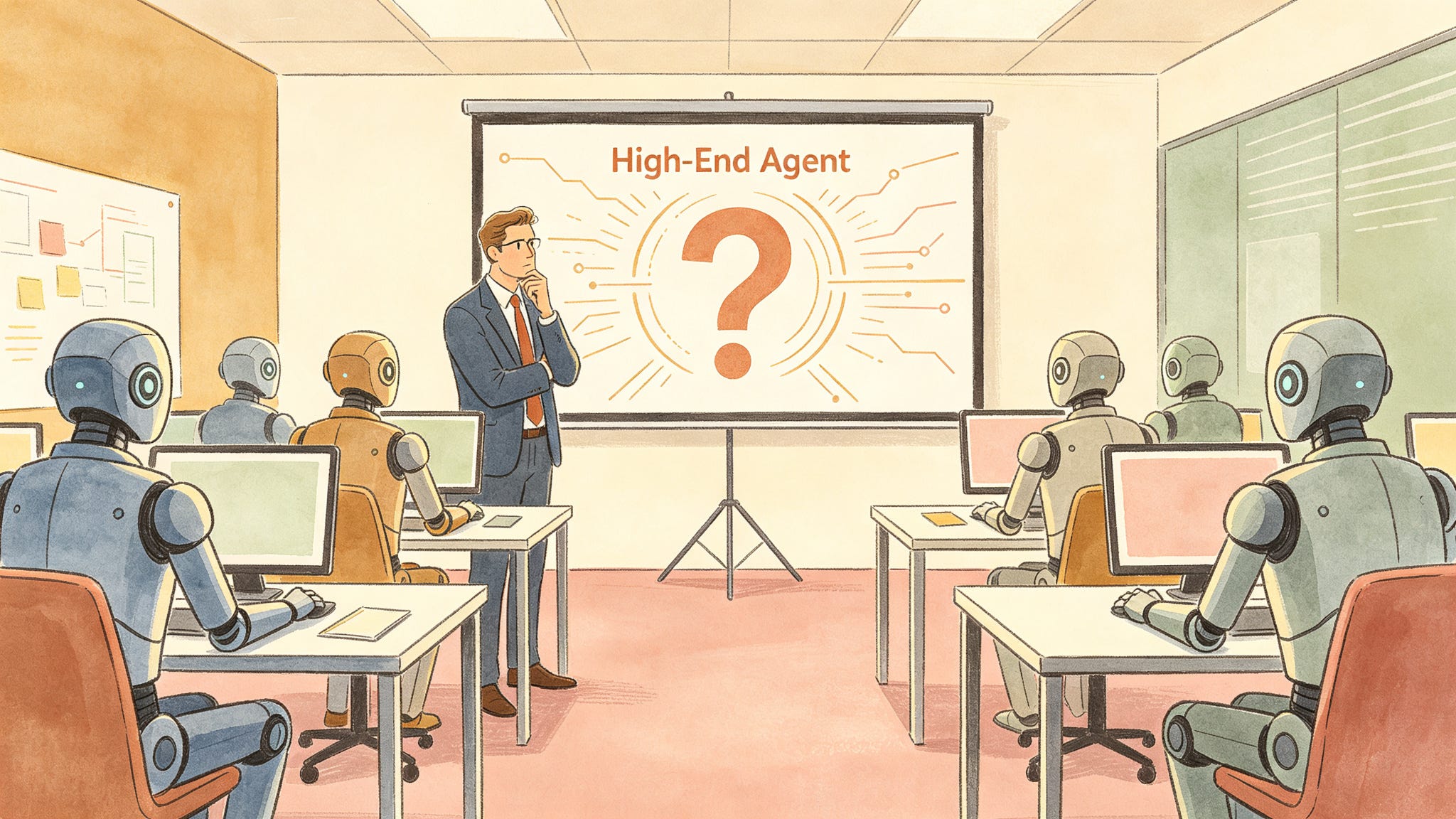
"Today's high-end Agent story is all fantasy."
The person who said this is Wang Xiangcheng (王相承), co-founder of Kouling (叩零). A company that does enterprise-grade Agent implementation. On one hand, he says "we've actually helped ByteDance deploy 160,000 Doubao digital employees; many business teams' daily active usage increased over 60%." On the other hand, he bluntly warns: "I've seen companies that have used Doubao for years but never fully grasped its prompt engineering; they say they're doing Agents — in my view, they've just written scripts."
This is the most vivid opening of an entire roundtable I've attended.
On August 13, the Unique Grand Awards · Shanghai AI Business Summit held a "High-End Agents Don't Brag; Real Implementation at First." The panelists were: Wang Xiangcheng from Kouling, Wang Yu (王禹) from Bojun Intelligence (伯俊数智), Zhou Jiaming (周家鸣) from Baihai AI (白海AI), Gao Ting (高亭) from Muse AI (缪斯AI) — also founder of the "AI Four Great Invention" community — and Zhao Qiyu (赵启予), CSO of Chaoxi Tech (潮汐科技). The host was Digital China's Zhou Yong (周勇).
Five founders, zero PPT, zero grandstanding. Over two hours, they talked about the biggest lie in the Agent space, why enterprise-grade Agent landing is a systematic project, what "high-end Agent" actually means, and where the money really is.
The result: the high-end Agent story everyone hears at conferences — fancy demos, model stacking, cross-platform orchestration — the people actually doing enterprise Agent deployment say: "That's not an Agent; that's a ChatGPT dressed up as a digital employee."
Below are the highlights from the entire conversation. If you're an entrepreneur, investor, or enterprise manager doing Agent implementation, these real-world lessons may save you six months of detours.
The Biggest Lie in the Agent Space: You're Not Building an Agent; You're Just Writing Scripts
At the start of the event, the host Zhou Yong threw out the topic: "Why are we all talking about Agents, but the industry still feels like it hasn't truly arrived?"
Wang Xiangcheng didn't hesitate. He came prepared: "What do I think today's Agent space is most hyped about? It's the fantasy of the high-end Agent story."
He defined it clearly: there are three kinds of products on the market today called "Agents." The first is ChatGPT with a pretty interface — actually just a large-model wrapper. The second is the LangChain chain-type tool that calls APIs in sequence — actually just a workflow. The third is truly autonomous decision-making and execution in complex enterprise scenarios, like an employee taking orders and completing tasks with a goal.
"Three different things all called Agent. If you're not doing the third, you're not doing an Agent. Most of what's being called 'high-end Agent' out there today is actually just scripts dressed in Agent clothing."
Wang Xiangcheng gave a standard: how do you tell if an Agent is real? Put it in a real enterprise scenario. Give it a task. Watch whether it can decide independently, adjust when things go wrong, and ultimately deliver a result that the business recognizes. If it can only perform fixed actions in fixed flows, it's RPA with a new coat.
"Why are there so many illusions? Because the market needs stories. The capital market needs valuation stories, the vendor ecosystem needs product story narratives, but the enterprise client only cares about one thing: did you save me money or make me money? If not, no matter how fancy the Agent, it's just a ChatGPT that costs more money."
Gao Ting from Muse AI (缪斯AI) added: "The most common mistake I see is teams treating Agents as technology rather than as business people. Technology is easy; the hard part is understanding which employee you're replacing, what their KPI was, what tools they use, what their day-to-day work looks like, and how you measure whether the Agent has done better than them. This is not a technical problem; it's an organizational problem."
Wang Yu from Bojun Intelligence has the numbers. His company serves large retail and consumer goods clients; they've built over 20,000 enterprise models and deployed over 50,000 digital employees, with over 1,000 corporate clients. His judgment: "I don't oppose the term Agent, but what I oppose is calling every text-generation tool an Agent. In the enterprise, what we do is call it a digital employee. The difference is: a digital employee has a position description, has KPIs, has onboarding, has performance reviews, and can be promoted or fired. If you can't answer these questions, your so-called Agent is just a chatbot."
Wang Yu said something even sharper: "When you call it an Agent, the client thinks it's smart, so they expect it to solve all problems. When you call it a digital employee, the client knows it's a new employee who needs training, hand-holding, and time to prove themselves. The word difference changes the client's expectation, and expectation determines whether the project succeeds or fails."
Enterprise-Grade Agent Landing Is a Systematic Project, Not Just Plugging In a Model
Gao Ting talked about a real case. His team was doing an Agent project for a large consumer goods company. The client initially said: "We've bought Doubao, integrated it internally; the technology is there, so why do you need to help?"
Gao Ting asked: "How many people on your team use Doubao every day? How many people have been trained? Who is the internal Doubao champion? What do you do when Doubao makes a mistake?"
The client fell silent.
"Most enterprises are like this. They think buying a large model API is using AI. But the truth is, most employees have never used Doubao in a business scenario. They know it can write copy, but they don't know it can analyze sales reports, generate pricing recommendations, or automatically reconcile inventory. The gap between technology and employees is bigger than you think."
He summarized enterprise Agent landing in three layers:
The first layer: employees who actually use it. If no one uses it, nothing works.
The second layer: processes that can be digitally transformed. You must have digitized business before you can have an Agent automate it. If your warehouse staff still do things on paper, no Agent will help.
The third layer: models that truly understand the business. This isn't a generic model; it's a model fine-tuned on your enterprise data, your industry terminology, your customer voice.
"These three layers form a stack. Skip one and it collapses. Most vendors only talk about layer three — building models and platforms. But the client's real problem is layer one: no one uses it."
Zhou Jiaming from Baihai AI brought a different perspective. His team does Agent operations for a lot of cultural tourism and retail clients. He said: "I want to give everyone a different angle — let's talk about ROI from the user's perspective."
He gave a data point: "We had a client in the cultural tourism space. They deployed an Agent for ticket booking and customer service. In the first month, the Agent handled 30,000 conversations. Human customer service handled the remaining 10,000. The Agent's resolution rate was 78%; human resolution rate was 85%. On the surface, humans were better. But the Agent cost a tenth of a human employee's salary, and it handled the peak hours when no human would work. The client calculated: after three months, the payback period was already clear. Why? Because in the cultural tourism industry, customer service peaks during holidays. You can't hire a team for two weeks of peak and fire them afterward. The Agent can."
Zhao Qiyu from Chaoxi Tech added: "Everyone says ROI is hard to calculate. But actually the simplest ROI is headcount. If an Agent replaces one FTE, the savings are clear. If it augments an FTE and lets one person do what two used to do, that's also clear. The hard part is when it augments but doesn't replace — how do you measure that? We've found that if you can't quantify it in headcount, you can quantify it in customer satisfaction, in response time, in error rates. Pick one and measure. The problem isn't that ROI is unmeasurable; it's that enterprises haven't defined their success metric before starting."
Zhou Jiaming concluded: "I see two types of clients. One type comes in and says 'I want an Agent.' We ask them what problem they want to solve; they can't say. These projects usually fail. The other type comes in and says 'I have 50 customer service agents; the cost is too high; can you help me reduce 30%?' These projects usually succeed. The difference is: do you have a clear goal, or do you just have a trend."
What Is a "High-End" Agent? Not More Models, but Better Process
The host raised the question: everyone says they're doing "high-end" Agents. What does high-end actually mean? Is it more models? More complex workflows?
Wang Xiangcheng said: "I've seen too many so-called high-end Agents that are just multi-model routing. Call Doubao when the task is simple, call DeepSeek when it's hard, call GPT when it's the hardest. Is that high-end? No. That's just model shopping. Real high-end means the Agent knows when to use which model, why it chose that model, and what to do when the model fails."
He gave an example: "We built an Agent for a client that automatically generates marketing copy for 5,000 SKUs. On the surface, it's just calling a model API. But the real complexity is: how do you ensure the copy complies with advertising law? How do you ensure the brand tone stays consistent across 5,000 products? How do you know when the model hallucinated a fake ingredient? These aren't model problems; they're process problems. High-end Agent means wrapping the model with a review system, a compliance check, a brand voice validator, and a feedback loop. The model is the engine, but the Agent is the car — you need wheels, steering, brakes, and a driver."
Wang Yu from Bojun Intelligence made a useful distinction: "I'd divide Agents into three levels. Level one is single-turn Q&A: 'Write me a product description.' Level two is multi-turn task completion: 'Analyze this sales data and propose three promotion strategies.' Level three is autonomous goal execution: 'Improve our store conversion rate by 15% in the next quarter.' Most vendors are at level one. A small number are at level two. Level three is where we're heading but haven't arrived yet. When people say 'high-end Agent' at conferences, they're usually talking about level three. But 90% of actual implementations are level one. That's the gap between narrative and reality."
Gao Ting added: "I want to reframe this. 'High-end' doesn't mean more complex; it means more embedded in the business. An Agent that helps a factory worker check production quality in real time is more valuable than an Agent that can write a thousand-line essay but has no connection to revenue. The question isn't how smart the Agent is; it's how close it is to the money."
Zhao Qiyu gave a market observation: "In the market, I see two camps. One camp says 'we have a universal Agent platform; bring your use case and we'll configure it.' The other camp says 'we build vertical Agents for specific industries — retail, manufacturing, finance.' The universal platform sounds great but usually fails because every industry has different data, different rules, different compliance. The vertical approach takes longer but sticks. Our advice to enterprises is: don't buy a universal Agent; buy an Agent that has already been deployed in your industry, because the hard part isn't the technology — it's the domain knowledge that's been accumulated through hundreds of deployments."
Where Is the Money? From "Efficiency" to "Revenue"
The last topic was the most direct: where is the money in Agents?
Wang Yu said: "The biggest market isn't replacing back-office staff; it's in revenue-generating roles. Think about it: a customer service Agent saves you 10,000 RMB a month. A sales Agent that generates one additional order a month earns you 100,000 RMB. Which one will the client pay more for? The ROI conversation changes completely when you move from cost reduction to revenue generation. The problem is, revenue-generating Agents are harder to build because they have to understand your product, your customers, your pricing, your competitors. Cost-saving Agents are easier but have lower ceiling."
He continued: "In retail, the highest ROI Agent isn't the one that writes copy; it's the one that recommends products to customers in real time and increases basket size. In manufacturing, the highest ROI Agent isn't the one that drafts reports; it's the one that predicts machine failure before it happens and reduces downtime. The money is where the P&L statement is."
Zhou Jiaming said: "I want to share an uncomfortable truth. Right now, most Agent projects are in cost reduction: customer service, back-office operations, document processing. These are easy to sell because the CFO can see the savings. But cost reduction has a ceiling — you can only cut so many people. The growth will come from revenue: Agents that help sales, Agents that help marketing, Agents that help product teams decide what to build next. Those are harder to build but the ROI is an order of magnitude higher. The companies that figure this out first will own the next wave."
Wang Xiangcheng said: "Let me be very specific. We had a client in e-commerce. We built an Agent that monitors 20,000 products daily, tracks price changes, and automatically adjusts pricing within rules. In the first quarter, it helped the client increase gross margin by 3.2%. On a revenue base of 500 million RMB, that's 16 million RMB in additional gross profit. The client pays us 800,000 RMB a year. That's the ROI conversation you want to have — not 'we saved you two customer service headcounts,' but 'we put 16 million RMB on your bottom line.' When you frame it that way, the budget fight changes."
He added: "The other thing I'd say is: don't underprice your Agents. Many vendors price their digital employees like software subscriptions — a few thousand RMB a month. But if your Agent is generating revenue or saving costs at a much higher level, you should price it as a share of the value you create, not as a software license. The market will pay for outcomes, not for seats."
Gao Ting closed the topic: "I'll say something provocative. The Agent industry right now is like the cloud computing industry in 2010. Everyone knows it's the future, but everyone's business model is still 'renting compute.' We haven't figured out the outcome-based model yet. In cloud computing, the shift from IaaS to PaaS to SaaS was about moving up the stack and capturing more value. The Agent industry needs the same shift: from 'we rent you an Agent' to 'we deliver business outcomes.' Whoever figures that out first will be the Salesforce of Agents."
Written at the End
I kept thinking about something Wang Xiangcheng said: "Most companies in China have over 30 million enterprises; very few have actually mastered Doubao. They say they're doing Agents, but they've never even done basic prompt engineering on a chatbot."
This isn't condescension. It's a reality check.
We've spent two years talking about AGI, about multi-agent systems, about self-driving software engineers. But in most Chinese enterprises, the AI adoption story is still at the stage of "we bought a Doubao enterprise account and told everyone to use it." No training, no process redesign, no measurement, no iteration.
The people on this panel aren't dreamers. They're the ones in the trenches — deploying digital employees for 1,000+ clients, building 20,000+ enterprise models, handling millions of Agent tasks. Their message isn't "Agents are dead." It's: stop fantasizing about level three autonomous agents. Start with level one. Teach your employees to use Doubao. Document your processes. Find the one workflow that costs you the most. Automate it. Measure it. Iterate.
"The high-end Agent story is a fantasy for people who don't have clients. The real Agent business is grinding, one implementation at a time, in places no keynote speech will ever reach."
More Conversation Details
Speakers
Wang Xiangcheng, Co-founder, Kouling (叩零)
Wang Yu, Founder & CEO, Bojun Intelligence (伯俊数智)
Zhou Jiaming, Director, Baihai AI (白海AI)
Gao Ting, Founder, Muse AI (缪斯AI) / AI Four Great Invention Community
Zhao Qiyu, CSO, Chaoxi Tech (潮汐科技)
Host
Zhou Yong, Digital China (神州数码)
Zhou Yong: Thank you everyone for being here. Today's topic is "High-End Agents Don't Brag; Real Implementation at First." We have five founders who are actually doing enterprise Agent deployment, not just talking about it. Let's start with quick self-introductions.
Wang Xiangcheng: I'm Wang Xiangcheng, co-founder of Kouling. We do enterprise-grade Agent implementation. We've helped ByteDance deploy 160,000 Doubao digital employees, and for many clients, daily active usage increased over 60%. We also do private deployment for large enterprises. Our view is simple: Agents are not a technology play; they're a business operation play.
Wang Yu: I'm Wang Yu, founder and CEO of Bojun Intelligence. We focus on retail and consumer goods enterprise clients. We've built over 20,000 enterprise models and deployed over 50,000 digital employees, serving over 1,000 corporate clients. We call them "digital employees," not Agents, because we think the enterprise needs to understand them as a workforce, not as a technology.
Zhou Jiaming: I'm Zhou Jiaming from Baihai AI. We do Agent operations for cultural tourism and retail clients. We've handled over 1 million Agent tasks and built 12,000+ bots for our clients. Our focus is on deployment and operations, not just technology.
Gao Ting: I'm Gao Ting, founder of Muse AI and the AI Four Great Invention community. We do enterprise Agent implementation across industries. I've seen too many clients buy a model API and think they're doing AI. We're here to tell you what actually happens on the ground.
Zhao Qiyu: I'm Zhao Qiyu, CSO of Chaoxi Tech. We do vertical Agent solutions — mainly retail and manufacturing. We've deployed over 2,000 Agents across 35% of our clients being non-Chinese companies. Our focus is on measurable outcomes.
Zhou Yong: Great. Let's dive into the first topic. Why is there such a gap between the Agent narrative and what enterprises are actually experiencing?
Wang Xiangcheng: I think the biggest lie in the Agent space is the "high-end Agent" fantasy. There are three types of products called Agent on the market. The first is a ChatGPT wrapper with a nice UI. The second is a LangChain chain that calls APIs in sequence — basically a workflow. The third is true autonomous decision-making in complex enterprise scenarios. If you're not doing the third, you're not doing an Agent. Most of what's called high-end Agent today is just scripts dressed up.
How do you tell if it's real? Put it in a real enterprise scenario. Give it a task. Can it decide independently, adapt when things go wrong, and deliver a business-recognized result? If it only performs fixed actions in fixed flows, it's RPA with a new coat.
Gao Ting: The most common mistake I see is treating Agents as technology rather than as business people. Technology is easy. The hard part is understanding which employee you're replacing, what their KPI was, what tools they use, what their day looks like, and how you measure whether the Agent did better. This is an organizational problem, not a technical one.
Wang Yu: I don't oppose the word Agent. What I oppose is calling every text-generation tool an Agent. In the enterprise, we call it a digital employee. A digital employee has a job description, KPIs, onboarding, performance reviews, and can be promoted or fired. If you can't answer those questions, your Agent is just a chatbot. And when you call it an Agent, the client thinks it's smart and expects it to solve everything. When you call it a digital employee, the client knows it's a new hire who needs training. The word changes the expectation, and expectation determines project success.
Zhou Yong: Let's move to the second topic. What are the actual pain points in enterprise Agent deployment?
Gao Ting: I'll give a real case. A large consumer goods client told us: "We bought Doubao, integrated it internally, the technology is there, why do you need to help?" I asked: how many people use Doubao every day? How many have been trained? Who's the internal champion? What happens when it makes a mistake? They were silent.
Most enterprises are like this. They think buying a model API is using AI. But most employees have never used Doubao in a business scenario. The gap between technology and employees is bigger than you think.
I'd say enterprise Agent landing has three layers. First, employees who actually use it — if no one uses it, nothing works. Second, processes that can be digitally transformed — you need digitized business before an Agent can automate it. If your warehouse still uses paper, no Agent helps. Third, models that truly understand the business — not a generic model, but one fine-tuned on your enterprise data, terminology, and customer voice. Skip one layer and it collapses. Most vendors only talk about layer three, but the client's real problem is layer one.
Zhou Jiaming: Let me give a different angle — ROI from the user's perspective. We had a cultural tourism client. They deployed a ticket booking and customer service Agent. Month one: the Agent handled 30,000 conversations; humans handled 10,000. Agent resolution rate was 78%; human was 85%. On the surface, humans won. But the Agent cost one-tenth of a human salary, and it handled peak hours when no human works. In cultural tourism, customer service peaks during holidays — you can't hire a team for two weeks and fire them. The Agent can.
Zhao Qiyu: Everyone says ROI is hard to measure. But the simplest ROI is headcount. If an Agent replaces one FTE, savings are clear. If it augments and one person does what two used to, that's also clear. The hard part is augmentation without replacement — how do you measure? If you can't quantify in headcount, quantify in customer satisfaction, response time, or error rates. Pick one. The problem isn't that ROI is unmeasurable; it's that enterprises haven't defined their success metric before starting.
Zhou Jiaming: I see two types of clients. One says "I want an Agent" but can't tell you what problem to solve. These projects usually fail. The other says "I have 50 customer service agents, costs are too high, help me cut 30%." These usually succeed. The difference is a clear goal vs. just following a trend.
Zhou Yong: Third topic: what does "high-end" Agent actually mean?
Wang Xiangcheng: I've seen too many so-called high-end Agents that are just multi-model routing — Doubao for simple tasks, DeepSeek for hard ones, GPT for the hardest. Is that high-end? No, that's model shopping. Real high-end means the Agent knows when to use which model, why it chose that model, and what to do when the model fails.
We built an Agent for a client generating marketing copy for 5,000 SKUs. On the surface, it's just calling an API. But the real complexity is: how do you ensure compliance with advertising law? How do you keep brand voice consistent across 5,000 products? How do you catch hallucinated fake ingredients? These aren't model problems; they're process problems. High-end Agent means wrapping the model with compliance checks, brand validators, and feedback loops. The model is the engine; the Agent is the car — you need wheels, steering, brakes, and a driver.
Wang Yu: I'd divide Agents into three levels. Level one is single-turn Q&A: "Write me a product description." Level two is multi-turn task completion: "Analyze this sales data and propose three promotion strategies." Level three is autonomous goal execution: "Improve store conversion rate by 15% next quarter." Most vendors are level one. A small number are level two. Level three is where we're heading but haven't arrived. When people say high-end at conferences, they're talking about level three, but 90% of implementations are level one. That's the gap.
Gao Ting: I want to reframe this. "High-end" doesn't mean more complex; it means more embedded in the business. An Agent that helps a factory worker check production quality in real time is more valuable than one that writes a thousand-line essay disconnected from revenue. The question isn't how smart the Agent is; it's how close it is to the money.
Zhao Qiyu: In the market I see two camps. One says "we have a universal Agent platform, bring your use case." The other says "we build vertical Agents for specific industries." The universal platform sounds great but usually fails because every industry has different data, rules, and compliance. The vertical approach takes longer but sticks. Our advice: don't buy a universal Agent; buy one already deployed in your industry, because the hard part isn't the technology — it's the domain knowledge accumulated through hundreds of deployments.
Zhou Yong: Final topic: where is the money?
Wang Yu: The biggest market isn't replacing back-office staff; it's revenue-generating roles. A customer service Agent saves you 10,000 RMB a month. A sales Agent that generates one additional order earns you 100,000 RMB. Which will the client pay more for? The ROI conversation changes when you move from cost reduction to revenue generation. Revenue-generating Agents are harder to build because they need to understand your product, customers, pricing, and competitors. Cost-saving Agents are easier but have a lower ceiling.
In retail, the highest ROI Agent isn't the one writing copy; it's the one recommending products in real time and increasing basket size. In manufacturing, it's not the one drafting reports; it's the one predicting machine failure before it happens. The money is where the P&L statement is.
Zhou Jiaming: An uncomfortable truth: right now most Agent projects are in cost reduction — customer service, back-office ops, document processing. These are easy to sell because the CFO sees savings. But cost reduction has a ceiling — you can only cut so many people. Growth comes from revenue: Agents that help sales, marketing, and product teams decide what to build next. Those are harder but ROI is an order of magnitude higher. The companies that figure this out first will own the next wave.
Wang Xiangcheng: Let me be specific. An e-commerce client: we built an Agent that monitors 20,000 products daily, tracks price changes, and auto-adjusts pricing within rules. Quarter one: gross margin up 3.2%. On 500 million RMB revenue, that's 16 million RMB in additional gross profit. The client pays us 800,000 a year. That's the ROI conversation — not "we saved you two headcounts," but "we put 16 million on your bottom line." Also, don't underprice your Agents. Many vendors price like software subscriptions — a few thousand a month. But if your Agent creates that level of value, price it as a share of outcomes, not as seats.
Gao Ting: Something provocative: the Agent industry is like cloud computing in 2010. Everyone knows it's the future, but the business model is still "renting compute." We haven't figured out outcome-based pricing yet. Cloud shifted from IaaS to PaaS to SaaS — moving up the stack and capturing more value. Agents need the same shift: from "we rent you an Agent" to "we deliver business outcomes." Whoever figures that out will be the Salesforce of Agents.
Zhou Yong: Thank you all for a very honest discussion. Let me close with one question for each: what's the one piece of advice you'd give to an enterprise starting their Agent journey today?
Wang Xiangcheng: Start with the most painful workflow in your company. Don't start with a grand vision. Find the one process that costs the most people and time, automate it, measure it, and iterate. Don't try to build an "enterprise Agent platform" on day one.
Wang Yu: Define the job description first. Before you build anything, write down what the digital employee would do, what KPIs they'd have, and how you'd evaluate them. If you can't write that job description, you're not ready for an Agent.
Zhou Jiaming: Start small and measure fast. Pick one team, one process, one month. If it doesn't show measurable improvement, stop and rethink. Don't deploy across the whole company on day one.
Gao Ting: Train your people first. The technology is already available. The bottleneck is that your employees don't know how to use it. Spend more on training than on tools.
Zhao Qiyu: Buy industry-specific, not universal. The hardest part isn't the model; it's the domain knowledge. Choose a vendor that has already done this in your industry, not one that claims to do everything.