
Original · Unique Research · 2026-08-17
Editor's note: This is a first-person personal essay. The voice, anecdotes, growth-marketing framework, and all platform results belong to the original Chinese author, a 26-year-old former Kuaishou growth product manager. This English rendition retains the complete first-person narrative, sections, headings, and numbers. The "100,000 followers in 40 days" result and all personal experience claims are the author's self-reports, not independently verified findings. Platform names and company references are preserved as the author uses them.
AI Industry Observation
I'm 26, and I used to be a growth product manager at Kuaishou.
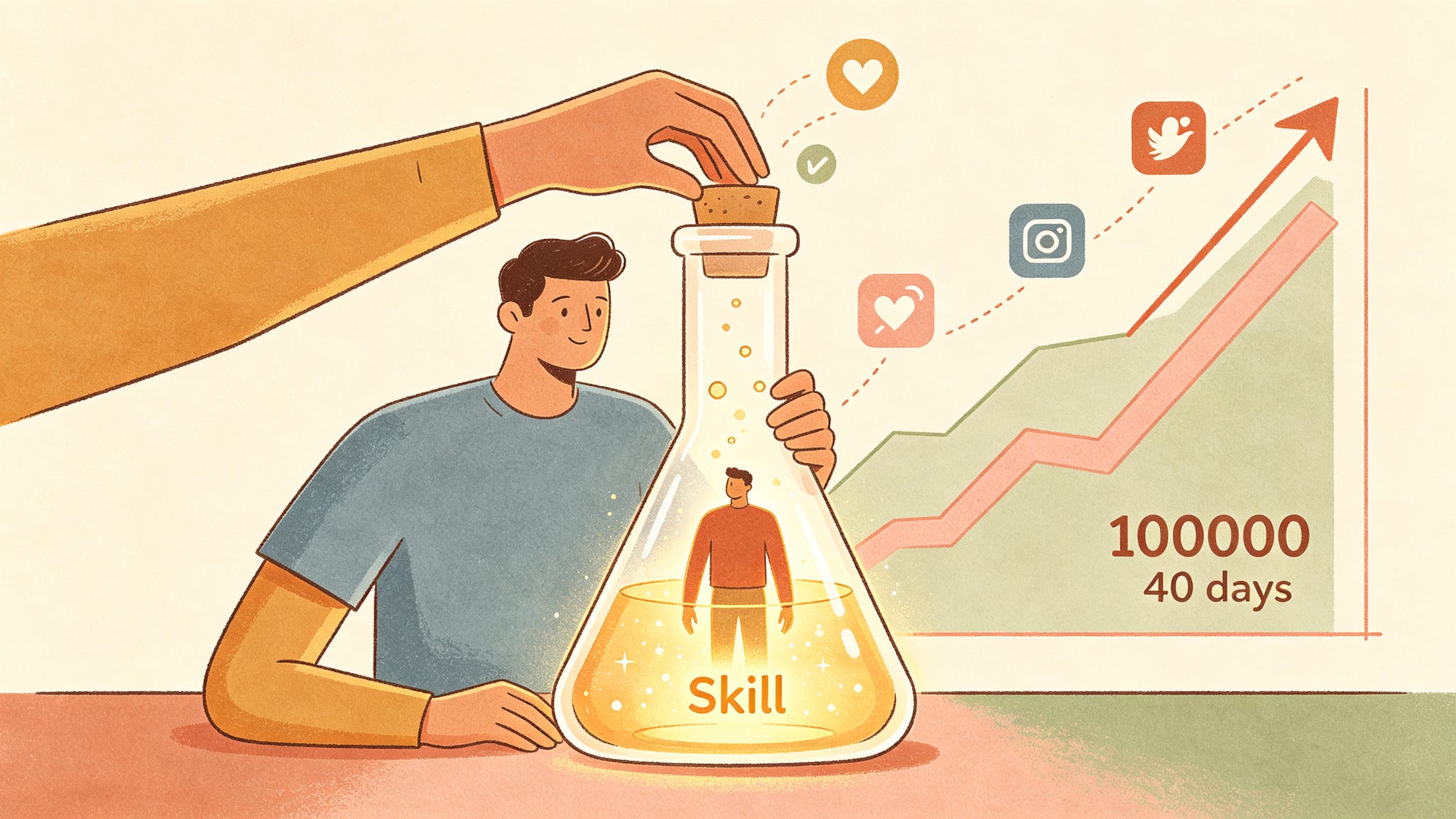
Over the past 40 days, I built two accounts from zero to 100,000 followers across Douyin and Xiaohongshu. Not with luck, not with douyin paid pushes, and definitely not by "posting and praying." I did it by treating myself as the model to be distilled.
Most people using AI to make content are asking the wrong question. They ask: "How do I use AI to write faster?" The real question is: "How do I turn myself into a Skill that an AI can run on my behalf?"
This is the full method.
Let me start with what I got wrong first.
In my first two weeks, I did what everyone does: I opened Doubao, wrote a prompt, got an article, posted it. The data was terrible — single-digit likes, a handful of views. I'd spent years doing growth at Kuaishou, and I knew distribution better than most, but the content itself felt generic. It sounded like AI because it was AI.
Then it hit me. The problem wasn't the model. The problem was me — I hadn't given the model anything worth reproducing. A model can only regurgitate what you feed it. If you feed it "write a viral tech post," you get generic sludge. If you feed it the actual operating system of how you think, what you've seen, what you believe — you get something that sounds like you, at scale.
This is what "self-distillation" means. In model training, distillation takes a large, expensive teacher model and compresses its knowledge into a smaller, cheaper student model. I applied the same logic to myself: I am the teacher model. The Skill I built is the student. The goal isn't to replace me — it's to let a machine produce output at my quality bar while I sleep.
The difference from "prompt engineering" is total. A prompt is a one-off instruction. A Skill is a compiled, persistent version of how you make decisions. It doesn't forget your tone, your examples, your judgment calls between a good post and a bad one.
I didn't build it in one go. It took four layers, and each layer took a week of grinding.
The first thing to distill isn't knowledge — it's voice. Readers don't follow a topic; they follow a person. So I dumped every piece of content I'd ever written that I was proud of into a single document — old growth notes, internal Kuaishou memos, posts I'd made. Then I had the model analyze what made them sound like me.
The output wasn't a style guide. It was a list of concrete, observable rules: I open with a specific number or scene, not a thesis statement. I use "you" more than "one." I end sections with a slightly provocative line, not a summary. I never say "in conclusion." These weren't vibes; they were replicable instructions.
Once those rules were written down, every post the Skill generated automatically followed them. I stopped having to rewrite the opening paragraph.
This is where most people stop at "give the AI my articles." That's not enough. My internal knowledge base isn't my public content — it's the stuff I know from years of doing growth that I'd never put in a public post.
I dumped: my notes on how Douyin's recommendation system actually behaves, the difference between Xiaohongshu's search traffic and feed traffic, the failure modes I'd watched friends walk into, the numbers from campaigns I'd run. All of it, unfiltered. The Skill now has access to a database that no external creator has, because it's mine.
This is the moat. Anyone can copy my surface style. No one can copy the ten years of messy, private operational experience sitting in my notes folder.
Here's the part that made the real difference. Templates make generic content. Decision rules make consistent content.
Instead of writing "here's a template for a hook," I wrote the judgment itself: "Given a topic, pick the hook angle that creates the strongest contradiction with what the audience already believes. If two angles are equally strong, choose the one that costs me less to make. Never use a question as a hook unless I can answer it in the first sentence."
These rules encode taste. The Skill doesn't just assemble words; it makes the same calls I would make about what's worth saying and what's boring. When a post underperforms, I don't edit the post — I edit the rule that produced it. That's how the system compounds.
The last layer is the one no one talks about. A Skill without feedback is a frozen model. Every week, I take the five best and five worst-performing posts of the week and feed them back in. The model learns which rules held and which ones betrayed me.
The first week, my best posts were the ones where I'd broken my own rules. By week four, the Skill was producing my best-post quality consistently, without me touching the keyboard. That's when I stopped being a content creator and started being a content operator — same as how I ran growth experiments at Kuaishou, but now the unit being optimized is my own personal brand.
Let me be honest about the window.
The reason a solo person can distill themselves into a Skill and out-produce a studio of ten people right now is that most creators are still using AI as a typewriter, not as a distillation target. The bar is low. The moment studios figure out they should be doing this too, the arbitrage closes.
But there's a structural reason this will keep working even then: distribution is fragmented across Douyin, Xiaohongshu, Bilibili, WeChat Channels, and now the overseas platforms. No studio can staff for all of them in every language. A well-distilled Skill, running across five platforms, outputting in two languages, is a cost structure no human team can match.
I also want to push back on one thing I keep hearing. People say "AI content will get flagged, platforms will crack down." In my reading of the past 40 days, the platforms don't penalize AI content — they penalize bad content. If the content is genuinely useful and the voice is consistent, the algorithm rewards it the same way it rewards any good creator. The crackdown is on farms spamming identical posts, not on a single operator who's systematized their own thinking.
The deeper shift is this: for the last twenty years, the scarce resource in media was distribution. Now distribution is mostly free — the algorithm will show anything decent. The scarce resource is voice and judgment. And voice and judgment are exactly the things that distillation can compress into a machine.
If you want to do this, here's the sequence that worked for me. Don't skip steps.
Week one: Stop posting. Spend the week writing down, in concrete and observable terms, how you actually decide what to say. Open your last twenty pieces of work and find the patterns you didn't know you had. This is the most uncomfortable week because you have to be honest about what's actually good.
Week two: Build the voice layer. Don't ask the model to "write like you." Give it the evidence of how you write and have it infer the rules. If you don't trust the inference, correct it — every correction is a permanent rule.
Week three: Build the knowledge base. Dump everything private. The public stuff is worth less than the operational notes you've never shared. The asymmetry is the whole point.
Week four: Build the feedback loop. Run the Skill on three posts a day, not one. You need enough data in a week to see which rules are lying. Edit the rules ruthlessly. A rule that produces a mediocre post three times in a row gets rewritten.
After four weeks, you should be spending about an hour a day. Not an hour writing — an hour reviewing what the Skill produced, editing the rules, and picking what to push harder. The rest of the time, the system runs.
A few honest notes.
I wasted the first two weeks trying to sound "expert." The posts that took off were the ones where I admitted I'd been wrong, where I showed my work, where I named a specific number from a specific campaign. Audiences smell authority as certainty, but they trust specific vulnerability. The Skill now defaults to "show the mess before the lesson."
I also underinvested in Xiaohongshu at the start. Douyin's feed rewards conflict and speed; Xiaohongshu rewards search-friendly, problem-solving content. The same post that flops on Douyin can become a top-10 result for a keyword on Xiaohongshu. One Skill, two distribution strategies — that took me three weeks to figure out.
The biggest mistake was thinking the Skill was a product I'd finish. It's not. It's a system I maintain. Every time I learn something new in my actual job, I have to feed it in, or the Skill starts producing yesterday's version of me. That's also the opportunity — a living Skill that gets more valuable the more you live.
I'm not special. I'm a 26-year-old who spent a few years on growth and happened to notice that the same loop we used to run on user retention — collect data, form a hypothesis, ship, measure, iterate — applies to personal brand. The AI just made the loop cheap enough for one person to run it at scale.
If you're reading this and you have ten years of something in your head — any industry, any craft — the question isn't whether AI can replace you. The question is whether you're going to be the person who distills themselves into a machine, or the person who waits to be displaced by someone who did.
I'd rather be the former. That's the whole point.