
Original · Unique Research · 2026-08-30
Editor's note: The first-person report and its judgments belong to the original Chinese author. This
English rendition retains the complete summit recap narrative, panels, named speakers, companies, and figures. Financial and deployment claims are speaker self-reports attributed to the named companies, not independently verified findings. Company and person names are preserved as source attributions.
AI Industry Observation
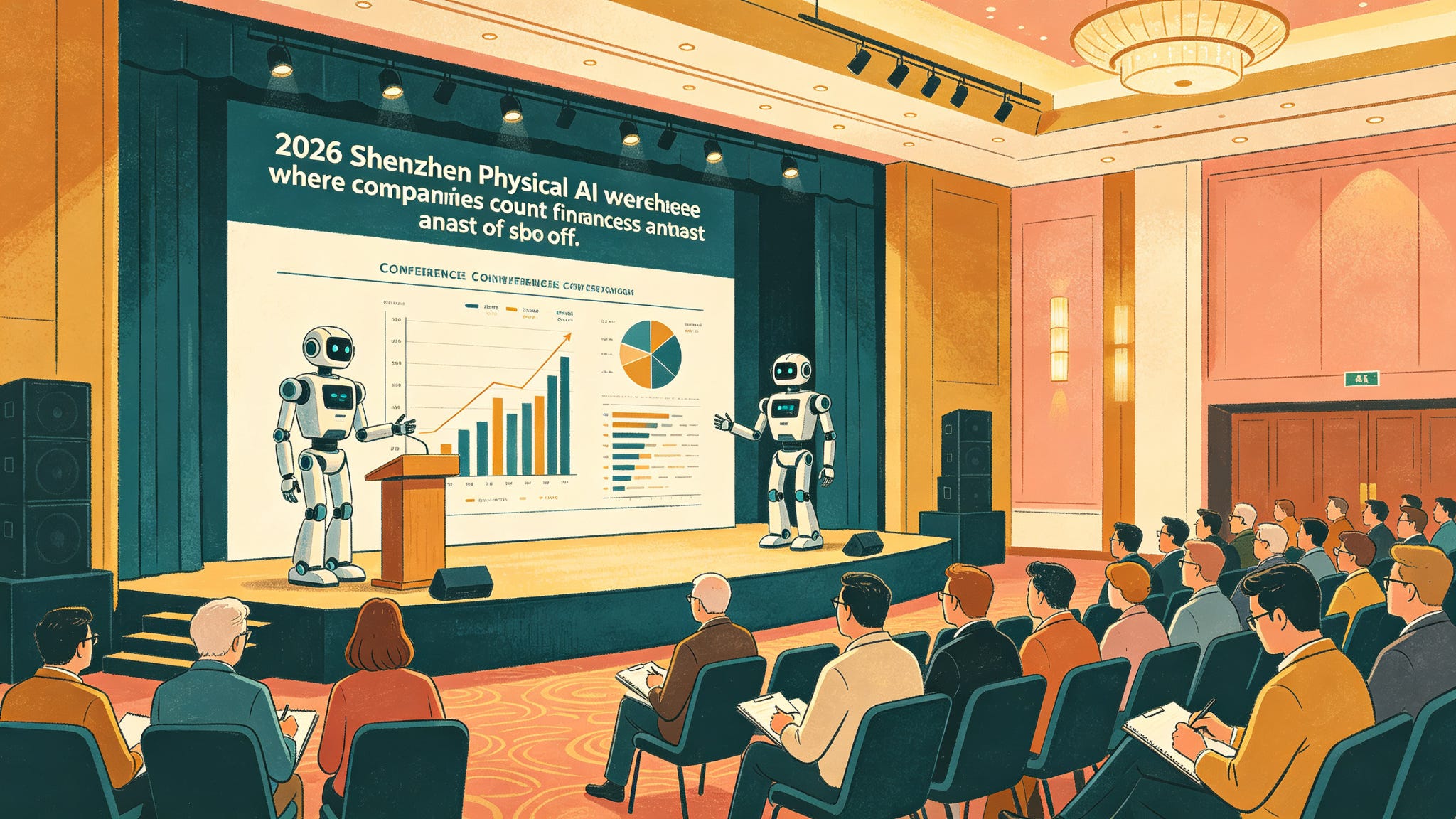
The most striking signal at this year's Shenzhen Physical AI Summit wasn't a new robot arm or a flashy demo. It was the questions on stage.
Two years ago, everyone at an embodied-AI summit wanted to show off dexterity: watch this hand flip a pancake, watch this robot walk a tightrope. This year, the first question a CFO asks a robotics founder is: "What's your unit economics?" The second is: "When does the cash conversion cycle turn positive?" The third is: "How many units have you actually shipped, not demoed?"
No one is showing off anymore. Everyone is counting the books.
That shift is the story of the 2026 Physical AI Summit. The hype cycle that peaked in 2024 has crashed, and the companies still standing are the ones that learned to run a business while building a robot.
The opening panel set the tone. A founder who'd raised a Series A on the strength of a viral warehouse-picking video admitted, to the room's laughter, that the demo ran on a tethered power supply and a human quietly correcting the vision model off-screen. "That robot could pick one item every forty-five seconds in perfect lighting," he said. "In our customer's actual warehouse, it picked one every three minutes and dropped one in six."
The industry's dirty secret, spoken out loud: the gap between a conference demo and a production deployment is not incremental. It is a cliff. Lighting changes, boxes deform, the conveyor jitters, a human walks through the frame. Each of those is a failure mode that no video on the internet prepared you for.
What changed this year is that customers, too, have stopped being dazzled. A manufacturing executive on a later panel said he now ignores any vendor who opens with a robot video. He asks for three things: a ninety-day pilot in his own facility, a service-level agreement on uptime, and a price point that beats the human worker he's trying to replace. "If the robot costs more than the temp worker it's supposed to displace, I'm not buying it no matter how clever it is."
This is the brutal math at the center of physical AI in 2026. The technology is real. The enthusiasm is real. But a robot that can't pay for itself in twenty-four months is a very expensive science experiment.
The most useful panels were the ones about who actually pays.
A consensus emerged: consumer humanoids are a sideshow. The money is in dull, repetitive, dangerous jobs where a human being is expensive, hard to hire, or risky to employ — factory floor, logistics sorting, hazardous inspection, last-mile in constrained environments. These customers don't care whether the robot has a face or can do a backflip. They care whether it reduces headcount by three people per shift and doesn't break the maintenance budget.
One logistics operator laid out his calculation in the bluntest terms. He runs a regional distribution center. A forklift driver costs him roughly a fixed monthly wage plus benefits, and turns over every nine months. An autonomous forklift, on a monthly subscription, works out to a defensible saving per shift — if uptime holds. His threshold is simple: if the machine saves one full human equivalent over three shifts, it gets bought. If not, it doesn't. "I'm not in the robotics business. I'm in the pallet-moving business. The robot is just a pallet-mover that happens to be electric."
The investor panel pushed back gently. The unit economics are still ugly for everyone except the most standardized use cases. But one partner noted that this is exactly how solar panels looked ten years ago: the first installations never broke even, the second batch did, the third batch printed money. Hardware cost curves, combined with software that improves with every deployment, have a habit of making today's math look silly in hindsight.
The disagreement wasn't about whether it works. It was about how long it takes for the cost curve to cross the labor curve in each specific vertical.
Beneath all the spreadsheet talk was a quieter anxiety: who builds these things?
A hiring director on a panel described the open roles he can't fill. He needs people who understand control theory, who can debug a vision model in production, who have shipped embedded software at scale, and who aren't already locked up at the big humanoid labs. The salary arms race has made even junior engineers expensive, and the few people with real deployment experience are poached within weeks.
The same founder who opened with the tethered-demo confession said his hardest problem isn't the model, it's finding field engineers who can spend two weeks in a customer's warehouse and make the robot behave. "The algorithm team is a luxury. The field team is the product. And the field team is a completely different kind of person — patient, practical, willing to troubleshoot a jammed gripper at midnight in a loading dock."
This is the gap between a lab and a company. The model can be rented from a foundation provider. The hardware can be assembled from suppliers. What you can't buy off the shelf is the accumulated operational knowledge of every way a deployment can go wrong.
As expected for a Shenzhen summit, supply chain came up constantly.
The pitch was familiar by now: China's hardware ecosystem means a robotics startup can iterate a mechanical part in three days that would take a month in most other markets. Actuators, sensors, structural components — the supply base is within an hour's drive of most of these companies' offices. Prototype costs and iteration cycles that would crush a US or Europe-based startup are routine here.
But the executives were honest about the limits of that advantage. Cheap parts don't solve software. A well-iterated mechanism still needs a controller that doesn't drift, a vision stack that handles a messy room, and a safety case that regulators and insurers will sign off on. The supply chain gives you the body. It doesn't give you the nervous system.
There was also real talk about going global. Chinese robotics companies face the same trust gap that every hardware exporter meets: overseas customers want local service, local compliance, and a supplier that won't disappear in eighteen months. Several founders said their hardest export problem isn't the robot itself but building a support organization in target markets before the demand arrives.
Near the end, a moderator asked for the one sentence each person wanted to leave with. The answers converged.
The era of showing off is over. Physical AI is now a manufacturing and operations business, not a research project. The winners won't be the company with the flashiest demo; they'll be the one that figures out the dull, expensive problems of reliability, service, and cost before anyone else. Customers will buy robots that quietly replace a boring job, not robots that perform on a stage.
One investor put it most memorably: "In software, you can ship a buggy version at midnight and patch it by morning. In hardware, a buggy version costs a customer a broken machine, a missed shift, and a service call to Shenzhen. That difference changes every decision you make. If you still think you're running a software company, you will fail."
The mood at the summit wasn't pessimistic. It was sober.
Two years ago, embodied AI was a story about the future. This year, it's a business about the present — payroll, unit economics, deployment timelines, and whether a robot can hold a part without dropping it. That sounds less exciting than a TED talk. But it's also the moment a real industry is born.
The companies still in the room at the end of 2026 aren't the ones with the best videos. They're the ones that learned to count the books first, and build the robot second.