
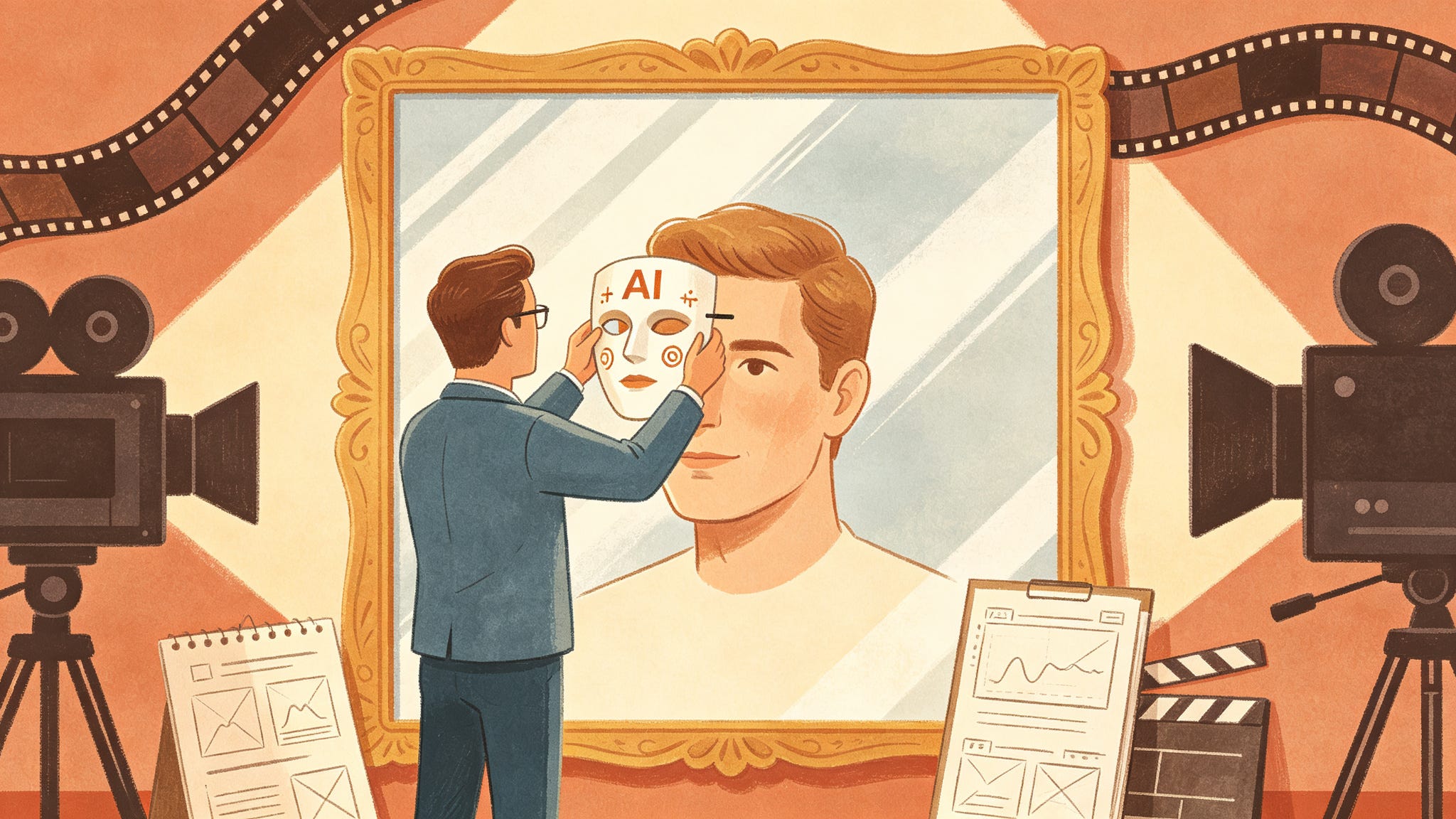
We already have too many images. What we’re really short on is: why shoot this image?
Someone who makes a living off AI says they increasingly don’t feel like they’re “studying AI.”
That’s Nanqiang Rylee. Originally a digital artist, now an AI film and TV director, producer, and art director. Their company is doing micro-dramas, commercials, and cultural tourism projects.
Across the whole conversation, the words that came up most were editing, narrative, lighting, composition — all old things that existed long before AI.
“The stronger AI gets, the less what I do feels like studying AI, and the more it feels like going back to creation itself.”
Nanqiang’s talk at this year’s GAIC was titled “AI Video Breakout: The Era of Premium Content Has Officially Arrived.” I asked why 2026 is the watershed year.
The answer had nothing to do with a new model release.
In the early years, people’s excitement about AI video mostly came from “it can actually do this.” The image moved. A person could speak stably. It generated a shot that could never have been filmed in real life. Everyone was amazed. At that stage, the technology itself was part of the content.
But by 2026, things changed.
“People used to treat AI as a gimmick. Now, the fact that an image is AI-generated is increasingly not a reason to watch it.” Audiences won’t automatically think it’s impressive just because “it’s made by AI.” Instead, they’ll judge it by normal film and TV standards: is the story good? Are the characters interesting? Is the shot comfortable? Can I keep watching?
“So I think this watershed isn’t about a model being released. It’s about the evaluation criteria changing. The previous stage was about ‘who can make it.’ Now it’s about ‘who makes it well.’”
Beautiful images are no longer a moat. When everyone can produce beautiful images, beauty itself becomes less scarce.
Nanqiang originally used AI as a design tool: fast, capable of generating concepts and styles, producing shots that used to be very expensive. But at that stage, “generating a pretty image” and “making a film” were still two completely different things.
What really changed their mind was realizing that many things that originally required different roles, different software, even different production stages, were starting to be connected. Traditional film pre-production is long, and many ideas get filtered out by cost before they’re even tested. For the first time, AI made it feel like what’s in a director’s head could be “seen” very quickly.
“What AI changes might not be a single job. It’s the entire creative path.”
Looking back at the changes over the years, the contrast is stark. When they first started with AI, most of the time was spent fighting the model: collecting assets, training styles, writing prompts, figuring out how to keep characters stable, how to make it not have an extra finger.
Now most of those technical problems are solved. What you can’t do today, swap to a new model in two months and it might be easy.
So where does the time go? All traditional things: does the story hold up? Are the characters interesting? Why is the camera placed here? Is the rhythm right? What will the audience remember in the end?
There’s also a new problem: choice. “Before, there were no images. Now there are too many images. When ten of them are all good enough, why do you pick this one?”
When we talked about “AI flavor,” I expected to hear complaints about image defects. I got something completely different.
Old AI flavor was easy to spot: distorted characters, hand problems, clothes suddenly changing, spatial relationships wrong. That was a model capability issue. But now many works are technically very clean, and you still feel it’s “very AI.”
“It’s not that there’s an extra finger in the image that makes it AI flavor. It’s whether the creator actually decided why this shot exists.”
The problem is in the generation logic. Nanqiang’s explanation: the model naturally gives you what it thinks is “cinematic,” and everyone is chasing this “cinematic look,” using similar models, similar prompt styles, and eventually producing a very similar visual language.
Nanqiang gave a counterexample. In real films, many shots taken individually aren’t beautiful — even ordinary. But because the character is here, the emotion has reached this point, it has to be this shot.
If AI work just keeps picking “the prettiest frame,” it ends up with AI flavor very easily.
Nanqiang has a self-test that’s very simple: take away the “AI-generated” part. Does this work still stand?
If it weren’t made by AI, would you still think the story is interesting? Would you still want to finish watching it? Would you remember a character, an emotion?
If the answer is no, then it’s a very good AI demo, but it’s not yet a real film and television work.
“We already have too many images. What we’re really short on is: why shoot this image?”
“Everyone Can Buy a Pen — Can Everyone Write an Article?”
When we talked about how creators will differentiate themselves in the future, we couldn’t avoid the phrase “technology democratization.”
There’s endless information saying technology is democratized. Nanqiang’s reaction: what’s there to discuss?
“I think technology has always been democratized. It’s like repeatedly telling me that everyone can buy a camera, everyone can press the shutter, everyone can buy a pen — can everyone write an article?”
In Nanqiang’s view, model control is certainly important, but it will increasingly become a basic skill. Just like a director doesn’t automatically become a better director because they know editing software. And AI’s technical barrier drops extremely fast: a trick you spend a long time figuring out today might be solved directly by the next model version.
If your core competitive advantage is just “I know how to use this model better than others,” that advantage is hard to sustain.
What’s really hard to erase is how you see things. Your taste, your way of telling stories, your understanding of characters, what you’ve watched and experienced, your ability to build a world — including knowing when to hold back and when to amplify.
Nanqiang has a judgment I think is very accurate: in the future, AI film and TV will see tools becoming more and more similar, but the gap between works will actually grow wider.
“Because when the technical problems are taken away, there’s less to hide behind. Before, if an image was impressive, people might first discuss the technology. In the future, when everyone can make impressive images, the audience will directly ask you: and then?”
That “and then?” is the creator’s real ability.
Artist, director, producer, art director, company manager — Nanqiang wears five hats. I asked whether these identities lead to conflicting conclusions about AI film and TV.
They do. But the biggest contradiction isn’t what people think — “art vs. money.”
The artist wants things to be as special as possible, likes uncertain, strange, even not-so-”correct” things. AI’s surprises are sometimes interesting.
The director can’t just look at whether a single image is beautiful. They need to see whether it has meaning in the story, whether it connects, whether the actors, shots, and emotions are unified.
The art director cares about whether the whole world holds together. You can’t have one stunning frame and the next frame suddenly looking like a different movie.
The producer is more realistic: how much time, how much budget, can this plan be completed reliably.
As a manager, there’s another layer: can this method be replicated? Can the team collaborate? Is delivery controllable?
“The biggest contradiction between creation and business isn’t ‘art vs. money.’ It’s the contradiction between possibility and certainty.”
Creators naturally love possibility, want to keep experimenting. Commercial projects need certainty: certain time, certain quality, certain delivery. And AI happens to be a tool with enormous possibility but historically weaker certainty.
“Real AI film and TV isn’t about whether you can generate an amazing shot. It’s about whether you can turn this uncertain capability into a relatively reliable production process.”
This is also what AI must solve as it moves from personal creation to industrialized production.
Nanqiang does both artistic and festival works, as well as CCTV, brand, and commercial projects. These categories have very different definitions of “good content.”
Artistic work starts with what you want to express. Sometimes you intentionally keep some ambiguity and uncertainty. It doesn’t need everyone to understand it — as long as the expression holds.
Festival work values authorship: what’s your perspective? Why are you telling this story? Does the work have its own language?
Commercial projects are completely different. “Commercial projects aren’t simply pursuing ‘good work.’ They’re about solving problems.”
Why did the brand come to you? What do they want consumers to remember? Where will the film ultimately be placed? Does the client want brand feel, virality, or a visual concept that couldn’t be achieved before?
CCTV and cultural tourism projects have broader audiences, so information delivery, cultural expression, and content accuracy become very important.
“Artistic creation often starts from ‘what do I want to express.’ Commercial creation more often starts from ‘what problem do I need to solve.’”
Nanqiang doesn’t think artistic work is more elevated than commercial work, nor that commercial projects must sacrifice artistry. They just have different goals.
“Really good commercial work is one that solves the problem while still keeping the creator’s own voice.”
Anyone who’s done commercial projects knows that revisions are hell. The AI era has a new version: clients think, “AI can just regenerate it.”
“This is a very real problem.” AI does make many modifications easier, but it creates an illusion: that everything can be infinitely revised.
Anyone who’s actually done it knows that regenerating once doesn’t mean only changing that one thing. You might just want to change the character’s action, but the expression, clothing, lighting, and composition all change along with it. Then there’s a bunch of work to re-unify everything.
“AI sometimes doesn’t make revisions fewer. It makes the cost of requesting revisions lower. These two concepts are different.”
Before, some revisions people knew were expensive, so they’d be cautious. Now, because it looks easy to try, it can actually produce a lot more branches.
Nanqiang’s team’s solution now is to front-load decisions: script, style, characters, key scenes, important shots — confirm as much as possible early. The later you go, the higher the revision cost.
Another important thing is letting clients know: AI isn’t an “infinite card draw” process. Commercial production ultimately needs clear milestones and confirmation mechanisms.
“AI can increase creative freedom, but it can’t turn a project into infinite possibility and infinite revision.”
What are brand clients actually willing to pay more for with AI film and TV? Cheap? Visual effects that couldn’t be filmed before? Speed?
Nanqiang’s judgment is direct: if it’s just cheap, it’s hard to form real premium.
“If the only thing AI can do is make what used to cost 1 million RMB for 500k, then it’s essentially still competing on price.”
What’s truly valuable is creativity that was previously very difficult to achieve, or even wouldn’t have been proposed.
Speed is also value, but the point isn’t “deliver faster.” What really got faster is creative validation: before, when an idea got close to a finished film, a lot of cost had already been invested. Now you can present many directions fairly completely early on, so clients and the creative team know much earlier whether the direction is right.
“AI shouldn’t just be a cheap substitute for traditional production. If you always prove your value by ‘how much cheaper than traditional,’ this industry will eventually become increasingly cutthroat.”
The math also needs recalculating. What AI saves most obviously is heavy-asset production: sets, locations, some actors and extras, lots of physical props, and shots that used to require complex CG.
Fantasy, sci-fi, and surreal content see the biggest difference.
Pre-production also saves: concept design, visual development, storyboarding, even animatics can move very quickly, so you don’t wait until shooting starts to find problems.
But some costs haven’t disappeared just because models got cheaper. The most typical is human judgment.
Director, art, writer, editor — plus a lot of communication, choice, revision, and final quality control time — these don’t automatically drop 90% just because one generation went from 10 yuan to 1 yuan. In premium projects, it might even increase.
“Before there might have been three options. Now there can be thirty options. But you still need someone to know which one is right.”
So Nanqiang doesn’t like simply saying “how much AI can reduce costs.” What AI really changes is the cost structure: the money that used to go to physical production disappears, but the requirements for creativity, taste, decision-making, and post-integration actually go up.
Finally I asked: with so many young people learning AI drawing and AI video, if they really want to enter AI film and TV, what should they learn?
Nanqiang’s advice: go learn things that change relatively slowly.
Watch more films, learn shots, learn editing, learn narrative, learn art, understand light, color, composition, and also learn to observe real people.
Editing was specifically called out — something many people overlook but that’s extremely important.
“Generation easily gets you addicted to individual shots. But film and TV really hold together because of what happens between shots.”
That’s true. AI updates might be monthly, weekly, even daily. But why people are moved by a story hasn’t changed that fast.
After the conversation, I kept thinking about that self-test question: take away “AI-generated.” Does your work still stand?
This question isn’t just for AI creators. When tools are powerful, they cover things up: mediocre taste, lazy narrative, the fact that you hadn’t really thought it through.
And what AI is doing right now is taking off those covers, one by one.
What’s left after the covers come off used to be called talent.
It still is.
More conversation details:
Guest: Nanqiang Rylee, AI film and TV director, producer, art director.
Nanqiang Rylee: It wasn’t a sudden moment when a model got particularly powerful. When I first started, I used AI as a design tool — it was fast, could help with concepts, find styles, produce shots that used to be expensive.
But at that stage I didn’t feel it would change film and TV, because “generating a pretty image” and “making a film” were still two completely different things.
What really changed my mind was later discovering that many things that originally required different roles, different software, even different production stages, started to be connected.
Traditional film pre-production is long, so many ideas get filtered out by cost before they’re really tested. But after AI appeared, for the first time, what’s in a director’s head could be “seen” very quickly.
I think this change is more important than just efficiency gains. What AI changes might not be a single job. It’s the entire creative path.
Nanqiang Rylee: The change is very obvious. When I first started with AI, most of the time was really spent fighting the model.
I was obsessed with training models, figuring out how to collect assets, how to train stylization, how to write prompts, how to keep characters stable, how to make it not have an extra finger, how to finally generate a shot that looked the way I wanted. Most of the time was spent scratching my head “studying AI.”
But as models got stronger, I worried less about these things. Because many technical problems are solved. What you can’t do today might be easy with a new model in two months.
There are already very mature image and video models on the market, so now I don’t spend much energy pursuing extreme techniques in a single model.
What I spend the most time on now is actually very traditional: does the story hold up? Are the characters interesting? Why is the camera here? Is the rhythm right? Does the art style serve the content? And what will the audience actually remember?
After doing AI film and TV, I’ve become more and more concerned with “choice.” Because AI suddenly gives you a lot of possibilities. Before, there were no images. Now there are too many images. When ten are all good enough, why do you pick this one? That judgment becomes more and more important.
So for me, the stronger AI gets, the less what I do feels like “studying AI,” and the more it feels like going back to creation itself.
Nanqiang Rylee: Yes, but I think thinking about problems should be multi-perspective.
As an artist, I certainly want things to be as special as possible. I like uncertain, strange, even not-so-”correct” things. AI’s surprises are sometimes interesting.
But a director doesn’t just look at whether a single image is beautiful. They need to consider whether it has meaning in the whole story, whether it connects, whether the actors, shots, and emotions are unified.
The art director cares more about whether the whole world holds together. You can’t have one stunning frame and the next frame suddenly looking like a different movie.
As a producer, it’s more realistic: how much time, how much budget, can this plan be completed reliably, not just theoretically possible.
As a company manager, there’s another layer: can this method be replicated? Can the team collaborate? Is project delivery controllable?
So I think the biggest contradiction between creation and business isn’t “art vs. money.” It’s the contradiction between possibility and certainty.
Creators naturally love possibility, want to keep experimenting to see if something better appears. But commercial projects need certainty — certain time, certain quality, certain delivery. And AI happens to be a tool with enormous possibility but historically weaker certainty.
So real AI film and TV isn’t about whether you can generate an amazing shot. It’s about whether you can turn this uncertain capability into a relatively reliable production process. I think this is also what AI must solve as it moves from personal creation to real industrialized production.
Nanqiang Rylee: I think in the early years, people’s excitement about AI video mostly came from “it can actually do this.”
An image moves. A person can speak stably. Or it generates a shot that’s hard to film in real life. Everyone is amazed, because at that time the technology itself was part of the content.
But by 2026, this starts to change. Before, people treated AI as a gimmick. Now, the fact that an image is AI-generated is increasingly not a reason to watch it.
Audiences won’t automatically think it’s impressive just because “it’s made by AI.” Instead, they start judging it by normal film and TV standards: is the story good? Are the characters interesting? Is the shot comfortable? Can I keep watching?
So I think this watershed isn’t about a model being released. It’s about the evaluation criteria changing. The previous stage was about “who can make it.” Now it’s about “who makes it well.”
Before, many AI works were actually showing technical capability — dozens of seconds, a few minutes, continuous very strong visual stimulation. But now there are so many works like that. When everyone can make beautiful images, beauty itself is less scarce.
When I say the premium era has arrived, I don’t mean everyone has to make it more expensive or more complex. Premium can even be a very simple short film. The important thing is that it needs to start being like a real work, not just an AI capability demonstration.
Nanqiang Rylee: Old AI flavor was easy to recognize: distorted characters, hand problems, clothes suddenly changing, spatial relationships wrong. Those were model capability issues. But now many works are technically very clean, and you still feel it’s “very AI.”
Now models naturally give you what they think is “cinematic,” and many people are chasing this so-called “cinematic look.” Over time, everyone uses similar models, similar prompt styles, and eventually a very similar visual language appears. So the AI flavor I understand now is actually a trace left by the generation logic.
It’s not that there’s an extra finger in the image that makes it AI flavor. It’s whether the creator actually decided why this shot exists.
In real films, many shots taken individually aren’t beautiful — even ordinary. But because the character is here, the emotion has reached this point, it has to be this shot. If AI work just keeps picking “the prettiest frame,” it ends up with AI flavor very easily.
Nanqiang Rylee: I think it ultimately comes back to the creator. Model control is certainly important, but it will increasingly become a basic skill. Just like today, being a director doesn’t automatically make you a better director just because you know editing software.
And AI has an interesting characteristic: the technical barrier drops extremely fast. A trick you spend a long time figuring out today might be solved directly by the next model version. So if a creator’s core competitive advantage is just “I know how to use this model better than others,” that advantage is hard to sustain.
There’s endless information now about “technology democratization,” but I think technology has always been democratized — there’s nothing to discuss. It’s like repeatedly telling me that everyone can buy a camera, everyone can press the shutter, everyone can buy a pen — can everyone write an article?
What’s really hard to quickly erase is how you see things.
Your taste, your way of telling stories, your understanding of characters, what you’ve watched and experienced, your ability to build a world — including knowing when to hold back and when to amplify.
I think in the future AI film and TV will see a very interesting situation: tools become more and more similar, but the gap between works actually grows wider. Because when the technical problems are taken away, there’s less to hide behind.
Before, if an image was impressive, people might first discuss the technology. In the future, when everyone can make impressive images, the audience will directly ask you: and then? That “and then?” is actually the creator’s real ability.
Nanqiang Rylee: I think the most common problem is making it for traffic, doing “AI for AI’s sake.” Many works look beautiful at first glance, but after ten seconds I start not knowing why I’m still watching.
I have a very simple self-test: take away the “AI-generated” part. Does this work still stand?
If it weren’t made by AI, would you still think the story is interesting? Would you still want to finish watching it? Would you remember a character or an emotion?
If the answer is no, then it might be a very good AI demo, but it’s not yet a real film and television work. So I think what AI film and TV most lacks now is no longer better images. We already have too many images. What we’re really short on is: why shoot this image?
Nanqiang Rylee: The difference is actually quite big. For my own artistic work, I first consider what I want to express. Sometimes I intentionally keep some ambiguity and uncertainty. It doesn’t need everyone to understand it — as long as the expression holds.
Festival work also values authorship. It wants to see your perspective, why you’re telling this story, and whether the work has its own language.
But commercial projects are completely different. Commercial projects aren’t simply pursuing “good work.” They’re about solving problems. For example, why did the brand come to you? What do they want consumers to remember? Where will this film ultimately be placed? Does the client want brand feel, virality, or a visual concept that couldn’t be achieved before?
CCTV and cultural tourism projects have their own requirements. Their audience might be broader, so information delivery, cultural expression, and content accuracy all become very important.
So I don’t think artistic work is more elevated than commercial work, nor that commercial projects must sacrifice artistry. They just have different goals.
Artistic creation often starts from “what do I want to express.” Commercial creation more often starts from “what problem do I need to solve.” Really good commercial work is one that solves the problem while still keeping the creator’s own voice.
Nanqiang Rylee: I think if it’s just “cheap,” it’s hard to form real premium. Clients certainly care about cost, but if the only thing AI can do is make what used to cost 1 million RMB for 500k, then it’s essentially still competing on price.
I think where AI really has value is that it can provide creativity that was previously very difficult to achieve, or even wouldn’t have been proposed.
Speed is also value, but I don’t think it’s simply “deliver faster.” More importantly, creative validation got faster. Before, when an idea got close to a finished film, a lot of cost had already been invested. Now you can present many directions fairly completely early on, so clients and the creative team know much earlier whether the direction is right.
So I think what brands are really willing to pay for is creativity that couldn’t be done before, plus higher implementation efficiency. AI shouldn’t just be a cheap substitute for traditional production. If you always prove your value by “how much cheaper than traditional,” this industry will eventually become increasingly cutthroat.
Nanqiang Rylee: This is a very real problem. AI does make many modifications easier, but it also creates an illusion: that everything can be infinitely revised. For example, a client might think, “isn’t this shot just regenerating it?”
But anyone who’s actually done it knows that regenerating once doesn’t mean only changing that one thing. You might just want to change the character’s action, but the expression, clothing, lighting, and composition all change along with it. Then to re-unify everything, a lot of work follows.
So AI sometimes doesn’t make revisions fewer. It makes the cost of requesting revisions lower. These two concepts are different. Before, some revisions people knew were expensive, so they’d be cautious. Now, because it looks easy to try, it can actually produce a lot more branches.
So we now try to front-load decisions. Script, style, characters, key scenes, including some important shots — confirm as much as possible early. The later you go, the higher the revision cost.
Another very important thing is letting clients know: AI isn’t an “infinite card draw” process. Commercial production ultimately needs clear milestones and confirmation mechanisms. AI can increase creative freedom, but it can’t turn a project into infinite possibility and infinite revision.
Nanqiang Rylee: What AI saves most obviously is first some heavy-asset production. For example, sets, locations, some actors and extras, lots of physical props, and shots that used to require complex CG. Especially fantasy, sci-fi, and surreal content — the difference is very obvious.
Another big change is pre-production. Concept design, visual development, storyboarding, even animatics can move very quickly. So many things don’t have to wait until actual shooting starts to find problems.
But some costs haven’t disappeared just because models got cheaper. The most typical is human judgment.
Director, art, writer, editor — plus a lot of communication, choice, revision, and final quality control time. These don’t automatically drop 90% just because one generation went from 10 yuan to 1 yuan. In premium projects, it might even increase.
Because AI gives you too many choices. Before there might have been three options. Now there can be thirty options. But you still need someone to know which one is right.
So I don’t like simply saying “how much AI can reduce costs.” What it really changes is the cost structure. Some money that used to go to physical production disappears, but the requirements for creativity, taste, decision-making, and post-integration actually go up.
Nanqiang Rylee: If you really want to enter AI film and TV, I’d actually advise young people to learn things that change relatively slowly.
Watch more films, learn shots, learn editing, learn narrative, learn art, understand light, color, composition, and also learn to observe real people.
Many people overlook editing, but I think it’s extremely important. Because generation easily gets you addicted to individual shots. But film and TV really hold together because of what happens between shots.
AI updates might be monthly, even weekly or daily. But why people are moved by a story hasn’t changed that fast.