
Unique Research · 2026 CHINA AI 100
Among the companies that applied to this year’s CHINA AI 100, half were founded after 2023. Their median company age is only 3 years.
Three years ago, the vast majority of these companies did not yet exist. Three years later, they appeared on the same application form as a group of predecessors that have already reached annual revenue in the billions of yuan.
On November 19, 2026, the 2026 CHINA AI 100 was officially announced on site at the 2026 UniqueBloom · Beijing · AI Creator Conference.

This year’s review continues to use the TPES four-dimension model: technology leadership (Technology), product competitiveness (Product), commercial growth (Economic), and social value (Social Value). No fixed weights are preset. Results are cross-checked through user research, company research, verifiable operating data, and expert review.
This is our third consecutive year researching these companies. We now have a deeper dataset, and several signals stand out.
Start with two figures that, at first glance, do not look encouraging.
Among the companies that applied this year, those with annual revenue exceeding 100 million yuan accounted for about one-third; last year it was 40 percent. Those already listed accounted for about 4 percent; last year it was 7 percent.
A setback? Put another set of figures next to them, and the answer becomes clear:
Companies founded after 2023 accounted for half of this year’s applicants. Last year that share was nearly 40 percent. The median company age is only 3 years. Mature companies that have reached Series C or later, gone public, or been acquired accounted for 18 percent, while early-stage companies that have never raised funding or have only reached Pre-A accounted for 54 percent.
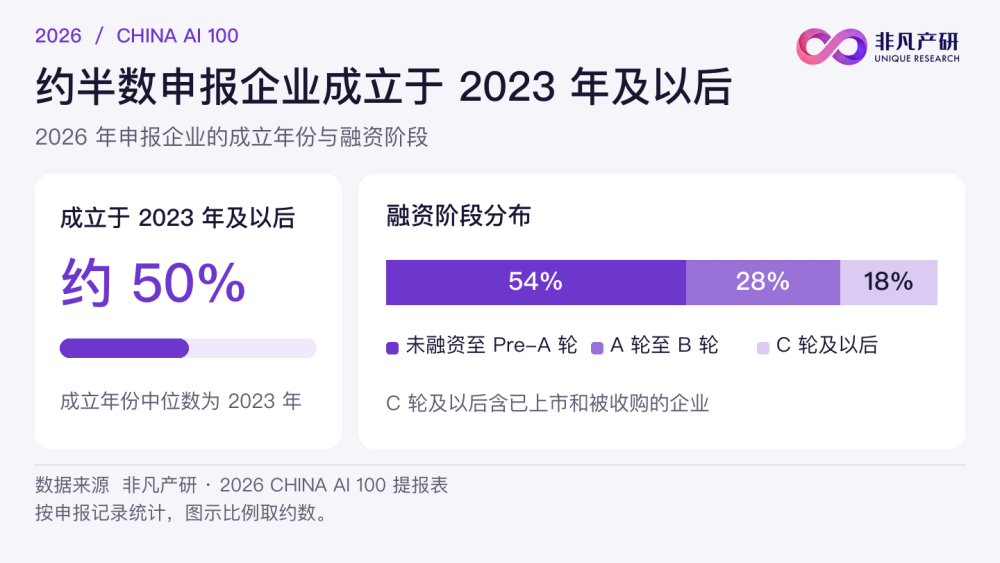
The denominator was rapidly enlarged by a large number of new entrants, so the share of mature companies was naturally diluted. This shows that the industry is still renewing itself at an accelerating pace: the arrival of new players has not slowed at all.
At one end, the first cohort of AI companies is turning in results on revenue and listings. At the other, an even newer generation is entering faster. Last year we called this a barbell. This year both ends of the barbell have grown thicker.
Young does not mean green.
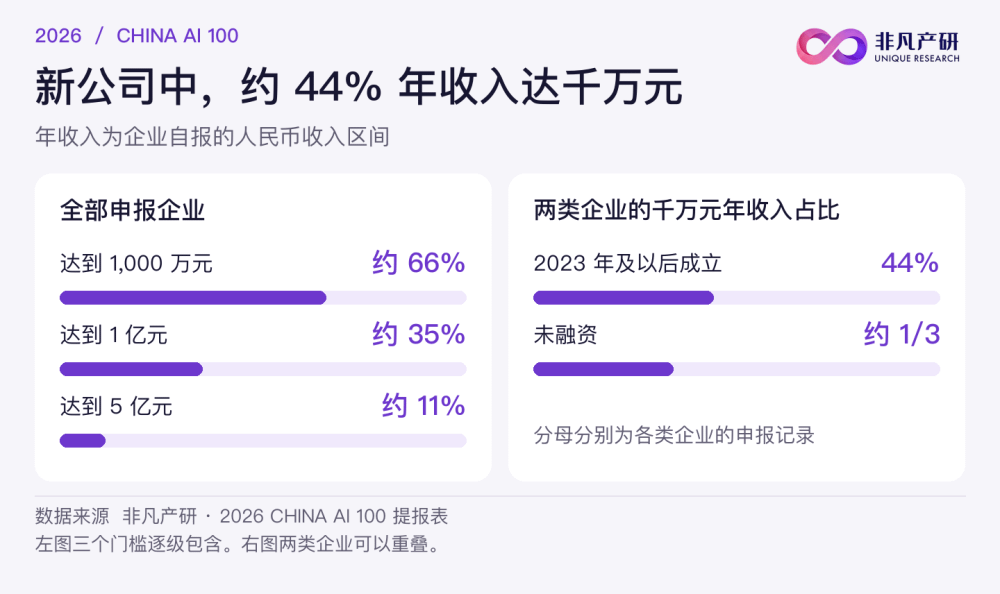
Almost all of the companies that applied this year have already begun commercializing. Those with annual revenue of tens of millions of yuan or more accounted for about two-thirds; those exceeding 100 million yuan accounted for more than one-third; and those above 500 million yuan accounted for more than one-tenth.
The speed is even more worth noting. Among the companies founded after 2023, 44 percent have already reached annual revenue of tens of millions of yuan or more. The previous generation of SaaS companies took far more years to reach the same revenue level.
There is also a counterintuitive detail: companies that have never raised funding accounted for nearly one-quarter, and among them about one-third have annual revenue of tens of millions of yuan or more.
Bootstrapping through revenue was an uncommon way to grow among the previous generation of Chinese technology companies. For this AI generation, it is becoming a viable path. The reason is simple: compute and agent orchestration have driven down delivery costs, and a small team can now take on business that used to require heavy upfront investment.
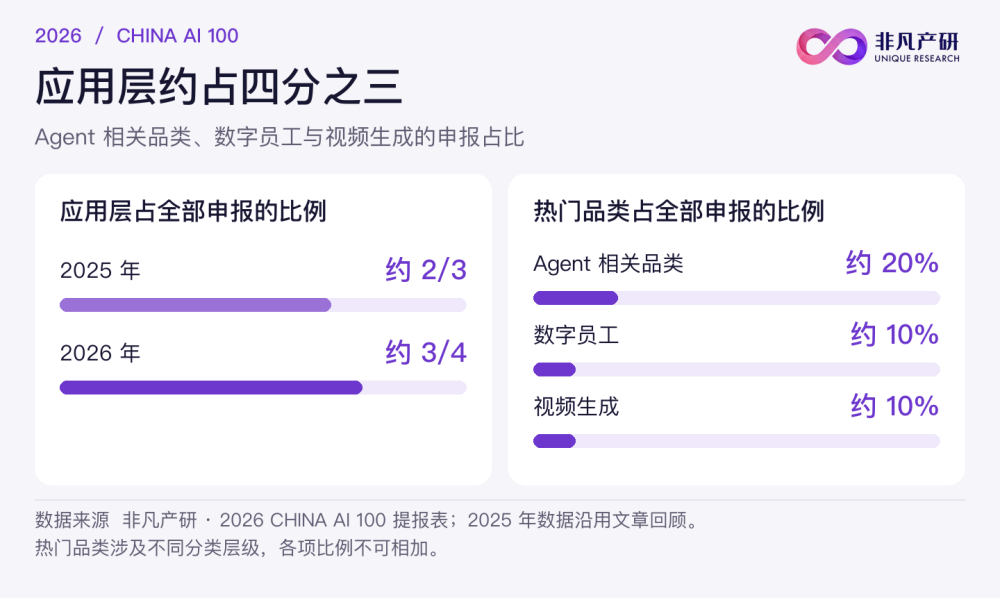
Application-layer companies accounted for about three-quarters of all applicants; last year it was about two-thirds. The center of gravity of value creation continues to shift toward “putting models to work in specific use cases.”
Broken down by category, two directions are the hottest.
One is agents. Agent development, general-purpose agents, and related categories together accounted for about one-fifth. Last year we observed an explosion of “digital employees”; this year that category has found its footing: companies applying in the digital-employee category accounted for one-tenth. The deliverable has changed from software to an “employee,” and pricing has changed from per seat to per output. A number of companies have already made that business model work.
The other is video generation. This single category alone accounted for about one-tenth of all applicants — a leading category even at this narrow level of classification. Adding adjacent categories such as audio, image, and design, companies related to generative content together accounted for about 14 percent.
Model-layer applicants still have a presence in absolute numbers, but no longer account for as large a share. The battlefield has shifted to the application side. This year there is no suspense at all.
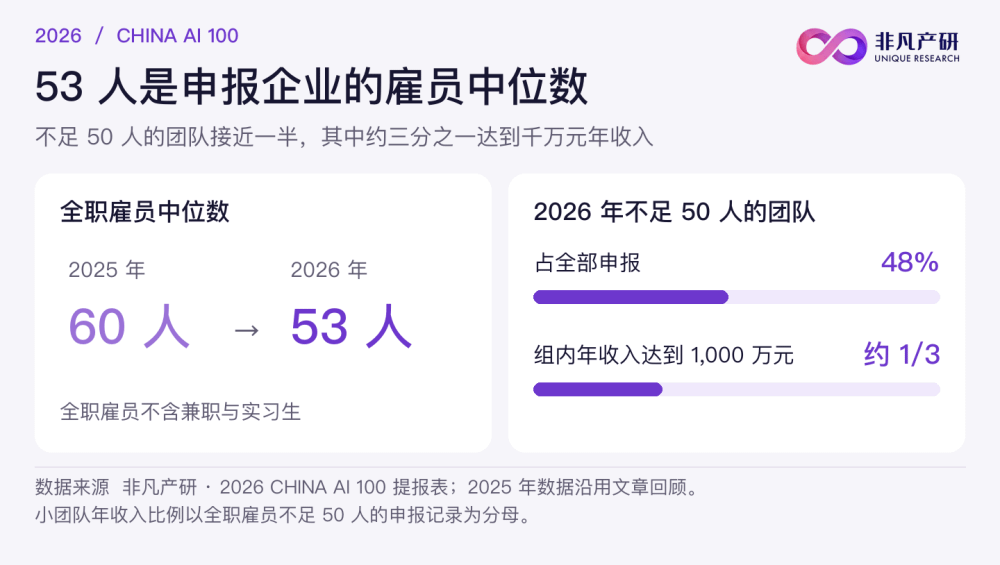
Last year this figure was 60 people, and 40 percent of companies had fewer than 50 people.
This year the median headcount is 53, and companies with fewer than 50 people accounted for nearly half.
Labor productivity is still being rewritten by AI itself. Among these companies with fewer than 50 people, about one-third have annual revenue of tens of millions of yuan or more, and teams with annual revenue exceeding 100 million yuan have also appeared.
A dozen or so people completing a production line that used to take more than a hundred: the application forms are full of teams like this. The organizational form of AI companies themselves remains the first exhibit of AI productivity.
The distribution of headquarters cities among the top five is no surprise: Shanghai about 30 percent, Beijing about 27 percent, Hangzhou about 17 percent, Shenzhen 7 percent, and Guangzhou 6 percent. The five cities together account for close to 90 percent.
Headquarters cities · share of applicant companies
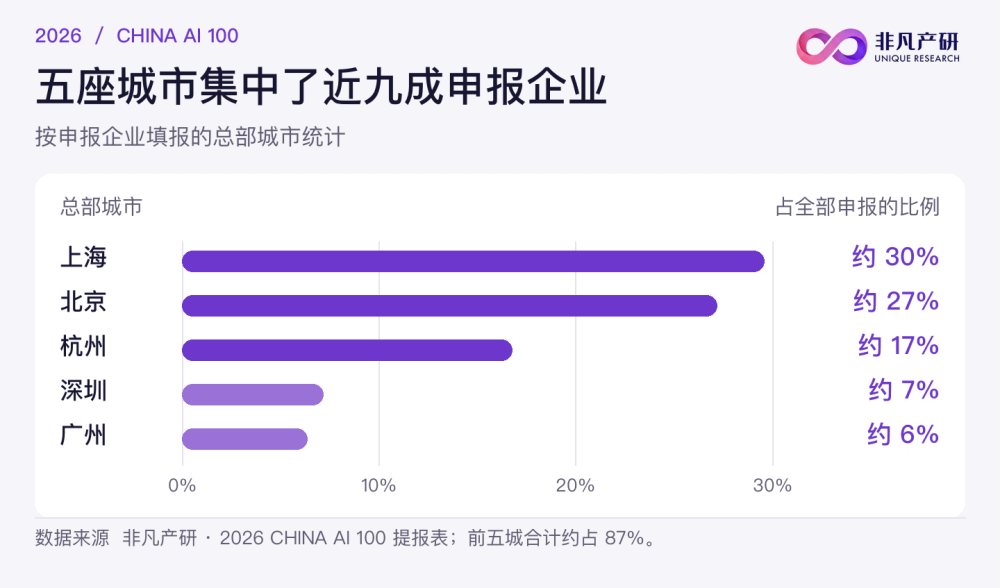
What is worth a closer look is Hangzhou. Hangzhou’s share is about equal to Shenzhen plus Guangzhou. Beyond the DeepSeek effect, its e-commerce and content-industry ecosystem, together with a lower cost of living, is turning Hangzhou into the de facto third hub for AI application startups.
Separately, about one-sixth of the applicant companies have set up a VIE, red-chip, Sino-foreign joint venture, or entirely overseas corporate structure. Preparing for US-dollar investment and the global market remains the default move of this generation of founders.
The above is only a slice of the application pool. The real protagonists are the 100 companies on the list.
Companies that did not exist three years ago are now on the list.
By this time next year, the list will have swapped in another batch of names we have not yet heard of. That is where the fascination of this industry lies.