
n 2025—when AI is shifting from proof-of-concept to large-scale commercialization—the industry structure is coming into focus. Bessemer Venture Partners (BVP), in its The State of AI 2025 report, frames the launch of ChatGPT as the “AI Big Bang,” a turning point from isolated experiments to a full ecosystem. The report highlights the deep convergence of AI and cloud computing, the reshaping of infrastructure, and the need for startups to balance hype with execution.
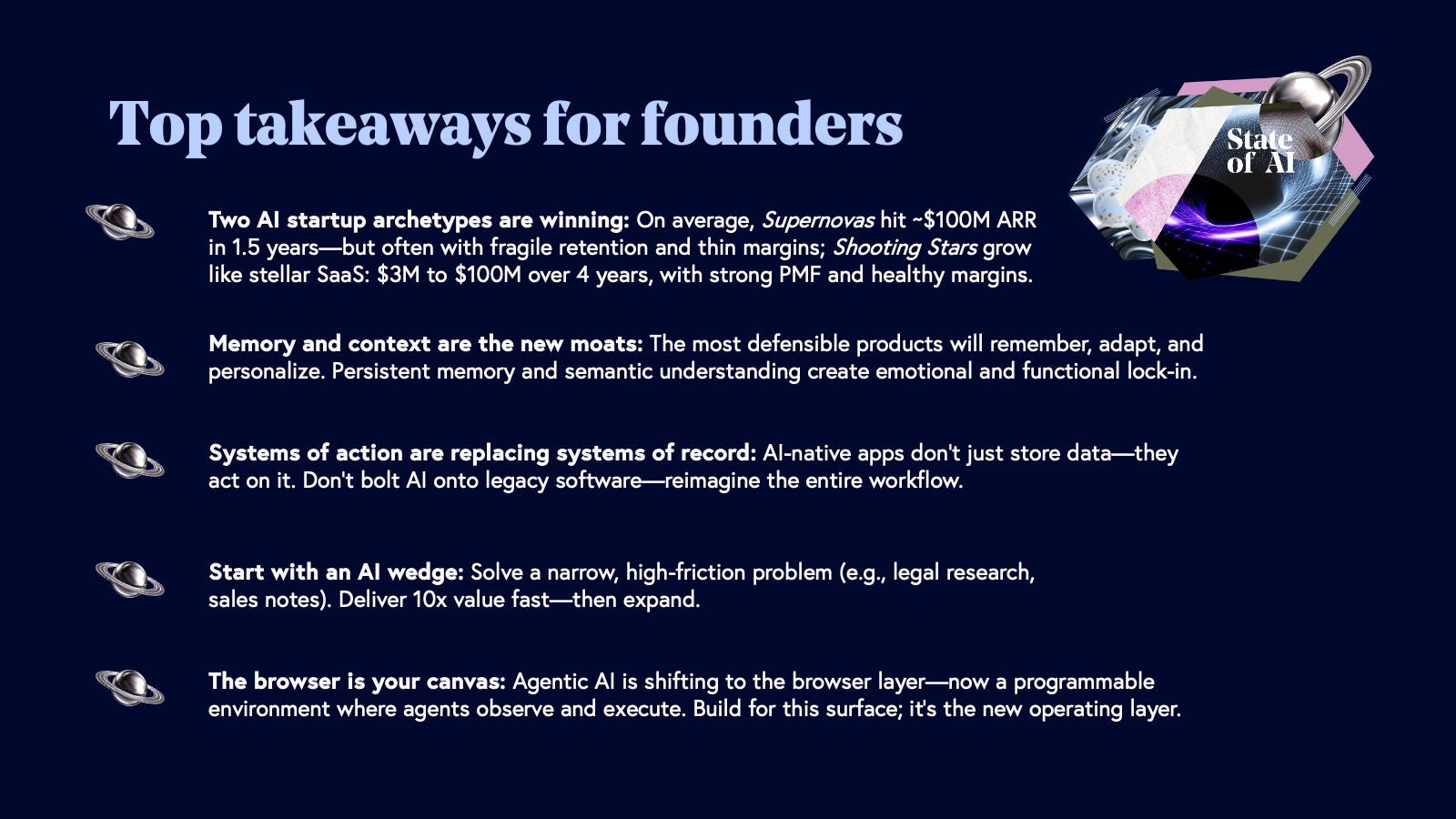
Using July 2025 data, we analyze a global and China-focused snapshot across annual recurring revenue (ARR), monthly active users (MAU), post-money valuation, and revenue per employee. The datasets focus on private, independent AI companies (not publicly listed and not acquired) and rank by total ARR, cumulative MAU, valuation, and revenue efficiency (ARR/FTE). Juxtaposing these results with BVP’s benchmarks reveals the diversity of AI growth trajectories—from explosive expansion to steady iteration—and the distinctive positioning of Chinese companies between their home market and global competition.
The global AI revenue leaderboard shows rising industry concentration, with the top five companies capturing a significant share.
OpenAI leads with $14.279B ARR, with ChatGPT and its APIs becoming default picks for both enterprises and consumers.
Anthropic follows at $5.0B ARR, with Claude’s safety and enterprise focus standing out.
Grammarly ($704M), Midjourney ($633M), and Anysphere ($500M) exemplify the rise of tools and creative AI focused on vertical use cases such as writing assistance and image generation.
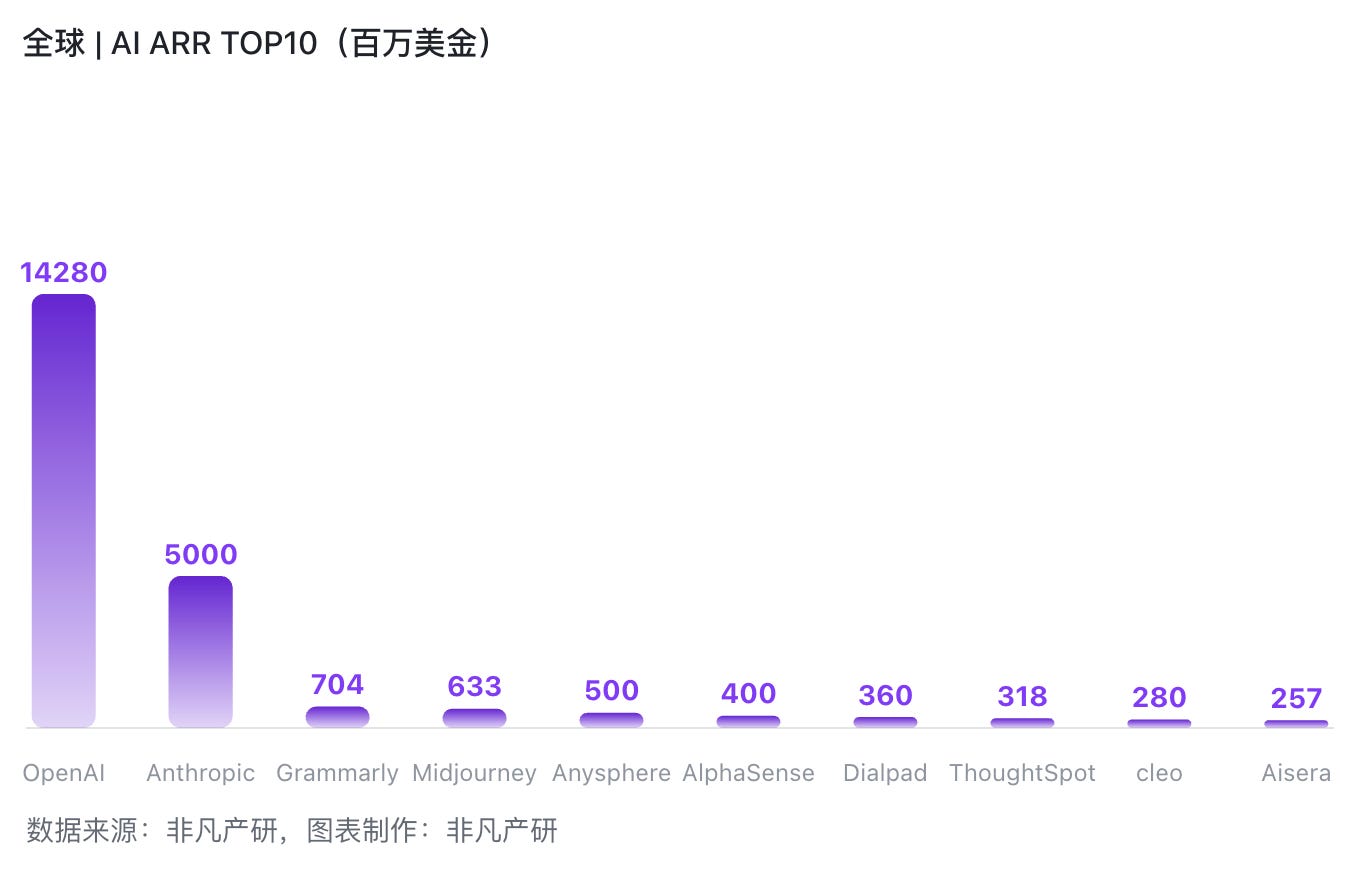
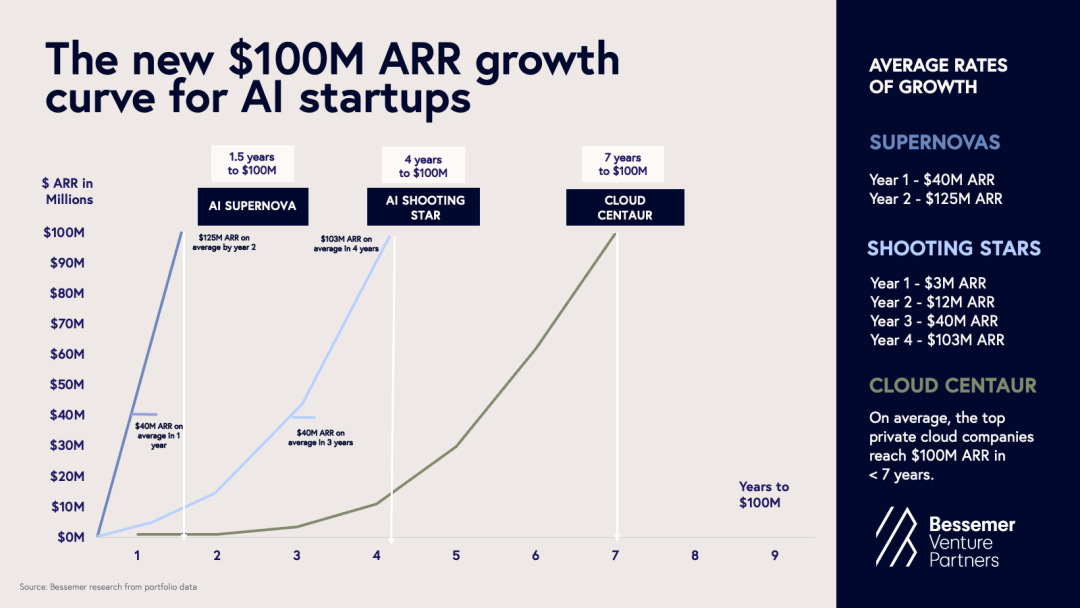
This pattern aligns closely with BVP’s “Supernovas” (hyper-growth startups): ~$40M ARR in year 1, ~$125M in year 2, and ~$1.13M ARR per employee. OpenAI’s ARR far exceeds this benchmark, reflecting its foundational-model advantage. Anthropic’s ~$455K ARR per employee is also near Supernova territory. In contrast, companies further down the list—e.g., Mistral AI ($60M ARR) and Groq ($47M)—look more like BVP’s “Shooting Stars” (steady growth): ~$3M in year 1, ~$103M by year 4, with ~60% gross margin, often focused on infrastructure or specialized verticals.
Notably, U.S. companies take 15 of the top 16 revenue slots, with San Francisco contributing over half of the top 20—a testament to Silicon Valley’s concentration of talent and capital, but also to geographic imbalances in AI’s development. Ruiqi Software (睿琪软件, $167M) is one of the few Chinese firms in the top 20 but still trails the global leaders, partly due to language and regulatory constraints. BVP notes that AI infrastructure is entering “Act II”—from “problem solving” to “problem defining.” That helps explain why Groq, a chip-optimized inference player, stands out: its ~$150K ARR/FTE is modest, but its $2.8B valuation hints at looming hardware-layer upside.
On the China revenue leaderboard, Meitu leads with $227M ARR, reflecting deep expertise in mobile, consumer-side imaging (e.g., Airbrush, Meitu camera). Ruiqi Software ($167M) and Kuaishou ($152M) follow—Ruiqi with lifestyle utilities such as PictureThis, and Kuaishou extending short-video ecosystems via KLING AI for video generation. Alibaba ($83M) and ByteDance ($34M) are mid-pack by ARR, but their product portfolios (e.g., Qwen at Alibaba and Doubao at ByteDance) underscore platform-scale ecosystem building.
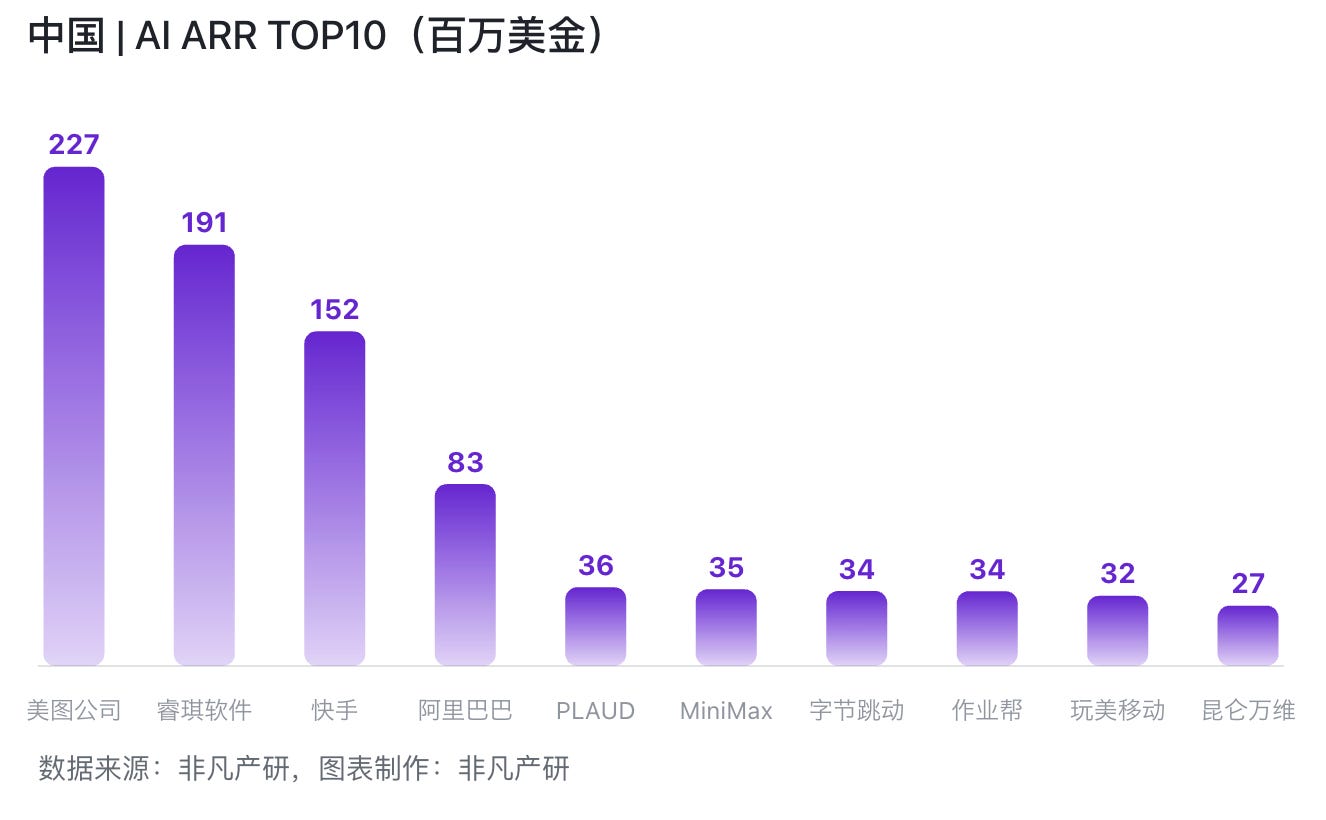
Compared with Chinese firms’ positions on the global list, domestic revenue skews toward consumer and entertainment verticals. Meitu’s ARR surpasses many global tool vendors (e.g., ElevenLabs, $151M), thanks to China’s massive mobile user base and strong demand for beautification/editing tools. BVP’s vertical-AI section notes that such apps are penetrating “tech-averse” sectors like consumer entertainment by embedding high-ROI tasks (e.g., image enhancement) seamlessly into workflows. The China dataset aligns: over half of the top 10 touch image/video generation, with average ARR ≈ $80M, well above many global mid-to-lower-tier peers.
Internationalization remains a challenge. Zuoyebang ($34M) and Perfect Corp. ($32M) have overseas products, but ARR still relies heavily on China. Relative to BVP’s Shooting Stars, domestic growth is more consumer-driven than enterprise SaaS, which may produce more margin volatility (BVP cites ~60% for Shooting Stars). Looking ahead, as MiniMax ($35M) and Shengshu Technology (生数科技, $20M) strengthen at the model layer, China could tilt more toward infrastructure plays, drawing on the Supernova growth pattern.
The coverage leaderboards (by cumulative MAU) illustrate AI’s shift from tools to platforms.
Global: ByteDance (1.037B MAU) and OpenAI (1.016B) lead, followed by Baidu (677M). Google (449M) and DeepSeek (211M) showcase strength in search and education. Meitu (192M) highlights the global pull of China’s consumer AI.
China: The ranking largely mirrors the global front end but is even more localized. ByteDance (1.004B) and Baidu (677M) top the list, with Yuanfudao (64M) and Tencent (49.3M) following.
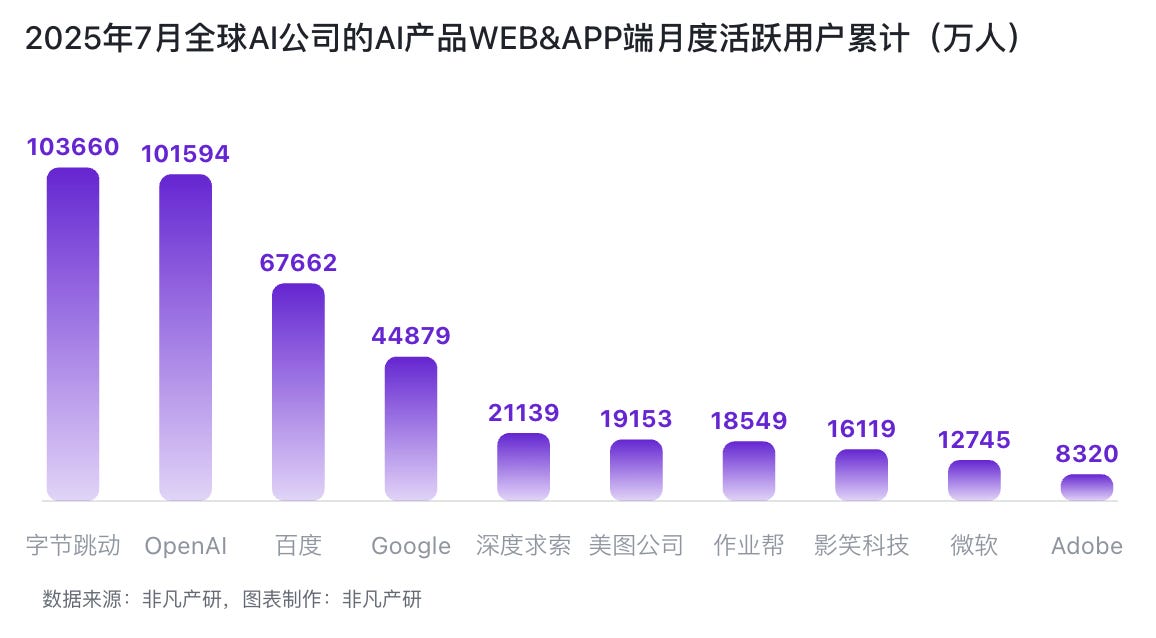
This reflects China’s mobile advantage: Top-10 China MAU averages ~350M, well above the global median. BVP notes consumer AI is moving from productivity utilities to deeper use cases (e.g., companionship, mental wellness)—a trend consistent with Zuoyebang (185M) in education and ByteDance (1.037B) expanding with chat-style agents (e.g., Doubao).
Comparing global vs. China, coverage is geographically divergent: Chinese firms dominate domestic MAU (e.g., DeepSeek’s 211M mostly at home) but have limited global reach. BVP predicts the browser will become the dominant agent interface, which could amplify search-native players like Perplexity AI (50.41M MAU) and encourage Baidu to expand internationally. Overall, coverage is becoming a leading indicator of revenue: among the global top 10, ARR and MAU correlate at ~0.85, signaling the formation of durable ecosystems.

The “Lean AI” (effectively a unicorn valuation) leaderboard ranks by post-money valuation: OpenAI at $300B, Anthropic at $170B, xAI at $50B. This aligns with BVP’s Supernova benchmarks: high ARR/FTE supports premium multiples (OpenAI’s ~$357K per employee vs. BVP’s ~$1.13M benchmark).
Perplexity ($15B) and Grammarly ($13B) illustrate investor appetite for search and tools. The average PS (price-to-sales) is around 50x, far above traditional SaaS.
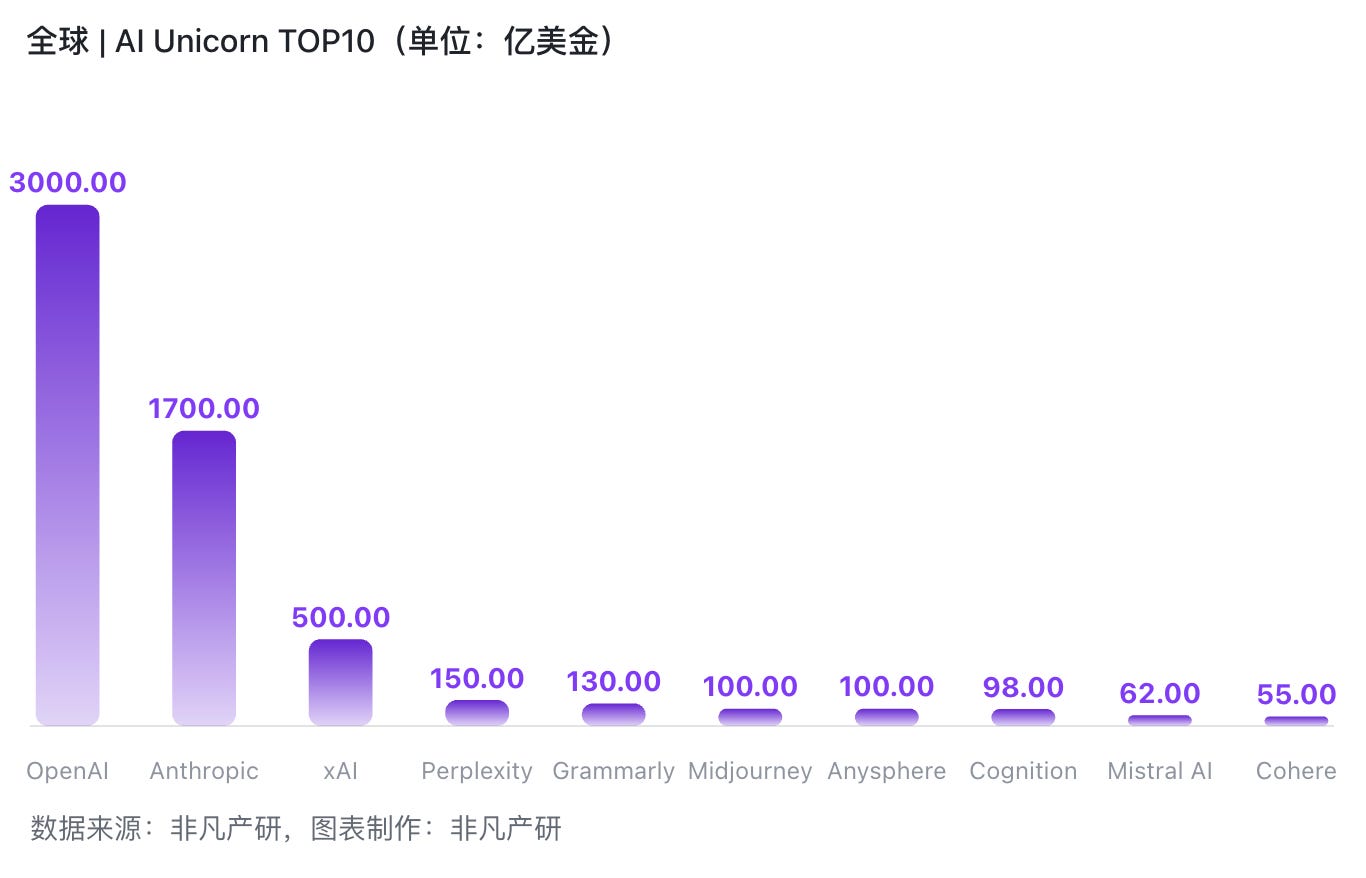
Chinese names appear but are fewer: Moonshot AI ($33B) and Zhipu AI ($30B) land in the top 30, with cumulative funding of $1.33B and $1.169B, respectively. Their lower average PS (~20x) likely reflects regulatory and market uncertainty. BVP expects more AI M&A in 2025, potentially catalyzing consolidation around players like MiniMax ($25B), echoing global precedents like Hugging Face ($4.5B) on the open-source track.
The global AI unicorn leaderboard, sorted by ARR per employee (ARR/FTE), is topped by Midjourney at ~$1.58M per employee—~$633M ARR with ~40 employees—a model case of lean, creative-AI leverage. HUBX (~$1.07M/FTE) and CHAI (~$1.07M/FTE) follow, each built around small teams with high output.
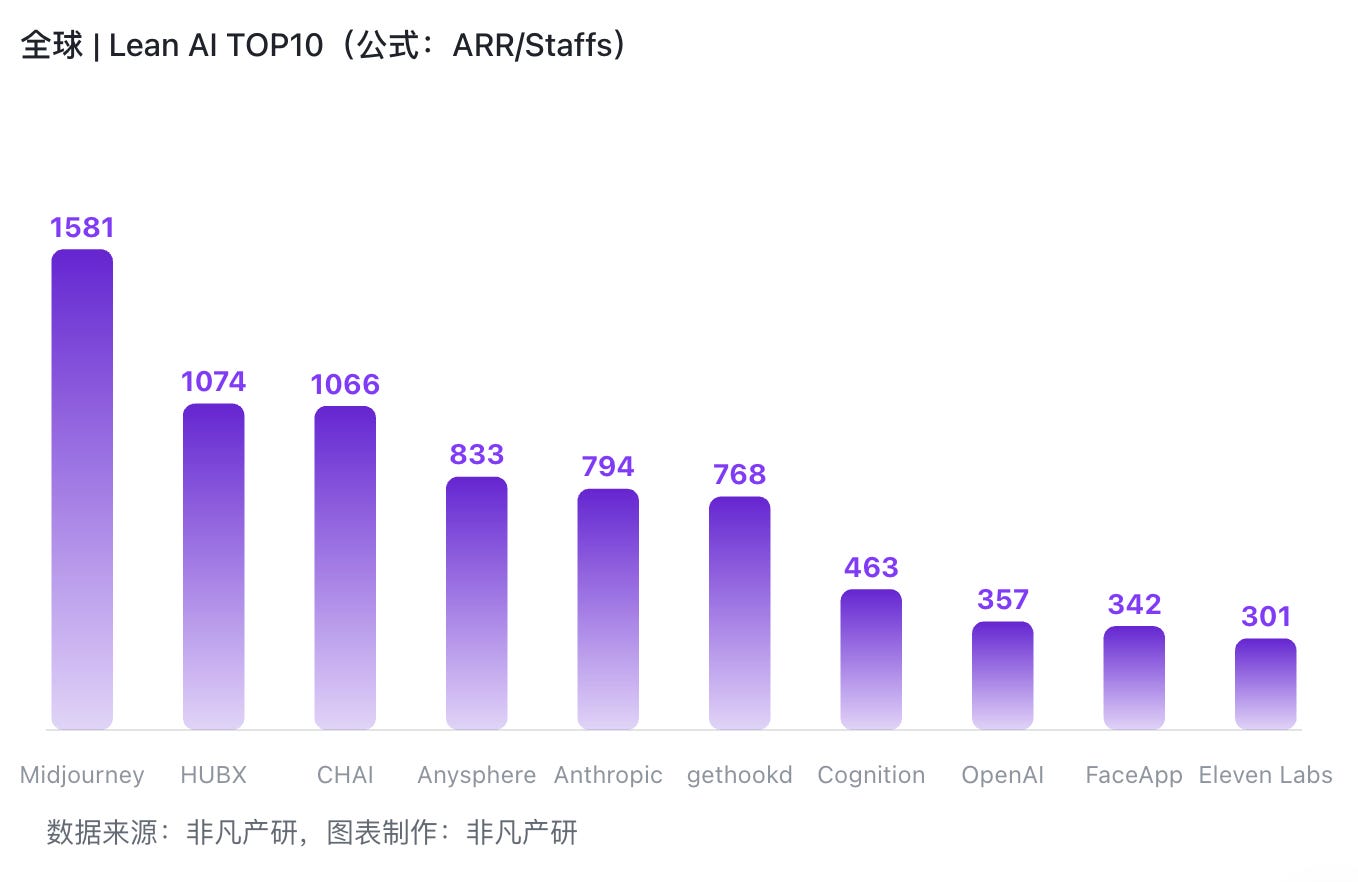
BVP’s Supernova efficiency (~$1.13M/FTE) lines up with the top of this list, while Shooting Stars (~$164K/FTE) maps to the middle and lower tiers (e.g., Mistral AI ~ $220K/FTE). Chinese firms are mid-pack: Caribbean Panda (~$258K/FTE) and Perception Step (~$59K/FTE) enter the top 50, but overall sit below the global median (~$300K/FTE)—partly a function of larger headcounts at top Chinese companies (e.g., Meitu), which dilutes per-employee metrics.
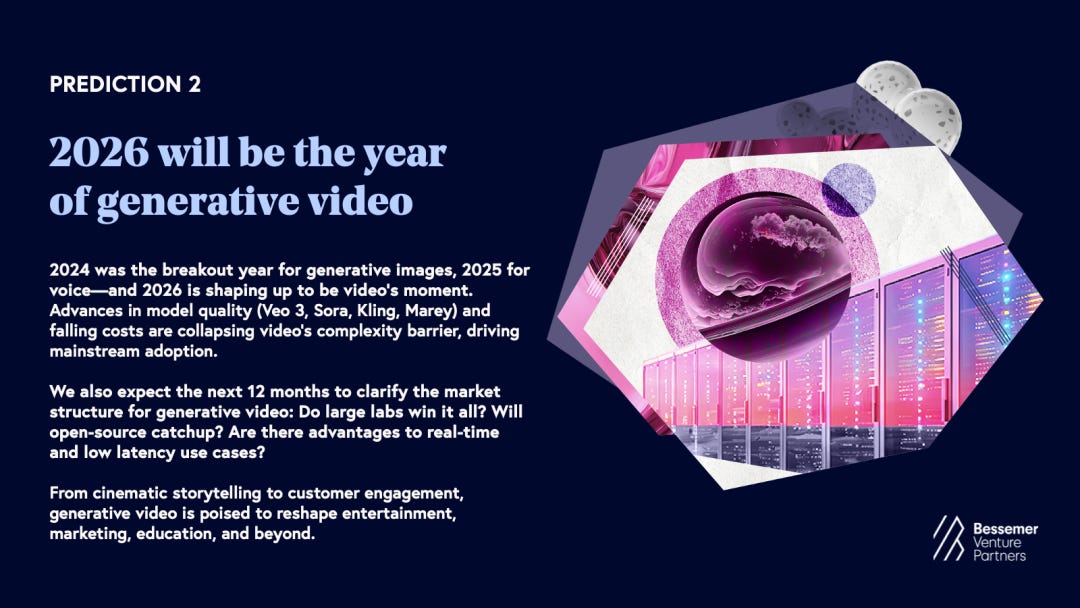
BVP’s AI Cosmos roadmap matches our data: model-layer leaders (OpenAI, Anthropic) dominate revenue and valuation, while vertical AI (e.g., Grammarly, Meitu) wins coverage. The report expects agentic AI to dominate the browser in 2025 and video generation to inflect in 2026—consistent with slower revenue growth among video players on our list (e.g., Runway ML, $150M ARR). China’s strength in consumer AI may benefit from the rise of AI-native social platforms—an area where ByteDance is well placed.
The intersection of efficiency and coverage hinges on data lineage and evaluation: high-efficiency teams like Midjourney typically pair strong memory mechanisms with repeatable value, accelerating enterprise adoption. Expect more M&A globally. For China, stronger internationalization is essential to track Supernova-style curves.
Bottom line: By 2025, AI has moved from Big Bang to galaxy formation. The next winners will be defined by **two flywheels—revenue and users—**closed by verifiable results and sustainable efficiency.
AI Company Revenue: Global AI Revenue, China AI Revenue
AI Company Coverage: Global AI Coverage, China AI Coverage
Lean AI (Valuation) & AI Unicorns: Global Lean AI, Global AI Unicorns
Open & Free: This AI product leaderboard will remain open-sourced and free, with full methodology and raw data for complete reproducibility.
Independent Data: All data is sourced strictly from independent third-party monitoring platforms. We do not accept company-submitted figures as evaluation evidence.
Neutral Ranking: The ranking system remains strictly neutral. We do not accept any commercial cooperation or payments that would influence results.
For the full underlying datasets behind the charts and leaderboards, visit 100aiapps.cn. All visible data may be copied and used free for personal learning and research; for commercial use, please contact UNIQUE RESEARCH for authorization. Feedback and suggestions from industry peers are welcome—thank you for your support!