
Original · Unique Research · 2025-10-29
Editor’s note: The original text describes a China–ASEAN Expo interview setting; its photograph names the China (Guangxi)–ASEAN Artificial Intelligence Enterprise Conference. Both source descriptions are retained without inferring a city. Performance, product, customer-reach and business claims are the source’s and interviewee’s accounts, not independently audited results.
As the industry races after the general capabilities of large models, Gao Qinquan, chairman of Imperial Vision Technology—the company behind PicMa—is focused on the “remaining 10%.” “What large models can do will become increasingly similar,” he said in a conference room at the China-ASEAN Expo. “What determines whether a startup can survive is precisely whether it can deliver that final 10% well.”
That observation captures Imperial Vision Technology’s nine-year approach to AI image processing and generation. In a field changing by the day, Gao and his team have chosen not to chase every new trend, but to go deep into specific use cases and turn technology into reliable value that users will pay for.
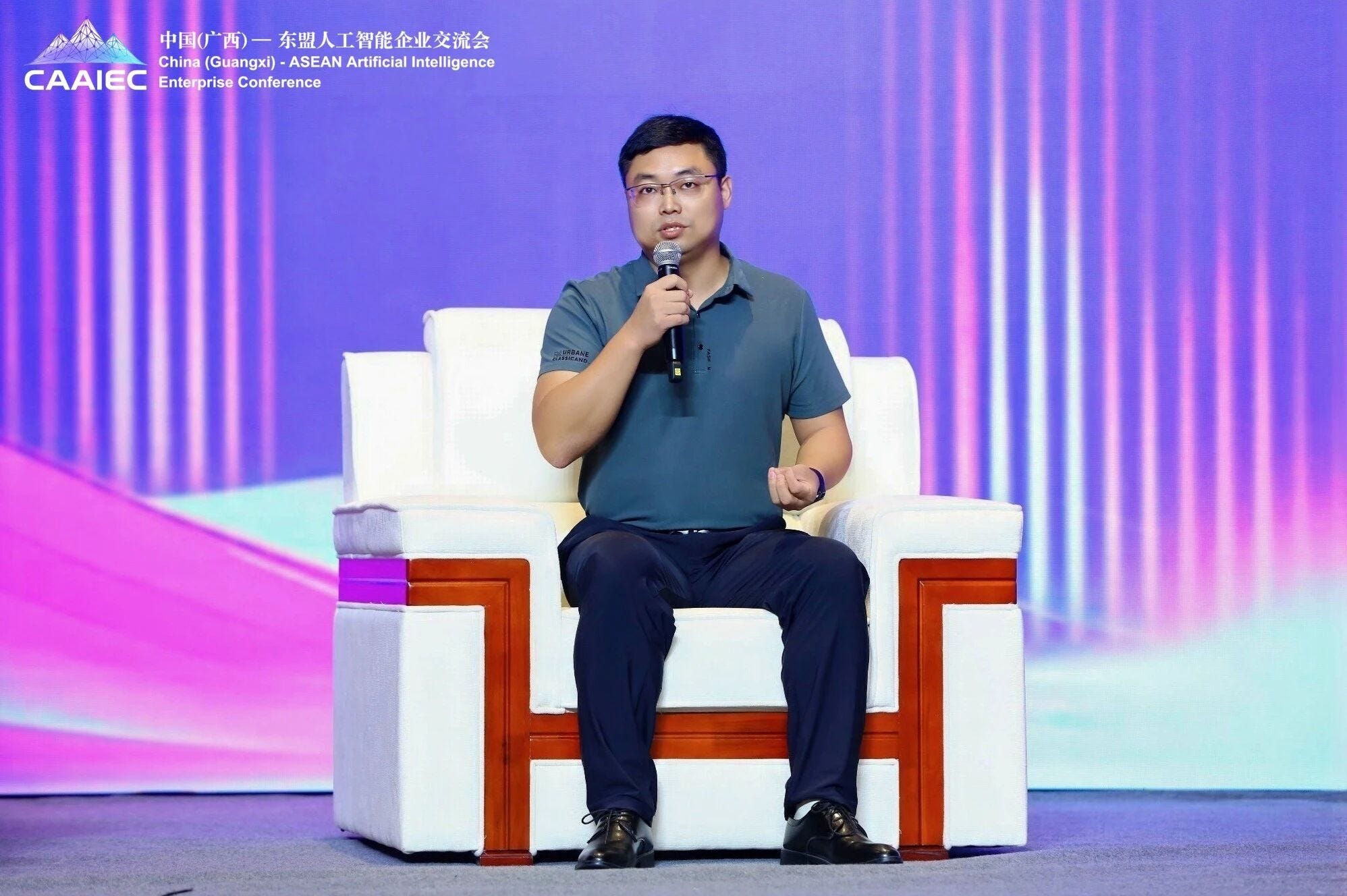
Source photograph: The backdrop reads “China (Guangxi)–ASEAN Artificial Intelligence Enterprise Conference” (CAAIEC).
Not a Lucky Break, but Nine Years of Focus
Imperial Vision Technology may not yet be a household name, but its capabilities—restoring old photos with one click, colorizing black-and-white images, and sharpening blurry pictures—may already have appeared in your WeChat Moments feed. Such features are now standard in many utility apps. But when the team moved into this field from broadcasting in 2016, it was aiming for more demanding image processing across both professional and consumer use cases.
The company did not begin by chasing a trend. It began with an exacting focus on image quality. Technology honed in broadcasting was ultimately tested in 8K ultra-high-definition livestream enhancement for the opening and closing ceremonies of the Beijing Winter Olympics. “Broadcasting has exceptionally demanding image standards,” Gao recalled. “The pictures go on television and serve a national event. There is no room for defects.” Years of serving professional film and television clients gave the team a substantial data moat and strong engineering capabilities—the foundations it now brings to the consumer market.
Its consumer product portfolio now includes PicMa for AI-assisted photo restoration, editing, and creative generation; MIRA for premium portrait generation; Studio, a professional web tool; and an “AI photo booth” designed to connect online tools with offline photography. Each product takes a distinct position while remaining centered on images.
Building Applications, Not Demos
The AI industry is crowded with products whose demos are stunning but whose user experience is unstable. Gao Qinquan is especially alert to this; he does not want to offer a “gacha-style” user experience.
“The model can solve 90% of the problems, but the remaining 10% must come from your own operating experience and optimization,” he said. “And that 10% is precisely what makes users willing to stay.”
For this critical 10%, the team invested substantial effort in product interaction, working hard to lower the usage barrier and strengthen must-have features. “In today’s environment of high user acquisition costs, if a product is not simple enough and not effective enough at solving problems, users have no reason to stay.”
Global Expansion Is Not an Escape; It Is a Choice About User Quality
PicMa’s global expansion began with a very practical consideration: compute costs.
“Every request made to an AI tool consumes cloud compute, which means you are burning money,” Gao explained. “If the users you are targeting only watch ads and never pay, that is a loss-making business.” The company therefore chose Tier-1 international markets with a stronger willingness to pay, because those users can support a sustainable business model for AI tools.
This logic stands in sharp contrast to the old mindset that overseas expansion of tools should prioritize scale above all else. In the AI era, the importance of user quality far exceeds user scale itself.
The Team Must Build a Business, Not Just Maintain Models
Inside the company, a comprehensive AI productivity-enhancement transformation had already been implemented. Gao Qinquan requires everyone to use AI tools, from designers and marketers to engineers, without exception.
“After efficiency rises, the workload for some positions has indeed become underutilized,” he admitted. “We are re-evaluating labor efficiency through AI, which is a necessary move to control costs in the current environment.”
This focus on efficiency also shapes the growth strategy. The team established a strict ROI framework: every paid-acquisition campaign is data-driven and adjusted immediately when performance falls short. At the same time, the company is connecting user journeys across its product portfolio and exploring secondary monetization models such as “AI portrait + custom physical figurine,” seeking a more resilient business flywheel beyond subscription and advertising revenue.
Survive to Reach the Future—Don’t Bet on Winning It
Looking back on nine years of entrepreneurship, Gao Qinquan’s insights may be especially valuable for AI entrepreneurs going global.
“Don’t ever pursue directions that big tech companies can enter easily. You must choose scenarios with real implementation barriers, otherwise once large-model capabilities become available, you’ll get crushed. Don’t be obsessed with technology; the use case comes first. No matter how powerful the technology is, once others open-source it, it’s gone.”
In this era of rapid technical iteration, Gao Qinquan and Imperial Vision Technology show a rare steadiness. They do not chase the flashiest technologies; they seek the most reliable execution. They do not rely on favorable winds; they build their own engine. This may be the underlying logic AI startups need most right now: do not bet on a distant future—first make sure you can survive long enough to reach it.
Interview highlights Q&A
Q1: What is PicMa’s core positioning, and what user problem does it solve?
Gao Qinquan: PicMa is an all-in-one AI imaging platform centered on image restoration, while also offering image editing and creative generation.
Its original vision at launch was to make it very easy for users around the world to handle various image-quality problems, such as restoring damaged, old photos or turning black-and-white photos into high-definition color in one click. In the past, these were major technical challenges that could not be solved with one click.
Q2: The image-app segment is highly competitive. How did Imperial Vision Technology enter the market and build an advantage?
Gao Qinquan: When we entered this industry, on the one hand it was because we already had core technology—we were one of the earliest teams in China to work on AI super-resolution technology; on the other hand, at that time (2016), there were very few apps doing a good job in the restoration field, which gave us a very good entry point.
Our core advantage comes from sustained focus. We have worked on image quality for nearly ten years, building a deep understanding of real business use cases and a substantial data moat. This gives us a major algorithmic advantage. Although we now compete directly with global consumer-app giants, we remain confident in many specialized segments.
Q3: In a context where AI foundation model capabilities (such as text-to-image) are converging, where does PicMa’s technological moat lie?
Gao Qinquan: Large models have already solved the basic problems pretty well and can do around 90 points. Now the real challenge, and also our opportunity, is in who can chew through the remaining 10 points.
This sounds simple, but in execution it is particularly demanding of a team’s patience and ability to execute. It is not just a matter of swapping out models; it is about truly understanding the scenario and continuously investing in tuning. For example, when facing a severely damaged old photo, we can restore details to a level that satisfies users, and this “being able to do it” itself is the capability we have ground out little by little over these years.
So our strategy now is very practical: use our self-developed models plus open-source models as the foundation, but focus our core effort on using our accumulated professional data and business understanding to make these models more reliable and stable in specific scenarios. Put plainly, what matters now is who can truly execute and continuously iterate, and that integrated capability has become the hardest thing to replicate.
Q4: In global growth, which markets have stronger willingness to pay? What differences are there across markets?
Gao Qinquan: Definitely developed countries. For example, North America, Japan, and South Korea—the payment rates there are far higher than in populous countries like India and Indonesia.
India and Indonesia have huge populations, and low acquisition costs can bring in large numbers of users. But if those users keep watching ads without paying, that is very unfavorable for us. In the AI era, every user request carries a compute cost. I therefore believe an advertising-led model is very difficult to make work for AI tools.
Q5: Is PicMa’s ROI controllable? What other effective growth levers are there?
Gao Qinquan: We only scale from small-batch to large-batch deployment after we have verified that ROI is controllable.
In addition to paid acquisition, we are also using other methods, such as KOC and KOL marketing, to quickly follow up on viral hits: once a hot feature point appears in the market—like Nano’s “3D figurine” style from recently—we have to “follow up by the next morning” to capture this traffic dividend. SEO and social media: we also have a web-side product and are exploring SEO playbooks.
Q6: Apart from subscriptions and advertising, what “secondary monetization” business models is PicMa also exploring?
Gao Qinquan: We have always been thinking about how to achieve secondary monetization of existing traffic.
For example, we are exploring “offline figurine business partnerships.” After users generate a 3D avatar or wedding photo in PicMa, we guide them to an independent site to “place a custom order” for a physical figurine and share the proceeds with partners.
We are also integrating software and hardware. One example is the travel-photography kiosk shown at this event, which connects our online app with offline AI hardware.
Q7: How has the rapid iteration and open-sourcing of large models affected Imperial Vision Technology’s R&D strategy?
Gao Qinquan: The impact is huge. We have gone through the entire AI development process. In the past, our technology roadmap was “95% self-developed.”
Now, if a new open-source algorithm truly outperforms ours, we study it and then optimize it with the professional datasets and understanding of business use cases we have accumulated. We can no longer “just keep investing blindly in R&D”; instead, we need to focus deeply on real business scenarios.
Q8: If you were to offer one most important piece of advice to an AI founder just entering overseas expansion, what would it be?
Gao Qinquan: Before entering this direction, you must conduct thorough research to see whether you can avoid the playing field of the big players.
You need to find a truly core business barrier or deployment barrier. If it is a field that a major company can enter with ease, it will be very difficult for you to do better than them, because the foundational capabilities of large models are in their hands.
In addition, you must make the “business scenario” your core focus and not “be overly obsessed with technology.” Sometimes you may think a technical point is very difficult and that you must crack it at all costs, only to find that “as soon as others update their large model, this technology is immediately surpassed,” and much of your R&D investment to date turns out to be in vain. This is a lesson we have paid for.