
“Whether it can be manufactured is the final exam.”
On September 22, the second Guangdong AI Application Matchmaking Conference opened in Guangzhou.
At the event, Cai Bolun, deputy director of the Foshan Artificial Intelligence Research Institute, unveiled the Orient industrial world model, co-developed with Vertens3D.
At first glance, “world model” could bury this in the flood of model launches this year. But Orient has a different goal: it is not trying to generate a more realistic world. It is trying to make sure the world AI generates can actually be manufactured.
That is the thread for understanding Vertens3D (www.vertens3d.com) and where it is heading.
Since 2013, the company has built 3D cloud design; in 2019 it connected design data to manufacturing; in 2022 it connected directly to CNC machines. For over a decade, 3D has been the through-line. But 3D is shifting from “design tool” to the infrastructure AI uses to understand and operate the physical world. In 2026, the company formally brings this capability to the world model.
Vertens3D is currently raising a Pre-IPO round; Unique Capital is the financial advisor.
Over the past two years, world models have been one of AI’s hottest directions. Video models learn motion and physics; robotics companies train agents in simulation; NVIDIA’s Cosmos, Omniverse, and Isaac build a full physical-AI stack around data, digital twins, robotics development, and simulation.
Put a world model into an actual factory and the problem changes immediately.
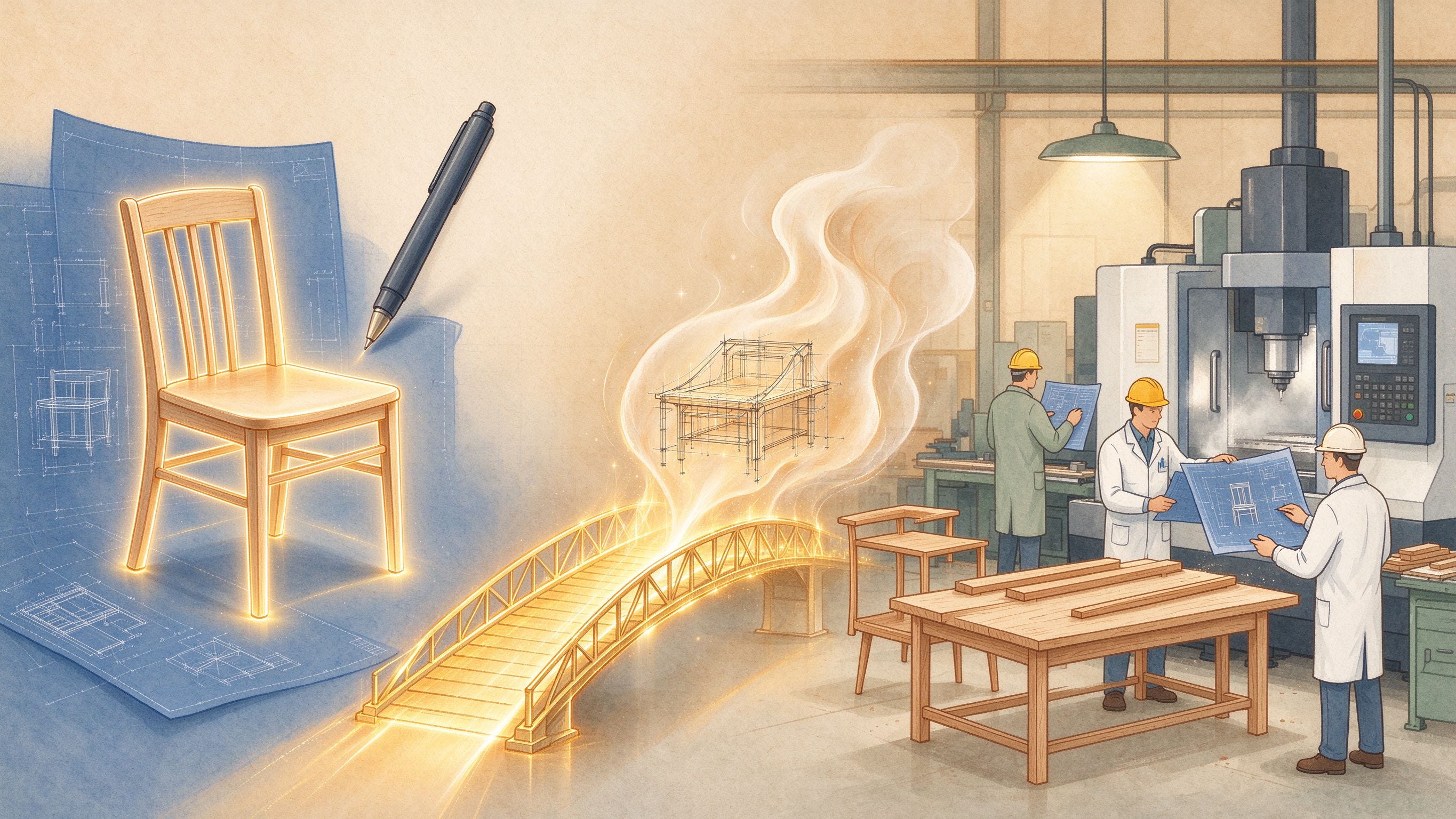
A 3D model of a chair that merely looks like a chair is not enough. The system needs to know the dimensions, the board thickness, how parts connect, whether structures interfere, how the machine should cut, what tool path to follow — and finally output CAD, BOM, CAM, even data a CNC machine can directly consume.
None of that exists in ordinary image or video generation models.
Vertens3D frames the gap as four breakpoints: missing engineering parameters, uncontrollable outputs, high cost of post-hoc correction, and insufficient closed-loop production data. Even mature overseas industrial software and physical-AI platforms usually spread these capabilities across CAD, simulation, and production-connection systems.
The hard part of an industrial world model is not “generation.” It is turning a probabilistic generated result into a deterministic, checkable, executable engineering object.
Vertens3D calls the middle layer “world compilation.”
Orient splits its capability into four blocks: perceive the world, generate the world, simulate the world, and create the world.
Perceiving the world digitizes physical space — 3D scanning plus multimodal understanding turns a real room into an editable, computable 3D space.
Generating the world is closer to familiar generative AI: long video, high-fidelity rendering, spatial consistency.
Simulating the world turns a 3D space into an interactive environment. Orient proposes using real home layouts to build robot-training environments, addressing the shortage of training data for home robots.
The critical block is the fourth — creating the world.
A product photo enters the system and does not just become a mesh. It continues by recognizing structure, recovering dimensions and assembly relationships, generating CAD and BOM, checking dimensions, tolerances, collisions, strength, and process feasibility, and finally producing 3D-printing slices or CNC tool paths.
From “generate a chair” to “how this chair gets made.” That middle is what Vertens3D means by world compilation.
In its architecture, a model output does not go straight to production. It first enters a typed World IR, where the system runs constraint solving, geometric construction, simulation evaluation, and conflict detection, then decides to commit or roll back, and finally outputs CAD, BOM, CAM, and G-code.
That explains why Vertens3D enters the world-model space now. What it is competing on is not just model capability.
In the large-model era, people are used to talking about internet data. Enter the physical world and the definition of data changes.
A furniture photo tells a model what the object looks like, but not the board thickness, where to drill, which joint is manufacturable, or what actually went wrong when production failed.
These are industrial ground truth.
According to Vertens3D, its system now holds 28 million+ real floor plans, 1.6 billion+ 3D spatial scenes, and 120 million+ real cabinet configurations, connected to 9,000+ cloud factories. Machining parameters, machine state, quality inspection, rework, and manual correction become training feedback signals.
Vertens3D serves 200,000+ paid designers and has connected nearly a hundred CNC-machine partners. Its existing chain already covers image input, 3D reconstruction, BOM breakdown, and CNC machining.
That may matter more than parameter count.
A core problem in industrial AI is: when the model is wrong, who tells it what right looks like? If design, machining, QC, rework, and final delivery all feed data back, an industrial software company’s historical business becomes the training substrate for physical AI. That is a different starting line from a pure AI startup.
Vertens3D is best known for home-design and manufacturing software. But its latest product architecture clearly will not stay there.
The plan is three layers: at the bottom, the Vertens3D world model; in the middle, an industrial AI execution workbench that understands tasks, calls agents and professional tools; on top, “domain world packs” installed for specific industries.
Directions already shown include home manufacturing, 3D printing, construction, appliance sheet metal, film, and games — positioning AI 3D as the entry point from “generating 3D content” to “generating a manufacturable world.”
The logic is straightforward. Home is the first industry with data, customers, factories, and machine connections, so it is easiest to validate. Once 3D understanding, engineering constraints, and world compilation are reusable, the platform can move to 3D printing, light industry, and other manufacturing.
One step further, it can enter robotics. Orient is already using real floor plans and 3D spatial data to build interactive home simulation environments. For service robots, the value of this data is no longer “how to design a home” but “what world the robot will operate in.”
That may be the biggest shift in Vertens3D’s story: it used to digitize what the factory produces. It now wants to digitize the physical world AI needs to understand and act in.
It is too early to say industrial world models have been proven. Vertens3D still has at least three things to prove.
First, distance from demo to stable production. Industrial tolerances are far tighter than content generation. A chair missing a leg in a video is a continuity error; a dimension off by two millimeters in a factory can mean an entire batch is reworked.
Second, whether the home advantage actually transfers. Cabinet and furniture data is valuable, but appliances, sheet metal, and complex equipment each have their own engineering rules. How fast the “domain world packs” can be replicated is the key to expansion speed.
Third, how much quantifiable commercial value the world model creates. Modeling time saved, rework reduced, human operations displaced, and what customers ultimately pay for matter more than “how much better the model is.”
So the most interesting thing about Orient is not that another world model exists. It raises a sharper question: as AI enters the physical world, do we need a model that imagines the world, or one that compiles the world into production instructions?
For consumer AI, generation may be the result. For industrial AI, generation is only the first step.
Whether it can be manufactured is the final exam.